Global Terrorism Index 2026: Trends and India's Counter-Terrorism Strategy
#GS-3: Current Events: National #GS-3: Current Events: International #GS-3: Science & Technology: Cyber Security #Internal Security #Global Terrorism #Counter-Terrorism Policy #Organized Crime
Why in News?
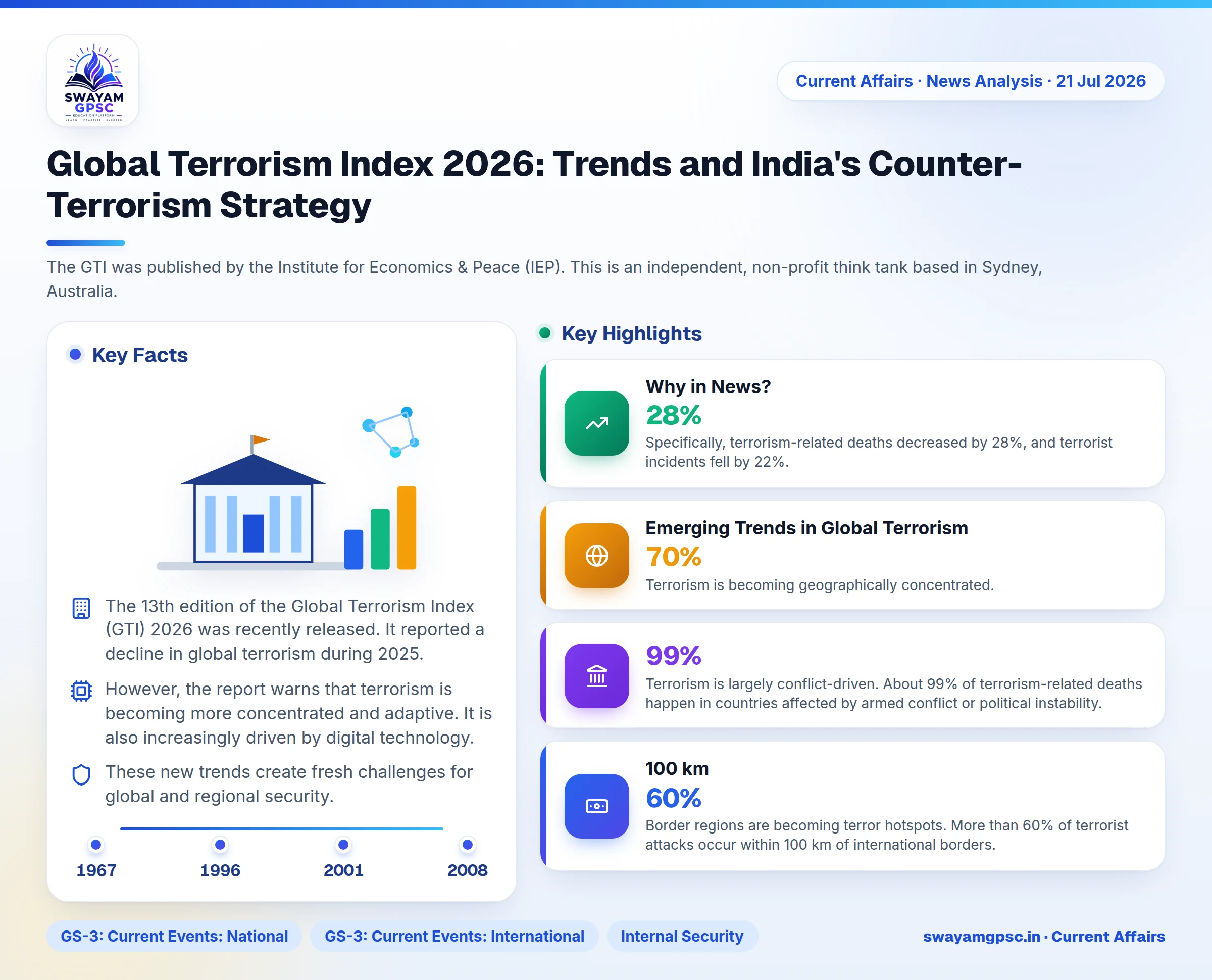
- The 13th edition of the Global Terrorism Index (GTI) 2026 was recently released. It reported a decline in global terrorism during 2025.
- Specifically, terrorism-related deaths decreased by 28%, and terrorist incidents fell by 22%.
- However, the report warns that terrorism is becoming more concentrated and adaptive. It is also increasingly driven by digital technology.
- These new trends create fresh challenges for global and regional security.
- The GTI was published by the Institute for Economics & Peace (IEP). This is an independent, non-profit think tank based in Sydney, Australia.
Key Findings of the Report
- The Global Terrorism Index 2026 shows a global decline in terrorism. However, terrorism is becoming more concentrated and decentralized.
- It is also more digitally driven and closely linked to armed conflicts. This presents new challenges for global security.
- India has adopted a zero-tolerance, intelligence-led counter-terrorism strategy. This strategy involves strengthening laws, institutions, and technology.
- It also focuses on international cooperation. India has shifted from a reactive response to proactive prevention, significantly enhancing internal security.
Emerging Trends in Global Terrorism
- Terrorism is becoming geographically concentrated. Nearly 70% of global terrorism-related deaths occurred in just five countries: Pakistan, Burkina Faso, Nigeria, Niger, and the Democratic Republic of the Congo (DRC).
- The Sahel region of Sub-Saharan Africa alone accounted for over half of all global terrorism fatalities.
- Pakistan is ranked as the world's most terrorism-affected country. In contrast, India is placed 13th globally.
- Terrorism is largely conflict-driven. About 99% of terrorism-related deaths happen in countries affected by armed conflict or political instability. This shows a strong connection between weak governance and violent extremism.
- There is a rise in decentralized and digital terrorism. Terrorist groups increasingly use lone-wolf attacks and small, autonomous cells. They also rely on online radicalization.
- This makes attacks harder for authorities to detect and prevent.
- Border regions are becoming terror hotspots. More than 60% of terrorist attacks occur within 100 km of international borders. This allows for easier cross-border infiltration, arms trafficking, and terrorist financing.
- Terrorist networks are highly adaptive. They are becoming more resilient by breaking into smaller groups. They exploit local grievances and quickly adjust to counter-terrorism measures.
- A few major terror groups dominate the global landscape. These include the Islamic State (IS), Jama'at Nusrat al-Islam wal-Muslimin (JNIM), Tehrik-e-Taliban Pakistan (TTP), Lashkar-e-Taiba (LeT), and Al-Shabaab.
- Geopolitical conflicts fuel extremism. Ongoing conflicts in West Asia and other geopolitical tensions create conditions for extremist groups to re-emerge and new radical groups to form.
Defining Terrorism
- There is no universally accepted legal definition of terrorism. This is because countries have not agreed on a single binding definition, mainly due to its political and sensitive nature.
- However, most definitions share three key elements: the use or threat of violence, targeting civilians or non-combatants to create fear, and the pursuit of political, ideological, or religious objectives by coercing governments or societies.
- The United Nations broadly describes terrorism as criminal acts. These acts aim to cause death or serious injury, spread terror among the public, or force governments or international organizations to act.
- In India, the Bharatiya Nyaya Sanhita (BNS), 2023, defines a terrorist act. It includes any act that threatens India's sovereignty, unity, integrity, security, or economic stability.
- This can involve lethal violence, destroying critical infrastructure, kidnapping, or circulating counterfeit currency.
- A 'terrorist act' is also defined under Section 15 of the Unlawful Activities (Prevention) Act, 1967 (UAPA). Section 2(1)(k) clarifies that 'terrorism' and 'terrorist' are understood according to this definition.
- Therefore, any act of violence falling under Section 15 is legally considered an act of terrorism.
Why Decline Does Not Mean a Safer World
- The concentration of terrorism in fragile states can create a false sense of global security. Violence in conflict-prone regions often receives less international attention, even as its intensity grows.
- Decentralized terrorism is on the rise. Terrorist organizations are increasingly relying on lone-wolf attacks and small, autonomous cells. This makes attacks less predictable and harder for intelligence agencies to detect.
- In Western countries, 93% of fatal terrorist attacks over the past five years were carried out by lone actors.
- Digital radicalization acts as a force multiplier. Social media, encrypted communication platforms, and AI-driven algorithms have accelerated extremist recruitment and self-radicalization. This allows terrorist groups to expand their influence without direct organizational contact.
- The conflict-governance nexus plays a role. Terrorism thrives in areas affected by armed conflict, weak governance, and institutional collapse. Here, extremist groups exploit security vacuums and challenge state authority.
- Terror networks are resilient and adaptive. Modern terrorist organizations have evolved into fragmented, localized networks. They exploit ethnic, political, and religious grievances, which helps them survive counter-terrorism operations and adapt quickly to changing security environments.
Challenges: Terrorism's Threat to India's Internal Security
- Cross-border terrorism and proxy warfare from Pakistan remain India's primary security concern. Proxy groups like Lashkar-e-Taiba (LeT) and Jaish-e-Mohammed (JeM) have orchestrated major attacks.
- Examples include the 2001 Parliament Attack, the 2016 Uri Attack, and the 2025 Pahalgam Attack.
- The ISI continues to exploit religious radicalization and separatist sentiments. Additionally, the China–Pakistan nexus strengthens hybrid warfare capabilities against India.
- Indian cities are vulnerable to urban terrorism. This includes mass-casualty attacks, lone-wolf terrorism, and white-collar terrorism.
- The 2008 Mumbai terror attacks and the 2025 blast near Delhi's Red Fort highlight the vulnerability of crowded civilian areas. The use of improvised explosives and attacks on public spaces continue to pose significant risks.
- India also faces internal insurgencies. These are in Jammu & Kashmir, the Northeast, and regions affected by Left-Wing Extremism (LWE). Extremist groups here exploit local grievances and sometimes receive external support.
- Cyber terrorism is a growing threat. Terrorist organizations increasingly use cyberspace for recruitment, propaganda, financing, and operational planning. The use of cryptocurrencies and the dark web complicates counter-terrorism efforts.
- Terror financing often occurs through organized crime. Terrorism is sustained by drug trafficking, counterfeit currency, hawala networks, and arms smuggling. India's proximity to the Golden Crescent and Golden Triangle intensifies this threat.
- India's 7,500-km coastline is vulnerable to maritime security threats. This includes infiltration, arms smuggling, and maritime terrorism. Stronger coastal surveillance and maritime security mechanisms are urgently needed.
India's Counterterrorism Doctrine
- India follows a zero-tolerance approach to terrorism. It rejects any distinction between terrorists and their sponsors. India also maintains that no cause can ever justify terrorism.
- India's doctrine emphasizes proactive and pre-emptive responses. This includes preventive intelligence, precision operations, and carefully planned retaliatory actions.
- Examples of this approach are the 2016 Surgical Strikes, the 2019 Balakot Air Strike, and Operation Sindoor (2025).
- The PRAHAAR Framework is a strategic blueprint. It formally shifts India’s internal security posture from reactive containment to intelligence-led, pre-emptive deterrence.
- This framework mandates a 'zero-tolerance' approach. It also explicitly separates terrorism from any religion, ethnicity, or civilization.
- India's policy rests on four distinct pillars. These have been built incrementally since 2014: Legislative Empowerment, Institutional Strengthening, Decisive Action against Cross-Border Terrorism, and Multilateral Counter-Terror Architecture.
Pillar 1: Legislative Empowerment
- The Unlawful Activities (Prevention) Amendment Act, 2019, allows the Central Government to designate individuals as terrorists. It also empowers National Investigation Agency Inspectors to investigate terror cases.
- This act expanded the agency's jurisdiction to include cyberterrorism, human trafficking, counterfeit currency, and offenses committed abroad that affect Indian interests.
- The National Investigation Agency (Amendment) Act, 2019, further expanded the NIA's jurisdiction. It allows the NIA to investigate terror-related offenses outside India.
- It also strengthened the NIA's powers to attach and seize properties linked to terror.
- Amendments to the Prevention of Money Laundering Act (PMLA) strengthened the Enforcement Directorate's powers. It can now trace, freeze, and confiscate assets linked to terror financing, including hawala and cryptocurrency networks.
- The Bharatiya Nyaya Sanhita, 2023 (effective 2024), defined terrorism and organized crime for the first time. It prescribes severe punishments, including death or life imprisonment for terrorist acts causing death.
- This law also criminalizes conspiracy, recruitment, training, harboring, and financing of terrorism.
- The Arms (Amendment) Act, 2019, tightened penalties for illegal arms trafficking, manufacture, possession, and sale. It also improved firearm traceability through digital licensing to curb terrorist access to weapons.
Pillar 2: Strengthening Institutions for a New India
- The National Investigation Agency (NIA) Act, 2008, was enacted after the 2008 Mumbai terror attacks. It established India's premier counter-terrorism investigation agency.
- The NIA investigates and prosecutes terrorism and national security offenses. Since 2014, the NIA has been strengthened with higher funding and 53 Special NIA Courts.
- It has also expanded regional offices and established a new National Terror Database Fusion and Analysis Centre (NTDFAC). The NIA has achieved a global-best conviction rate of 92.70%.
- The Multi-Agency Centre (MAC) operates under the Intelligence Bureau. It serves as India's top intelligence-sharing platform, connecting 28 agencies.
- An upgrade worth Rs 500 crore and the launch of the Cyber Multi-Agency Centre (2025) have improved real-time intelligence integration and cyber threat monitoring.
- The National Intelligence Grid (NATGRID) integrates various databases. These include immigration, banking, telecom, and travel information. This supports counter-terrorism investigations.
- As of March 2026, NATGRID connects 11 Central User Agencies and all States and Union Territories.
- The upgraded Crime and Criminal Tracking Network and Systems (CCTNS) 2.0 (2024) connects police stations across India. It uses an Artificial Intelligence-enabled platform for seamless sharing of criminal and terrorism-related data.
- Police Modernisation efforts from 2021–2026 have seen India allocate over Rs 6,300 crore. This funding is under the Assistance to States for Modernisation of Police Scheme and Modernisation Plan-IV.
- The goal is to strengthen counter-terrorism through advanced weapons, surveillance, forensic infrastructure, and secure communications.
Pillar 3: Operations against Cross-Border Terrorism
- After the Uri terrorist attack, the Indian Army conducted precision Surgical Strikes across the Line of Control.
- These strikes took place on 29th September 2016. They targeted terrorist launch pads, marking a shift towards a proactive counter-terrorism doctrine against cross-border terrorism.
- In response to the Pulwama terror attack, the Indian Air Force carried out a precision air strike. This occurred on 26th February 2019.
- The strike targeted a Jaish-e-Mohammed terrorist training camp in Balakot, Pakistan. This action demonstrated India's readiness for pre-emptive action against terrorist infrastructure.
- Operation Sindoor (2025) was launched on 7th May 2025, following the Pahalgam terrorist attack. It targeted terrorist infrastructure in Pakistan and Pakistan-Occupied Jammu and Kashmir.
- This operation reinforced India's doctrine of swift, precise, and proportionate retaliation against cross-border terrorism.
Pillar 4: Multilateral and Diplomatic Counter-Terror Architecture
- Since joining in 2010, India has used the Financial Action Task Force (FATF) to strengthen actions against terror financing. It has also improved anti-money laundering measures.
- The No Money for Terror Ministerial Conference is a global initiative. It was launched in Paris in April 2018 to boost international cooperation against terror financing. India hosted its 3rd Ministerial Conference in New Delhi (2022).
- India proposed the Comprehensive Convention on International Terrorism at the United Nations in 1996. This aimed to establish a universal legal framework against terrorism.
- India successfully secured the designation of Masood Azhar as a global terrorist by the United Nations Security Council in 2019.
- Tahawwur Rana, who was accused in the 2008 Mumbai attacks, was extradited from the United States to India in 2025.
- India has Joint Working Groups on Counter-Terrorism with 27 countries and 5 multilateral forums. This strengthens intelligence sharing and coordinated action.
- BHARATPOL (2025) was launched in 2025. It connects Indian law enforcement agencies with INTERPOL to combat terrorism and transnational crime.
- The Delhi Declaration was adopted under India's Chairmanship of the United Nations Security Council Counter-Terrorism Committee in 2022. It provides guiding principles to counter terrorists' misuse of drones, digital technologies, social media, and online terror financing.
Outcomes of Counter-Terrorism Reforms (2014–2026)
- Security in Jammu & Kashmir has significantly improved. Terrorism and cross-border violence have declined substantially.
- Terrorist-initiated incidents fell from 228 in 2018 to just 12 in 2025. This reflects better security and stability.
- Civilian and security force casualties have sharply decreased. This highlights the effectiveness of intelligence-led operations and stronger force protection.
- Normalcy has been restored. Stone-pelting incidents have remained near zero since 2022. Strikes and shutdowns have virtually disappeared, allowing normal public life and governance to resume.
- Improved security has boosted development and economic revival. This includes infrastructure development, employment generation, tourism, and private investment. These factors strengthen socio-economic growth in Jammu & Kashmir.
- Enhanced intelligence, inter-agency coordination, and technology-driven surveillance enable pre-emptive counter-terrorism. Authorities can now foil terror plots before they are executed.
- Hinterland terrorism has declined. Since the 2013 Hyderabad blasts, India has seen very few major urban terrorist attacks. This demonstrates the success of its proactive, intelligence-led counter-terrorism strategy.
Conclusion
- India has significantly transformed its counter-terrorism architecture. It has adopted a zero-tolerance policy by strengthening legal frameworks and empowering security agencies.
- The country has also enhanced intelligence sharing and expanded international cooperation.
- This shift from a reactive response to proactive prevention has greatly reduced terror incidents. It has also strengthened internal security and improved public confidence.
Frequently Asked Questions (FAQs)
- The Global Terrorism Index (GTI) is an annual report. It is published by the Institute for Economics & Peace (IEP).
- This index measures the impact of terrorism across countries based on terrorist incidents, fatalities, injuries, and hostages.
- The GTI 2026 reported a 28% decline in terrorism-related deaths. It also noted a 22% fall in terrorist attacks during 2025.
- However, it emphasizes the increasing concentration of terrorism in conflict zones. It also highlights the rise of decentralized, digitally enabled extremism.
- PRAHAAR is India's National Counter-Terrorism Policy and Strategy. It is built on a zero-tolerance approach and a seven-pillar framework.
- This framework focuses on prevention, response, intelligence coordination, de-radicalisation, international cooperation, and post-incident recovery.
- India continues to face threats from cross-border terrorism, proxy warfare, cyber terrorism, digital radicalisation, urban terrorism, Left-Wing Extremism (LWE), terror financing, and maritime infiltration.
- These threats require a comprehensive and intelligence-led security response.
- Despite a decline in global terrorist incidents, the world is not necessarily safer. Terrorism is becoming more concentrated, decentralized, digitally driven, and adaptive.
- Conflict zones, online radicalization, and lone-wolf attacks are emerging as major security challenges.