Global Mapping of Arbuscular Mycorrhizal Fungi
#GS-3 #Environment #Biodiversity #Climate Change #Science & Technology #Current Events #National
Key takeaways
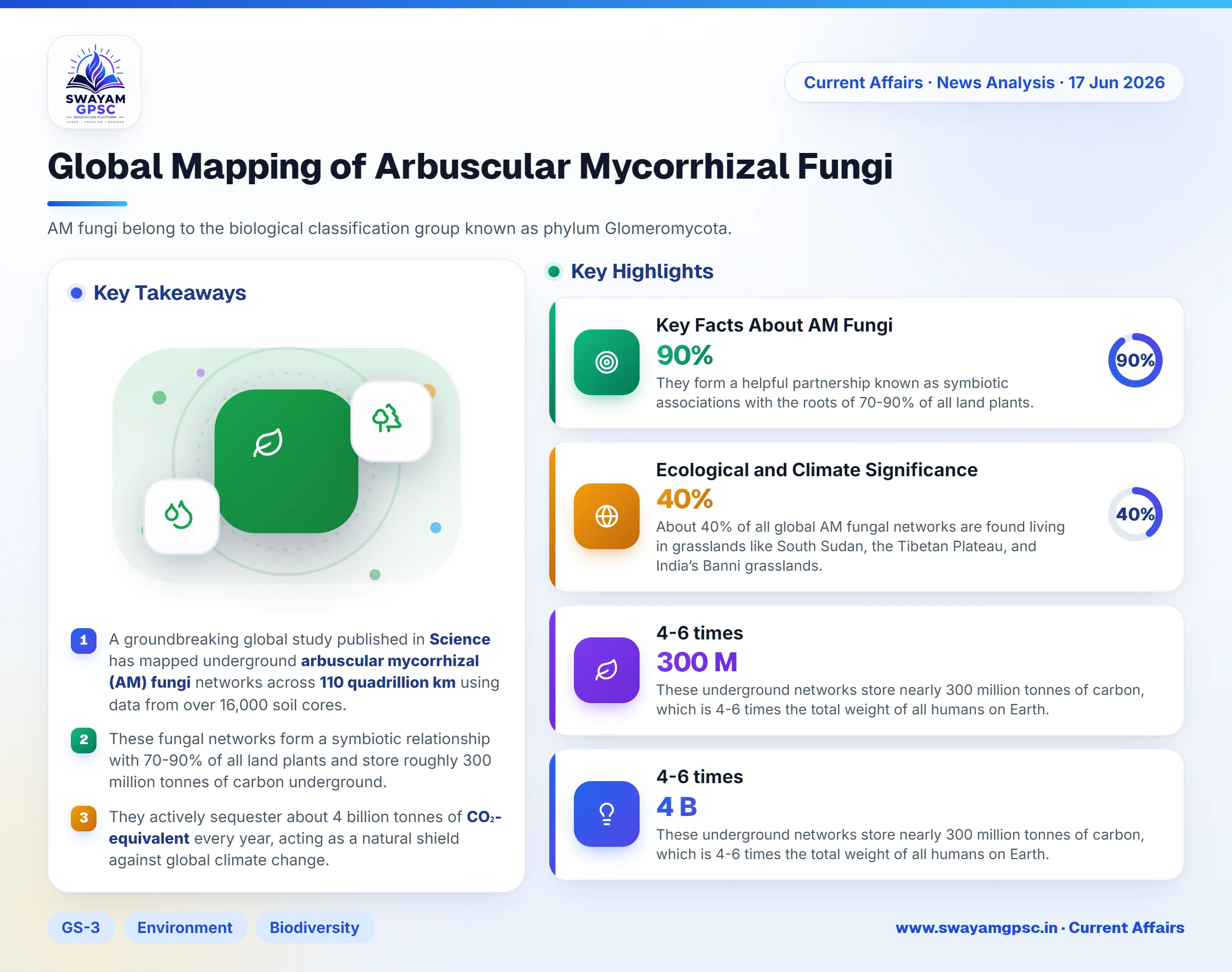
- A groundbreaking global study published in Science has mapped underground arbuscular mycorrhizal (AM) fungi networks across 110 quadrillion km using data from over 16,000 soil cores.
- These fungal networks form a symbiotic relationship with 70-90% of all land plants and store roughly 300 million tonnes of carbon underground.
- They actively sequester about 4 billion tonnes of CO₂-equivalent every year, acting as a natural shield against global climate change.
- Cropland soils suffer from 50% lower fungal density compared to wild ecosystems, highlighting the urgent need for better soil management policies.
Why in News
- A recent study published in Science magazine has mapped the global underground network of arbuscular mycorrhizal (AM) fungi for the very first time.
- Researchers used machine learning along with data collected from more than 16,000 soil cores to complete this study.
- The study reveals that the fungal hyphae stretch across an incredible length of approximately 110 quadrillion km underground.
Key Facts About AM Fungi
- AM fungi belong to the biological classification group known as phylum Glomeromycota.
- They form a helpful partnership known as symbiotic associations with the roots of 70-90% of all land plants.
- This makes their partnership one of the most common plant relationships found anywhere on land.
- Scientists describe AMF as living fossils and ancient asexuals because they have existed since the time of the very first land plants without any known sexual reproduction stage.
- They are made of thin and branching thread-like structures called hyphae that act as two-way conduits to move nutrients and carbon back and forth between plants and the soil.
Ecological and Climate Significance
- These fungi act as key biotic components of soil because losing them reduces soil health, nutrient cycling, and overall ecosystem efficiency.
- About 40% of all global AM fungal networks are found living in grasslands like South Sudan, the Tibetan Plateau, and India’s Banni grasslands.
- These underground networks store nearly 300 million tonnes of carbon, which is 4-6 times the total weight of all humans on Earth.
- They also lock away about 4 billion tonnes of CO₂-equivalent every single year to help fight global climate change.
- They work as natural biofertilizers by helping plants absorb water and nutrients, boosting their growth, and providing pathogen protection in return for carbon produced by plant photosynthesis.
Challenges and Policy Relevance
- Farmland ecosystems generally have 50% less fungal density when compared to wild and untouched ecosystems.
- The rapid conversion of natural grasslands into other land uses creates major environmental risks.
- These dangers highlight the urgent need to integrate AM fungi into official climate change and ecosystem management policies.