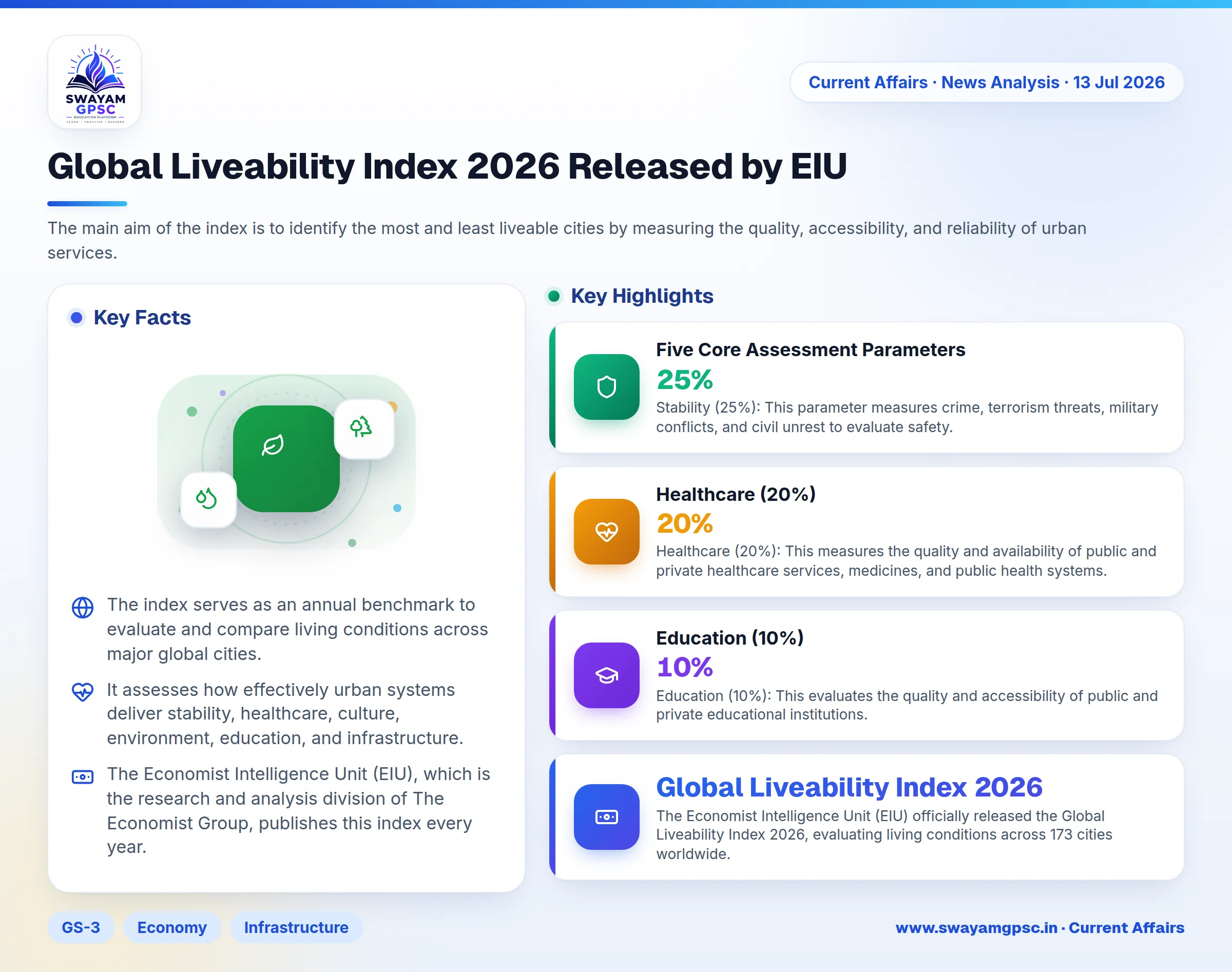
Global Liveability Index 2026 Released by EIU
#GS-3 #Economy #Infrastructure #Environment #Pollution #Sustainable Development #Current Events #International #Global Liveability Index 2026 #Economist Intelligence Unit
Why in News
- The Economist Intelligence Unit (EIU) officially released the Global Liveability Index 2026, evaluating living conditions across 173 cities worldwide.
About Global Liveability Index 2026
- The index serves as an annual benchmark to evaluate and compare living conditions across major global cities.
- It assesses how effectively urban systems deliver stability, healthcare, culture, environment, education, and infrastructure.
- The Economist Intelligence Unit (EIU), which is the research and analysis division of The Economist Group, publishes this index every year.
- The main aim of the index is to identify the most and least liveable cities by measuring the quality, accessibility, and reliability of urban services.
Five Core Assessment Parameters
- Stability (25%): This parameter measures crime, terrorism threats, military conflicts, and civil unrest to evaluate safety.
- Culture & Environment (25%): This assesses climate, corruption, censorship, social restrictions, cultural opportunities, sports, and consumer goods.
- Healthcare (20%): This measures the quality and availability of public and private healthcare services, medicines, and public health systems.
- Infrastructure (20%): This examines roads, public transport, international connectivity, housing, energy, water supply, and telecommunications.
- Education (10%): This evaluates the quality and accessibility of public and private educational institutions.
Performance of Indian Cities
- New Delhi ranked 1st in India and 120th globally.
- Mumbai ranked 2nd in India and 121st globally.
- Chennai ranked 3rd in India and 123rd globally.
- Bengaluru ranked 4th in India and 127th globally.
Key Reasons Behind India's Low Rankings
- Severe air pollution, rising temperatures, poor waste management, and environmental degradation lower urban liveability.
- Limited capacity in public hospitals and high out-of-pocket medical expenses restrict affordable access to quality healthcare.
- Unplanned urbanization causes severe traffic congestion, poor public transport, housing shortages, slum growth, water scarcity, and urban flooding.