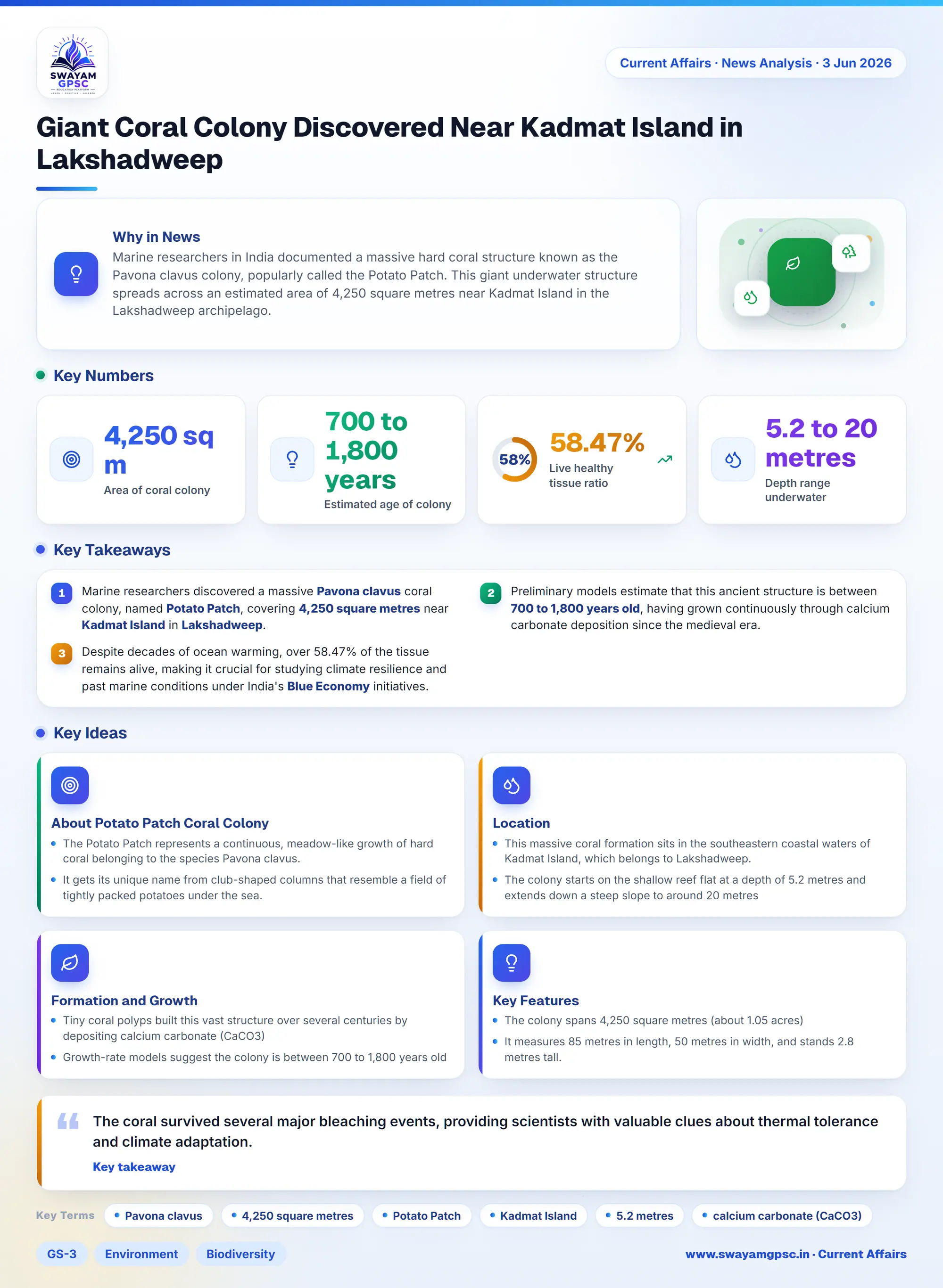
Giant Coral Colony Discovered Near Kadmat Island in Lakshadweep
#GS-3 #Environment #Biodiversity #Geography #Physical Geography #Current Events #National
Key takeaways
- Marine researchers discovered a massive Pavona clavus coral colony, named Potato Patch, covering 4,250 square metres near Kadmat Island in Lakshadweep.
- Preliminary models estimate that this ancient structure is between 700 to 1,800 years old, having grown continuously through calcium carbonate deposition since the medieval era.
- Despite decades of ocean warming, over 58.47% of the tissue remains alive, making it crucial for studying climate resilience and past marine conditions under India's Blue Economy initiatives.
Why in News
- Marine researchers in India documented a massive hard coral structure known as the Pavona clavus colony, popularly called the Potato Patch.
- This giant underwater structure spreads across an estimated area of 4,250 square metres near Kadmat Island in the Lakshadweep archipelago.
About Potato Patch Coral Colony
- The Potato Patch represents a continuous, meadow-like growth of hard coral belonging to the species Pavona clavus.
- It gets its unique name from club-shaped columns that resemble a field of tightly packed potatoes under the sea.
Location
- This massive coral formation sits in the southeastern coastal waters of Kadmat Island, which belongs to Lakshadweep.
- The colony starts on the shallow reef flat at a depth of 5.2 metres and extends down a steep slope to around 20 metres deep.
Formation and Growth
- Tiny coral polyps built this vast structure over several centuries by depositing calcium carbonate (CaCO3) without interruption.
- Growth-rate models suggest the colony is between 700 to 1,800 years old, meaning it has been growing continuously since medieval times.
- To establish its exact age, scientists will need to perform detailed core testing using sclerochronology techniques.
- Strong ocean waves on the steep reef slope prompted the colony to grow thick, heavy calcareous pillars instead of delicate branches.
- These sturdy columns help the structure withstand severe ocean currents and tropical storms over long periods.
Key Features
- The colony spans 4,250 square metres (about 1.05 acres), making it larger than famous giant corals on the Great Barrier Reef (3,973 square metres) and in the Solomon Islands (1,000 square metres).
- It measures 85 metres in length, 50 metres in width, and stands 2.8 metres tall.
- A baseline survey showed that 58.47% of its tissue remains completely alive and healthy despite rising ocean temperatures.
- The large surface area hosts many fish species, acting as an important nursery and feeding area within the atoll ecosystem.
Significance
- The coral survived several major bleaching events, providing scientists with valuable clues about thermal tolerance and climate adaptation.
- Its ancient calcium skeleton stores historical records of ocean temperatures and sea-level shifts, serving as a natural paleoclimate record.
- This discovery highlights the ecological value of Lakshadweep and supports marine conservation under India's Blue Economy initiatives.