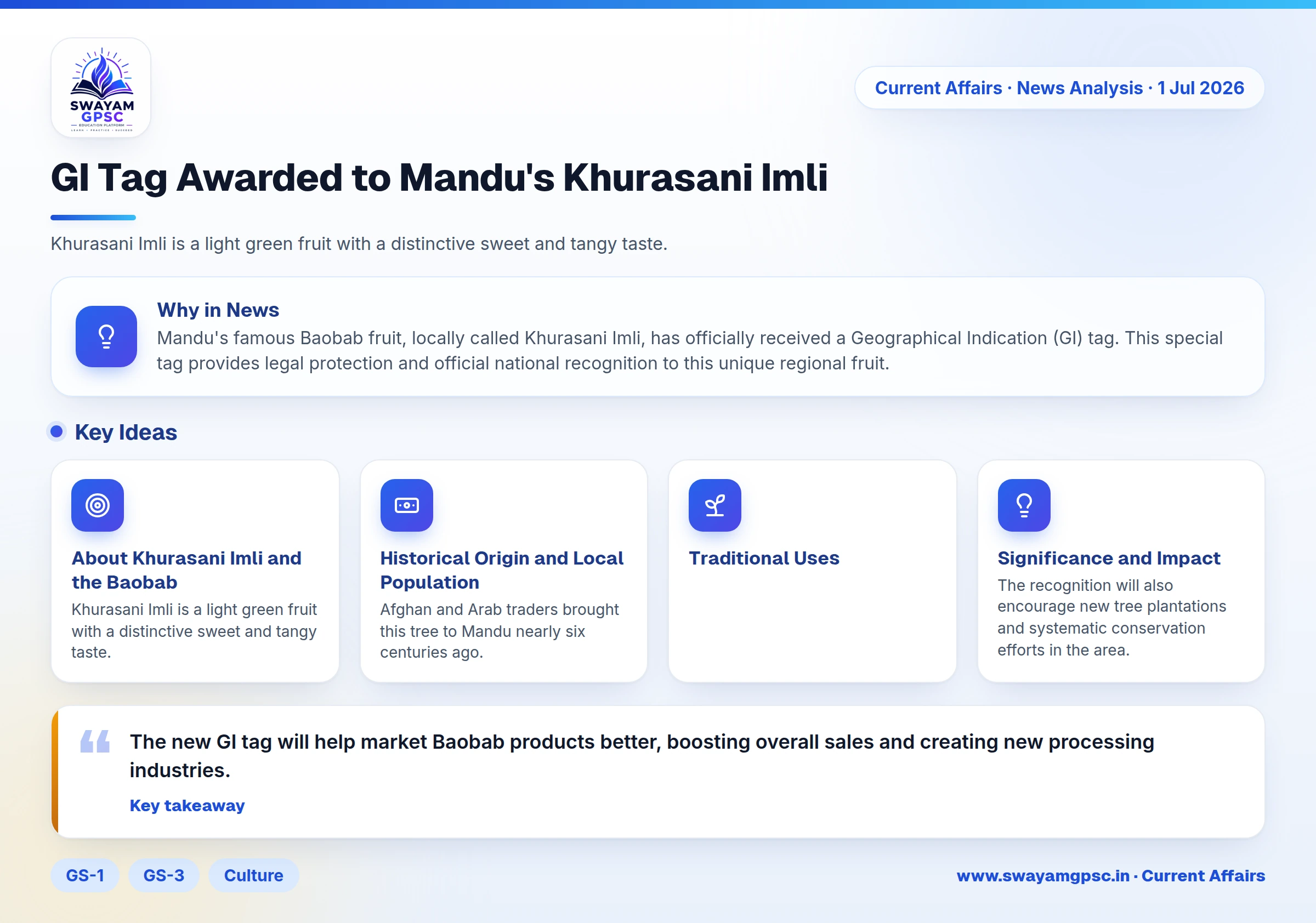
GI Tag Awarded to Mandu's Khurasani Imli
#GS-1 #GS-3 #Culture #Heritage #Tribal Culture #Economy #Agriculture #Environment #Biodiversity #Current Events #National
Why in News
- Mandu's famous Baobab fruit, locally called Khurasani Imli, has officially received a Geographical Indication (GI) tag.
- This special tag provides legal protection and official national recognition to this unique regional fruit.
About Khurasani Imli and the Baobab Tree
- Khurasani Imli is a light green fruit with a distinctive sweet and tangy taste.
- People in the Mandu region value this fruit deeply for its rich nutritional, health, and cultural qualities.
- The Baobab tree, known scientifically as Adansonia digitata, features a massive trunk that stores water and uniquely shaped branches that look upside down.
Historical Origin and Local Population
- Afghan and Arab traders brought this tree to Mandu nearly six centuries ago.
- Over time, the tree fully adapted to the local weather and soil conditions of the region.
- Today, Mandu holds India's largest natural group of Baobab trees, with local officials estimating over 1,000 trees.
Traditional Uses
- Local tribal communities have used the fruit pulp, juice, seeds, and dry bark as natural remedies for generations.
- They rely on these plant parts to treat common health issues like diabetes, digestive troubles, fever, and fatigue.
Significance and Impact
- The new GI tag will help market Baobab products better, boosting overall sales and creating new processing industries.
- Local tribal families who collect and process the fruit will directly earn higher incomes and build stronger marketing cooperatives.
- The recognition will also encourage new tree plantations and systematic conservation efforts in the area.
Challenges
- Despite the GI recognition, the region still lacks dedicated government conservation plans for these ancient trees.
- There is also a shortage of detailed scientific research to explore the full potential of the Baobab tree.