Geographical and Strategic Importance of Jordan
#GS-2 #Current Events #International #Geography #Physical Geography
Key takeaways
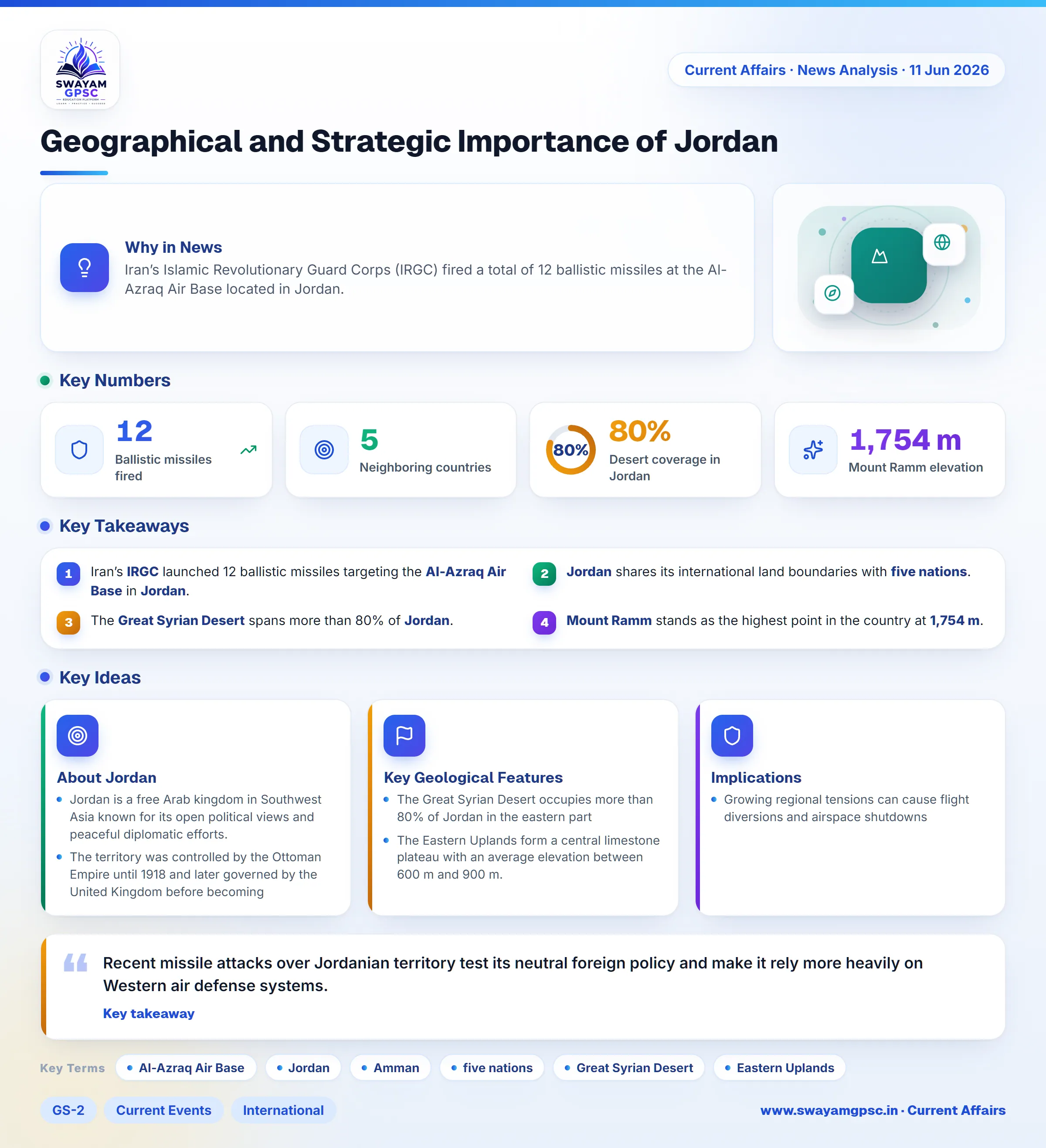
- Iran’s IRGC launched 12 ballistic missiles targeting the Al-Azraq Air Base in Jordan.
- Jordan shares its international land boundaries with five nations.
- The Great Syrian Desert spans more than 80% of Jordan.
- Mount Ramm stands as the highest point in the country at 1,754 m.
- The Dead Sea represents the lowest land point on Earth at 430 m below sea level.
Why in News
- Iran’s Islamic Revolutionary Guard Corps (IRGC) fired a total of 12 ballistic missiles at the Al-Azraq Air Base located in Jordan.
About Jordan
- Jordan is a free Arab kingdom in Southwest Asia known for its open political views and peaceful diplomatic efforts.
- The territory was controlled by the Ottoman Empire until 1918 and later governed by the United Kingdom before becoming a sovereign constitutional monarchy in 1946.
- At present, the nation serves as a major center for business, travel, and culture in the Middle East.
- The capital city of the country is Amman.
- The country shares its borders with five nations, namely Syria, Iraq, Saudi Arabia, Israel, and the West Bank.
Key Geological Features
- The Great Syrian Desert occupies more than 80% of Jordan in the eastern part, featuring basalt plains and sandstone granite areas with very little plant life.
- The Eastern Uplands form a central limestone plateau with an average elevation between 600 m and 900 m.
- This plateau contains Mount Ramm, which reaches 1,754 m as the highest elevation in the country.
- The Jordan Valley and the Dead Sea belong to the Great Rift Valley system in the western region.
- The Dead Sea sits at approximately 430 m below sea level, making it the lowest land elevation on Earth.
- The Jordan River flows directly into the Dead Sea, while rich soil in the upper valley helps farming despite high salt levels in other areas.
- The local weather varies from Mediterranean in the western zone to dry desert in the eastern zone, featuring hot khamsin winds and severe water shortages.
Implications
- Recent missile attacks over Jordanian territory test its neutral foreign policy and make it rely more heavily on Western air defense systems.
- Growing regional tensions can cause flight diversions and airspace shutdowns, which push up transport expenses and harm trade routes across West Asia.