Geographical Indications in India: Protecting Heritage and Boosting Rural Economy
#GS-3 #Science & Technology #Intellectual Property Rights (IPRs) #Economy #Culture #Heritage #Current Events #National
Key takeaways
- India has registered over 800 GI products, with Uttar Pradesh leading among states with 81 tags as of December 2025.
- Under the Geographical Indications of Goods Act, 1999, GI tags remain valid for 10 years and can be renewed for successive periods.
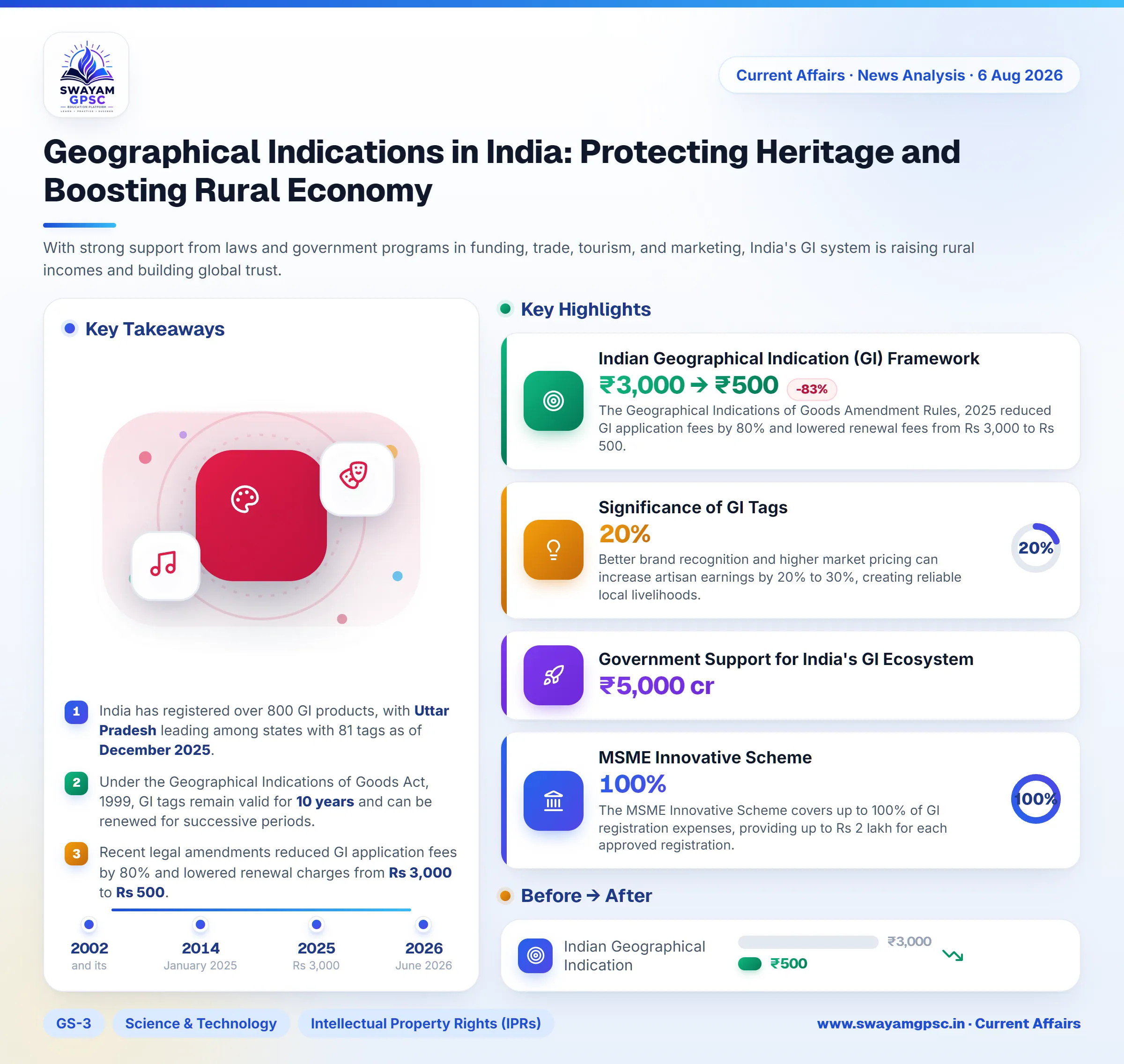
- Recent legal amendments reduced GI application fees by 80% and lowered renewal charges from Rs 3,000 to Rs 500.
- The central government allocated Rs 5,000 crore to construct PM Ekta Malls across states for marketing GI goods and local handicrafts.
- Securing a GI tag boosts artisan and farmer incomes by 20% to 30% while expanding exports to international markets.
Why in News
- Geographical Indication (GI) tags are helping protect India's cultural heritage by linking traditional products to their exact origin.
- This legal recognition prevents misuse of product names and helps artisans, weavers, farmers, and local groups get better market visibility.
- With strong support from laws and government programs in funding, trade, tourism, and marketing, India's GI system is raising rural incomes and building global trust.
What is Geographical Indication (GI)
- A Geographical Indication (GI) is a specialized mark placed on products that come from a specific geographical location.
- This tag shows that the product's unique quality, reputation, or physical traits directly result from its regional origin.
- Article 22 (1) of the Trade-Related Aspects of Intellectual Property Rights (TRIPS) agreement defines GIs as markers identifying goods that originate in a specific region or locality of a member nation.
- Global agreements like the Paris Convention for the Protection of Industrial Property and the WTO TRIPS Agreement formally protect GIs across international borders.
Indian Geographical Indication (GI) Framework
- India regulates GI tags through the Geographical Indications of Goods (Registration and Protection) Act, 1999 and its 2002 Rules.
- The Geographical Indications Registry handles all GI registrations in India, issuing tags that remain valid for 10 years with options for renewal.
- Under Section 27 of the Act, officials can cancel or modify a GI registration if someone obtained it dishonestly or if it turns out to be misleading or legally invalid.
- The Geographical Indications of Goods Amendment Rules, 2025 reduced GI application fees by 80% and lowered renewal fees from Rs 3,000 to Rs 500.
- India now has over 800 registered GI products, with 607 added since 2014, while authorized users grew from 365 to nearly 29,000 by January 2025.
- As of December 2025, Uttar Pradesh leads all states with 81 GI products, followed by Tamil Nadu with 76 and Maharashtra with 55.
- Darjeeling Tea became India's very first registered GI product, followed shortly by traditional items like Aranmula Kannadi and Pochampally Ikat.
Significance of GI Tags
- GI tags protect traditional skills and local heritage while guaranteeing buyers that a product is authentic and high quality.
- Better brand recognition and higher market pricing can increase artisan earnings by 20% to 30%, creating reliable local livelihoods.
- A GI tag opens international markets for producers, as seen when 30 metric tonnes of Muzaffarnagar jaggery were exported to Bangladesh in 2025, directly aiding 545 farmers.
Government Support for India's GI Ecosystem
- The government allocated Rs 5,000 crore to build PM Ekta Malls across states, providing dedicated store space for GI goods, One District One Product (ODOP) items, and local crafts.
- Under the One Station One Product scheme, railway stalls give weavers, farmers, and artisans a chance to market regional crafts and food items directly to passengers.
- States are connecting GI hubs with travel routes, such as tea trails and weaving villages, highlighted by Assam's proposed Muga Silk Trail, Silk Tourism Park, and Muga Utsav.
- The MSME Innovative Scheme covers up to 100% of GI registration expenses, providing up to Rs 2 lakh for each approved registration.
- The Development Commissioner for Handicrafts offers legal help up to Rs 1.5 lakh to defend GI rights and support training and legal enforcement.
- By June 2026, the Handloom Marketing Assistance wing under the National Handloom Development Programme backed 104 GI handloom items and 53 registrations.
- APEDA promotes GI agricultural products in foreign markets by improving processing infrastructure, product quality, and farmer training.
- New export channels sent Karnataka GI fruits to the Maldives, Salem Sago to Canada, Joha Rice to the UK and Italy, and Tezpur Litchi to Dubai.
- India incorporates GI coverage in trade talks, leading to Indi Lime exports under the India-Oman CEPA, commitment from New Zealand, and ongoing negotiations with the European Union.
- Public events like Dilli Haat exhibitions, GI & Beyond: Virasat se Vikas Tak, World Food India, and the Tribal Business Conclave bring GI goods to wide audiences.
Way Forward
- GI tags act as powerful drivers of rural employment, export expansion, and cultural preservation rather than simple legal certificates.
- Connecting items directly to their origin allows local weavers, farmers, and craftspeople to move from unbranded selling to premium brand marketing.
- Expanding authorized user registrations, ensuring quality checks, using digital marketing, and linking GIs with tourism will help turn India's local skills into world-famous brands.