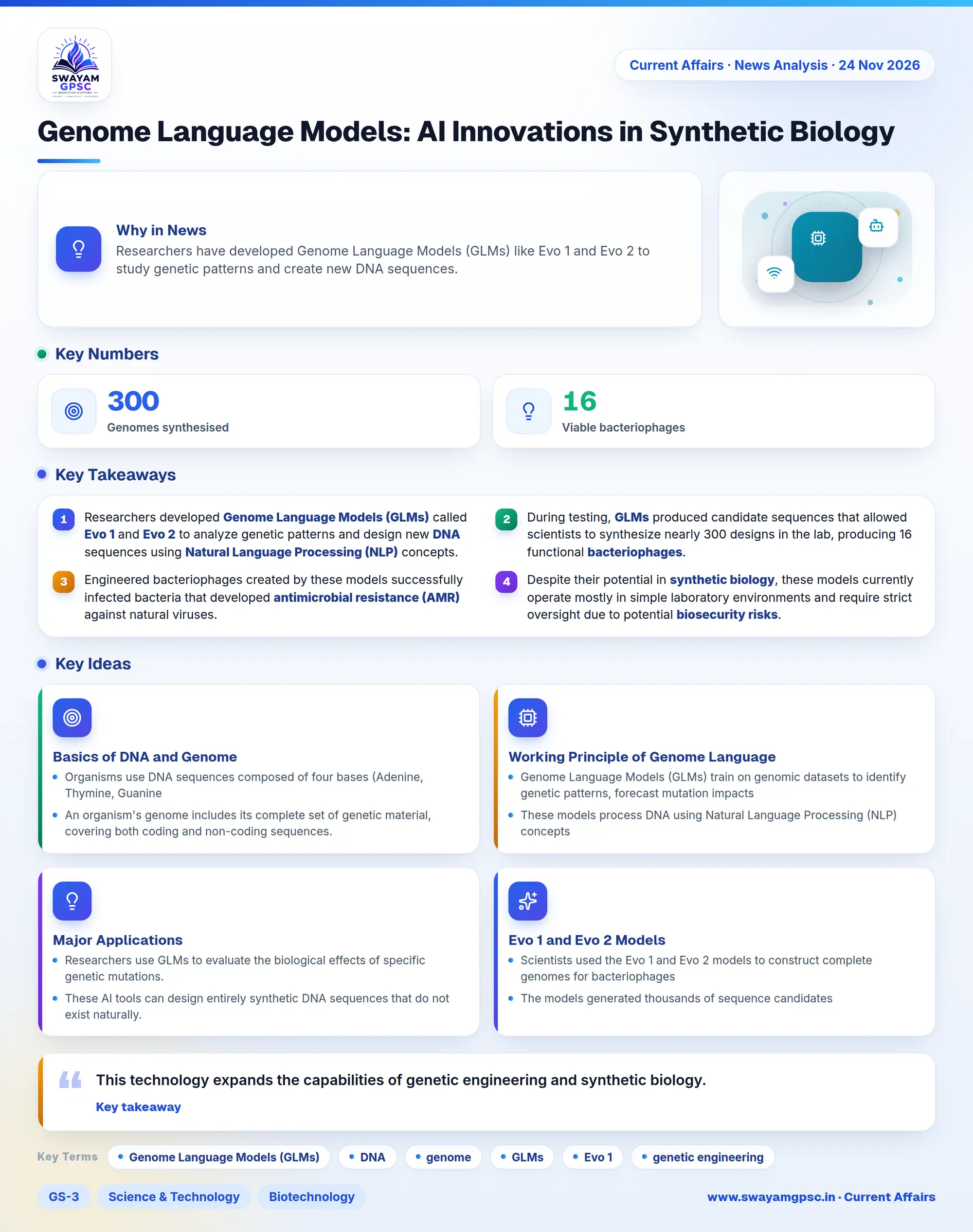
Genome Language Models: AI Innovations in Synthetic Biology
#GS-3 #Science & Technology #Biotechnology #Artificial Intelligence #Current Events #National #Rapid Fire CA #Quick Facts For Prelims #Scientific Innovations & Discoveries
Key takeaways
- Researchers developed Genome Language Models (GLMs) called Evo 1 and Evo 2 to analyze genetic patterns and design new DNA sequences using Natural Language Processing (NLP) concepts.
- During testing, GLMs produced candidate sequences that allowed scientists to synthesize nearly 300 designs in the lab, producing 16 functional bacteriophages.
- Engineered bacteriophages created by these models successfully infected bacteria that developed antimicrobial resistance (AMR) against natural viruses.
- Despite their potential in synthetic biology, these models currently operate mostly in simple laboratory environments and require strict oversight due to potential biosecurity risks.
Why in News
- Researchers have developed Genome Language Models (GLMs) like Evo 1 and Evo 2 to study genetic patterns and create new DNA sequences.
Basics of DNA and Genome
- Organisms use DNA sequences composed of four bases (Adenine, Thymine, Guanine, and Cytosine) to store genetic instructions.
- An organism's genome includes its complete set of genetic material, covering both coding and non-coding sequences.
Working Principle of Genome Language Models
- Genome Language Models (GLMs) train on genomic datasets to identify genetic patterns, forecast mutation impacts, and construct original genetic sequences.
- These models process DNA using Natural Language Processing (NLP) concepts, viewing the genetic code as a language with a four-letter alphabet.
- GLMs use self-supervised learning to spot missing or upcoming sequence elements without relying on pre-labeled data.
- They uncover connections between different genes without requiring explicit input about underlying biological rules.
Major Applications
- Researchers use GLMs to evaluate the biological effects of specific genetic mutations.
- These AI tools can design entirely synthetic DNA sequences that do not exist naturally.
- They help scientists gain a clearer understanding of gene functions and complex biological systems.
- The models assist medical teams in discovering and designing targeted drug treatments.
Evo 1 and Evo 2 Models
- Scientists used the Evo 1 and Evo 2 models to construct complete genomes for bacteriophages, which are viruses that infect bacteria.
- The models generated thousands of sequence candidates, leading to the lab synthesis of nearly 300 sequences and the creation of 16 functional bacteriophages.
- Several of these lab-created bacteriophages successfully infected bacterial strains that were resistant to natural viruses.
Significance of GLMs
- This technology expands the capabilities of genetic engineering and synthetic biology.
- Engineered bacteriophages offer a promising strategy to combat antimicrobial resistance (AMR) by destroying resistant bacteria.
- The tools speed up basic genetic research and support the creation of targeted therapies.
Challenges
- Current applications remain largely limited to simple biological systems and controlled laboratory tests.
- Scientists must conduct extensive laboratory experiments to confirm that AI-designed sequences are safe and functional.
- Creating new biological sequences introduces potential biosecurity risks, creating a need for strong regulatory policies.