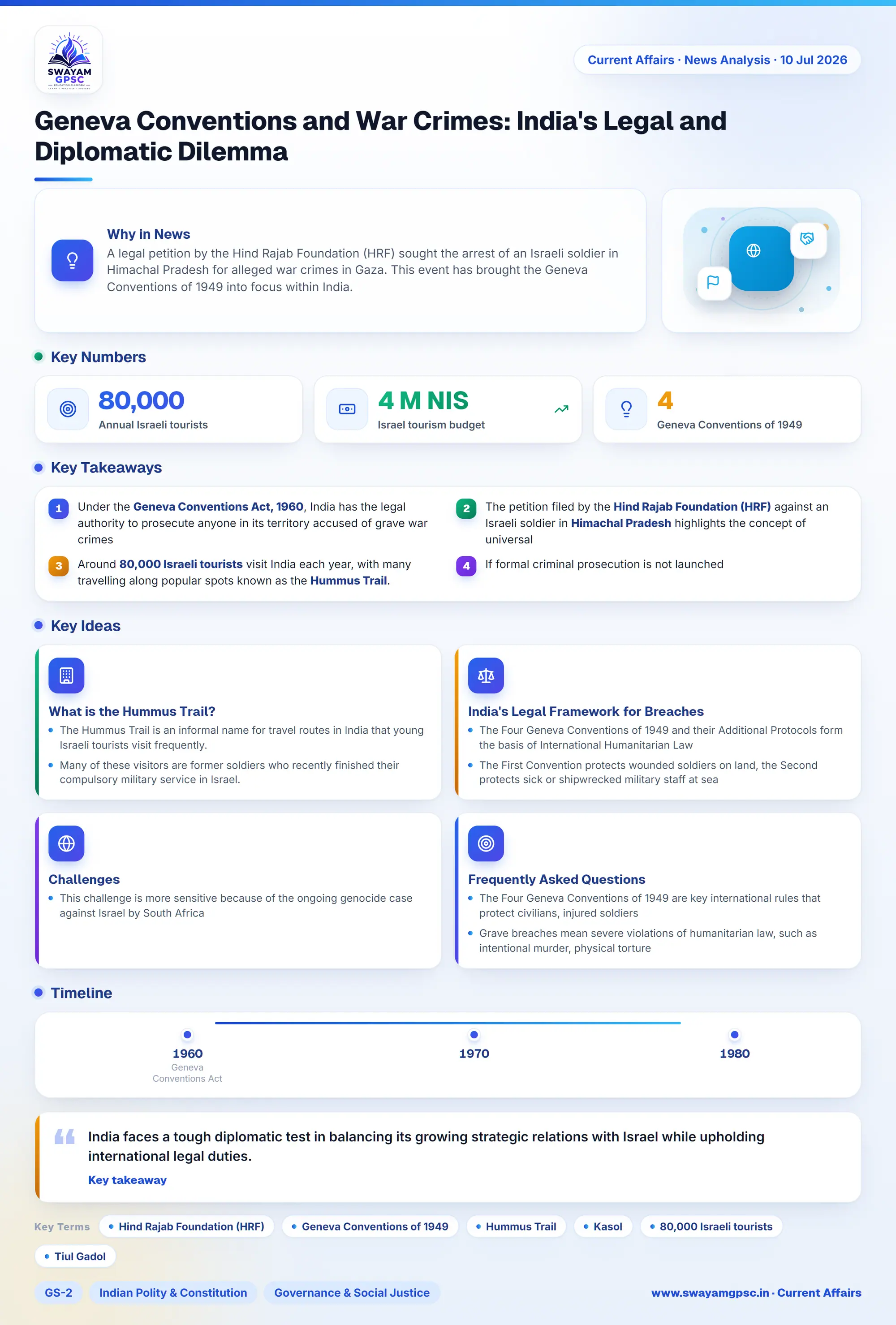
Geneva Conventions and War Crimes: India's Legal and Diplomatic Dilemma
#GS-2 #Indian Polity & Constitution #Governance & Social Justice #Current Events #International Treaties & Agreements #Important International Institutions #Geneva Conventions #Universal Jurisdiction
Key takeaways
- Under the Geneva Conventions Act, 1960, India has the legal authority to prosecute anyone in its territory accused of grave war crimes, regardless of where the crime occurred.
- The petition filed by the Hind Rajab Foundation (HRF) against an Israeli soldier in Himachal Pradesh highlights the concept of universal jurisdiction.
- Around 80,000 Israeli tourists visit India each year, with many travelling along popular spots known as the Hummus Trail.
- If formal criminal prosecution is not launched, the Ministry of Home Affairs can use administrative powers to deport accused foreign citizens.
Why in News
- A legal petition by the Hind Rajab Foundation (HRF) sought the arrest of an Israeli soldier in Himachal Pradesh for alleged war crimes in Gaza.
- This event has brought the Geneva Conventions of 1949 into focus within India.
- The issue creates a complex debate among international law, India's domestic legal duties, and government administrative powers.
What is the Hummus Trail?
- The Hummus Trail is an informal name for travel routes in India that young Israeli tourists visit frequently.
- Many of these visitors are former soldiers who recently finished their compulsory military service in Israel.
- The route gets its name from the Hippie Trail of the 1970s and 1980s, which was known for backpacker culture.
- Key tourist spots include Kasol, Dharamkot, Rishikesh, Pushkar, Goa, Hampi, Gokarna, Kodaikanal, and the Andaman and Nicobar Islands.
- Nearly 80,000 Israeli tourists visit India every year.
- Many young veterans undertake a long trip called Tiul Gadol, which lasts six months to a year and is funded by post-service benefits.
- In 2026, Israel allocated 4 million NIS to promote tourism partnerships and increase travel between both nations.
India's Legal Framework for Breaches of the Geneva Conventions
- The Four Geneva Conventions of 1949 and their Additional Protocols form the basis of International Humanitarian Law to protect people during war.
- The First Convention protects wounded soldiers on land, the Second protects sick or shipwrecked military staff at sea, and the Third protects prisoners of war.
- The Fourth Geneva Convention (1949) protects civilians and classifies actions like deliberate killing, torture, and widespread property destruction as grave breaches.
- The universal jurisdiction rules in these conventions mandate that member countries search for and prosecute anyone accused of grave breaches, regardless of nationality.
- India enacted the Geneva Conventions Act, 1960, which makes grave breaches under the four international conventions a crime in Indian law.
- Under the Geneva Conventions Act, 1960, Indian authorities can arrest and try any accused person in India, no matter where the crime happened or what country the person belongs to.
- If formal judicial prosecution does not start, the Ministry of Home Affairs can use executive powers to deport foreign citizens immediately.
- Human rights groups like the HRF have used universal jurisdiction rules in courts in Chile, Brazil, and Canada to pressure governments to take legal action.
Challenges
- India faces a tough diplomatic test in balancing its growing strategic relations with Israel while upholding international legal duties.
- This challenge is more sensitive because of the ongoing genocide case against Israel by South Africa at the International Court of Justice (ICJ).
Frequently Asked Questions
- The Four Geneva Conventions of 1949 are key international rules that protect civilians, injured soldiers, and prisoners during armed conflicts.
- Grave breaches mean severe violations of humanitarian law, such as intentional murder, physical torture, and unjustified property damage.
- The Geneva Conventions Act, 1960 is an Indian law that enforces these international conventions and sets punishments for serious war crimes.
- The Hummus Trail refers to popular Indian destinations where young Israeli veterans travel for extended holidays after completing army duty.