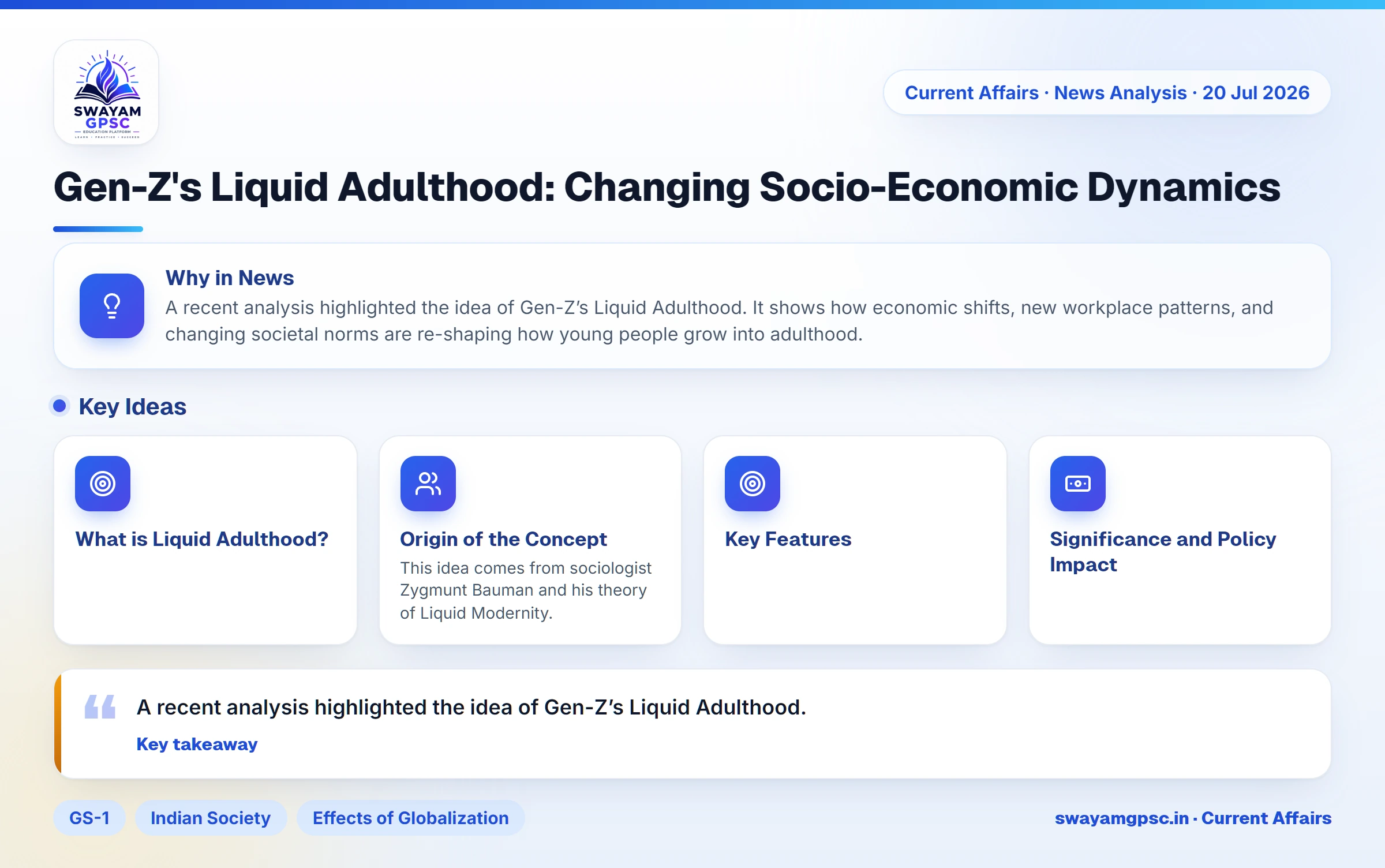
Gen-Z's Liquid Adulthood: Changing Socio-Economic Dynamics
#GS-1 #Indian Society #Effects of Globalization #GS-2 #Governance & Social Justice #GS-3 #Economy #Employment #Science & Technology #Artificial Intelligence #Current Events #National
Why in News
- A recent analysis highlighted the idea of Gen-Z’s Liquid Adulthood. It shows how economic shifts, new workplace patterns, and changing societal norms are re-shaping how young people grow into adulthood.
What is Liquid Adulthood?
- Liquid Adulthood refers to a new stage of life where traditional life goals like stable jobs, buying a home, getting married, and keeping long-term careers get delayed or remain uncertain due to changing conditions.
Origin of the Concept
- This idea comes from sociologist Zygmunt Bauman and his theory of Liquid Modernity. His theory explains that modern life features flexible identities, fluid roles, and temporary personal bonds rather than stable social structures.
Key Features
- Young adults continuously rebuild their personal identity instead of simply taking on fixed roles passed down by traditional society.
- High housing prices, unstable job markets, and rising costs of living prevent young people from achieving financial independence quickly.
- Short-term contract jobs, gig economy tasks, and workplace changes caused by Artificial Intelligence (AI) have largely replaced lifelong careers.
- People are delaying marriage and family formation while using digital platforms and flexible arrangements to build relationships.
Significance and Policy Impact
- This concept challenges old benchmarks of adult life and points out the new social and economic realities of younger generations.
- It underlines the urgent need for structural reforms across employment, housing, education, social security, and mental health support.
Relevance in Exam Preparation
- Under GS-1 (Indian Society), it connects to topics like youth roles, social change, changing family systems, urbanization, and global cultural trends.
- Under GS-2 (Governance), it helps students analyze youth policies, educational planning, and social welfare programs.
- Under GS-3 (Economy), it links directly to employment trends, the gig economy, AI workplace disruption, and maximizing the demographic dividend.
- For Essay writing, it provides analytical material on youth aspirations, societal impacts of technology, and the future of work.