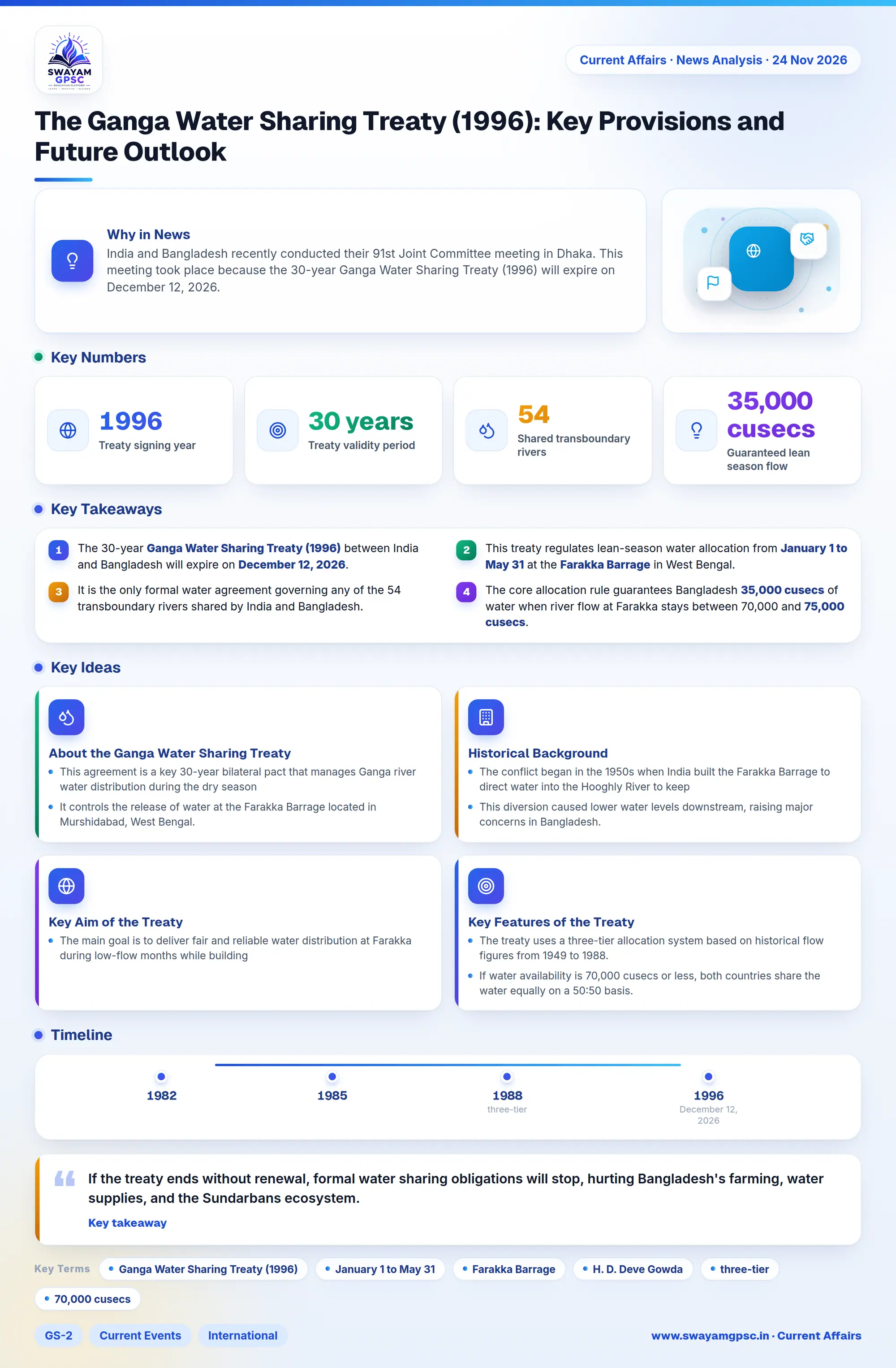
The Ganga Water Sharing Treaty (1996): Key Provisions and Future Outlook
#GS-2 #Current Events #International #Ganga Water Treaty #India Bangladesh Relations #Farakka Barrage #Water Diplomacy
Key takeaways
- The 30-year Ganga Water Sharing Treaty (1996) between India and Bangladesh will expire on December 12, 2026.
- This treaty regulates lean-season water allocation from January 1 to May 31 at the Farakka Barrage in West Bengal.
- It is the only formal water agreement governing any of the 54 transboundary rivers shared by India and Bangladesh.
- The core allocation rule guarantees Bangladesh 35,000 cusecs of water when river flow at Farakka stays between 70,000 and 75,000 cusecs.
- Allowing the pact to expire without renewal threatens agricultural security and the Sundarbans ecosystem in Bangladesh.
Why in News
- India and Bangladesh recently conducted their 91st Joint Committee meeting in Dhaka.
- This meeting took place because the 30-year Ganga Water Sharing Treaty (1996) will expire on December 12, 2026.
- Bangladesh prefers to renew the current treaty despite recent political tensions and local concerns in Indian states.
About the Ganga Water Sharing Treaty (1996)
- This agreement is a key 30-year bilateral pact that manages Ganga river water distribution during the dry season from January 1 to May 31.
- It controls the release of water at the Farakka Barrage located in Murshidabad, West Bengal.
- It is the only formal water sharing treaty between both nations out of 54 shared cross-border rivers.
- Former Prime Ministers H. D. Deve Gowda and Sheikh Hasina signed the treaty on December 12, 1996, in New Delhi with a provision for renewal by mutual agreement.
Historical Background
- The conflict began in the 1950s when India built the Farakka Barrage to direct water into the Hooghly River to keep Kolkata Port navigable.
- This diversion caused lower water levels downstream, raising major concerns in Bangladesh.
- Before finalizing the 1996 pact, both countries signed temporary short-term agreements in 1977, 1982, and 1985.
Key Aim of the Treaty
- The main goal is to deliver fair and reliable water distribution at Farakka during low-flow months while building cooperation around shared river basins.
Key Features of the Treaty
- The treaty uses a three-tier allocation system based on historical flow figures from 1949 to 1988.
- If water availability is 70,000 cusecs or less, both countries share the water equally on a 50:50 basis.
- If flow ranges between 70,000 and 75,000 cusecs, Bangladesh receives 35,000 cusecs and India gets the remaining amount.
- When river volume reaches 75,000 cusecs or more, India receives 40,000 cusecs while Bangladesh gets the rest.
- Under the minimum flow guarantee, both nations receive 35,000 cusecs during three alternating 10-day periods between March 11 and May 10.
- According to Article II, if water flow drops below 50,000 cusecs, both sides must hold emergency talks based on fairness and avoiding harm.
- A joint committee tracks river flow at Farakka and Hardinge Bridge, sending unresolved issues to the Joint Rivers Commission.
- Under Article XII, the agreement remains active until December 12, 2026, and needs joint consent for any extension.
Implications of Expiry or Renegotiation
- If the treaty ends without renewal, formal water sharing obligations will stop, hurting Bangladesh's farming, water supplies, and the Sundarbans ecosystem.
- Renegotiating the treaty offers a chance to solve siltation, drinking water, and irrigation issues in Bihar and West Bengal.
- The outcome will test India's Neighbourhood First foreign policy and its regional water diplomacy.