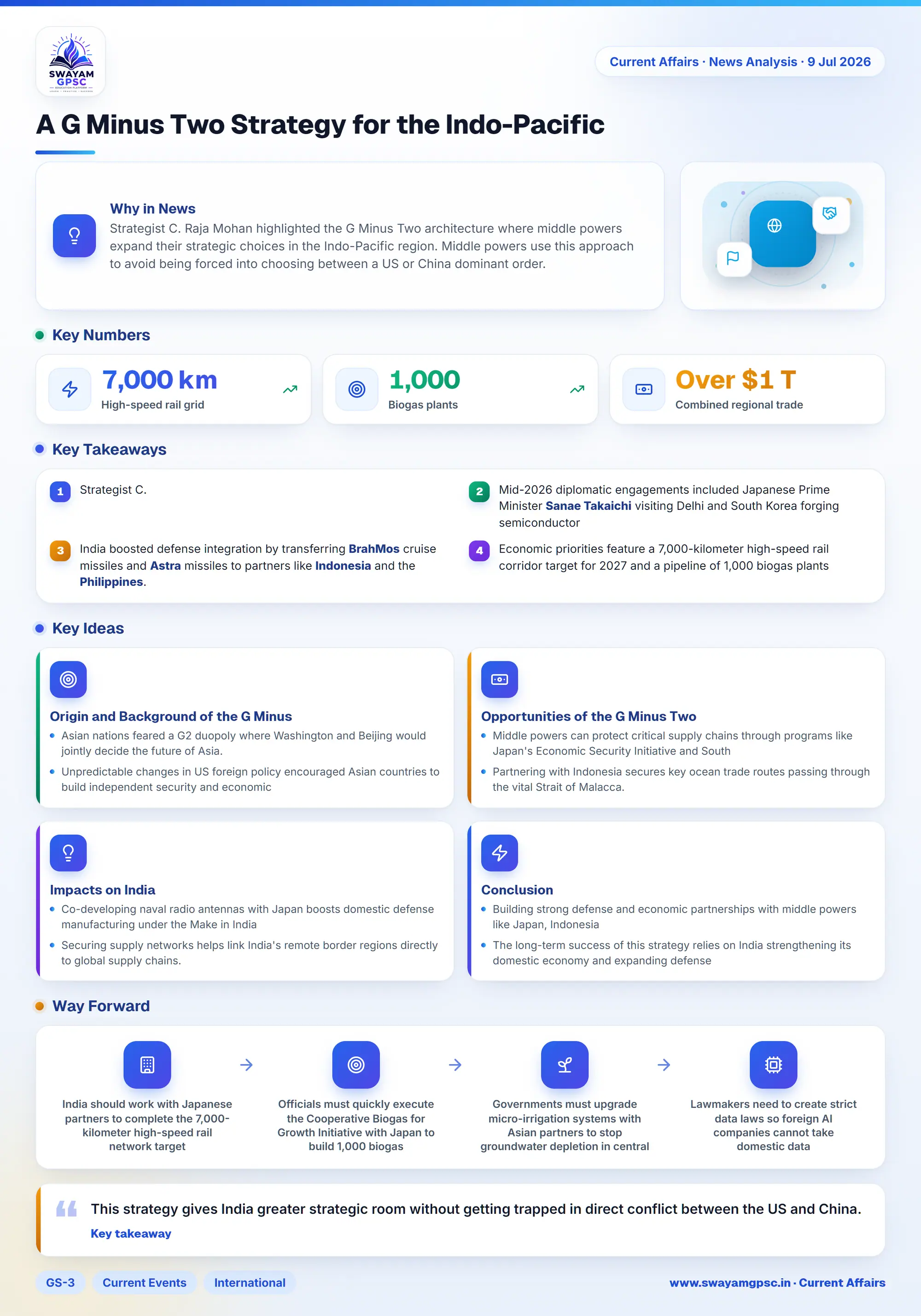
A G Minus Two Strategy for the Indo-Pacific
#GS-3 #Current Events #International #Indo-Pacific #Foreign Policy #Strategic Autonomy
Key takeaways
- Strategist C. Raja Mohan introduced the G Minus Two framework to describe middle powers expanding strategic autonomy without depending solely on the US or China.
- Mid-2026 diplomatic engagements included Japanese Prime Minister Sanae Takaichi visiting Delhi and South Korea forging semiconductor agreements with India.
- India boosted defense integration by transferring BrahMos cruise missiles and Astra missiles to partners like Indonesia and the Philippines.
- Economic priorities feature a 7,000-kilometer high-speed rail corridor target for 2027 and a pipeline of 1,000 biogas plants under the Cooperative Biogas for Growth Initiative.
Why in News
- Strategist C. Raja Mohan highlighted the G Minus Two architecture where middle powers expand their strategic choices in the Indo-Pacific region.
- Middle powers use this approach to avoid being forced into choosing between a US or China dominant order.
- This model forms flexible bilateral and minilateral networks rather than an isolated third bloc or military alliance.
Origin and Background of the G Minus Two Strategy
- Asian nations feared a G2 duopoly where Washington and Beijing would jointly decide the future of Asia.
- Unpredictable changes in US foreign policy encouraged Asian countries to build independent security and economic arrangements.
- Diplomatic momentum grew in 2026 following Japanese Prime Minister Sanae Takaichi visiting Delhi and South Korean President Lee Jae-myung holding summits.
- Asian powers continue binding Washington to regional stability because they cannot balance China's military might on their own.
- Full economic separation from Beijing remains impossible because regional trade with China exceeds $1 trillion.
Opportunities of the G Minus Two Framework
- Middle powers can protect critical supply chains through programs like Japan's Economic Security Initiative and South Korea's semiconductor pacts with India.
- Partnering with Indonesia secures key ocean trade routes passing through the vital Strait of Malacca.
- Regional powers exchange specialized resources such as Australia supplying critical minerals and New Zealand sharing advanced agricultural technology.
- Defense agreements allow India to supply BrahMos and Astra missiles to partners like Indonesia and the Philippines.
- Promoting local currency trade between India and Japan protects bilateral commerce from global currency instability.
Impacts on India
- This strategy gives India greater strategic room without getting trapped in direct conflict between the US and China.
- Co-developing naval radio antennas with Japan boosts domestic defense manufacturing under the Make in India initiative.
- Securing supply networks helps link India's remote border regions directly to global supply chains.
- Supplying military equipment to Southeast Asian partners strengthens India's presence near key maritime choke points.
- Strong regional partnerships improve India's position for permanent seats in bodies like a reformed UNSC and the IEA.
Way Forward
- India should work with Japanese partners to complete the 7,000-kilometer high-speed rail network target by 2027.
- Officials must quickly execute the Cooperative Biogas for Growth Initiative with Japan to build 1,000 biogas plants.
- Governments must upgrade micro-irrigation systems with Asian partners to stop groundwater depletion in central and western states.
- Lawmakers need to create strict data laws so foreign AI companies cannot take domestic data without compensation.
- India must continue internal economic reforms and build a self-reliant defense manufacturing sector.
Conclusion
- Building strong defense and economic partnerships with middle powers like Japan, Indonesia, and Australia safeguards India's strategic freedom.
- The long-term success of this strategy relies on India strengthening its domestic economy and expanding defense manufacturing.