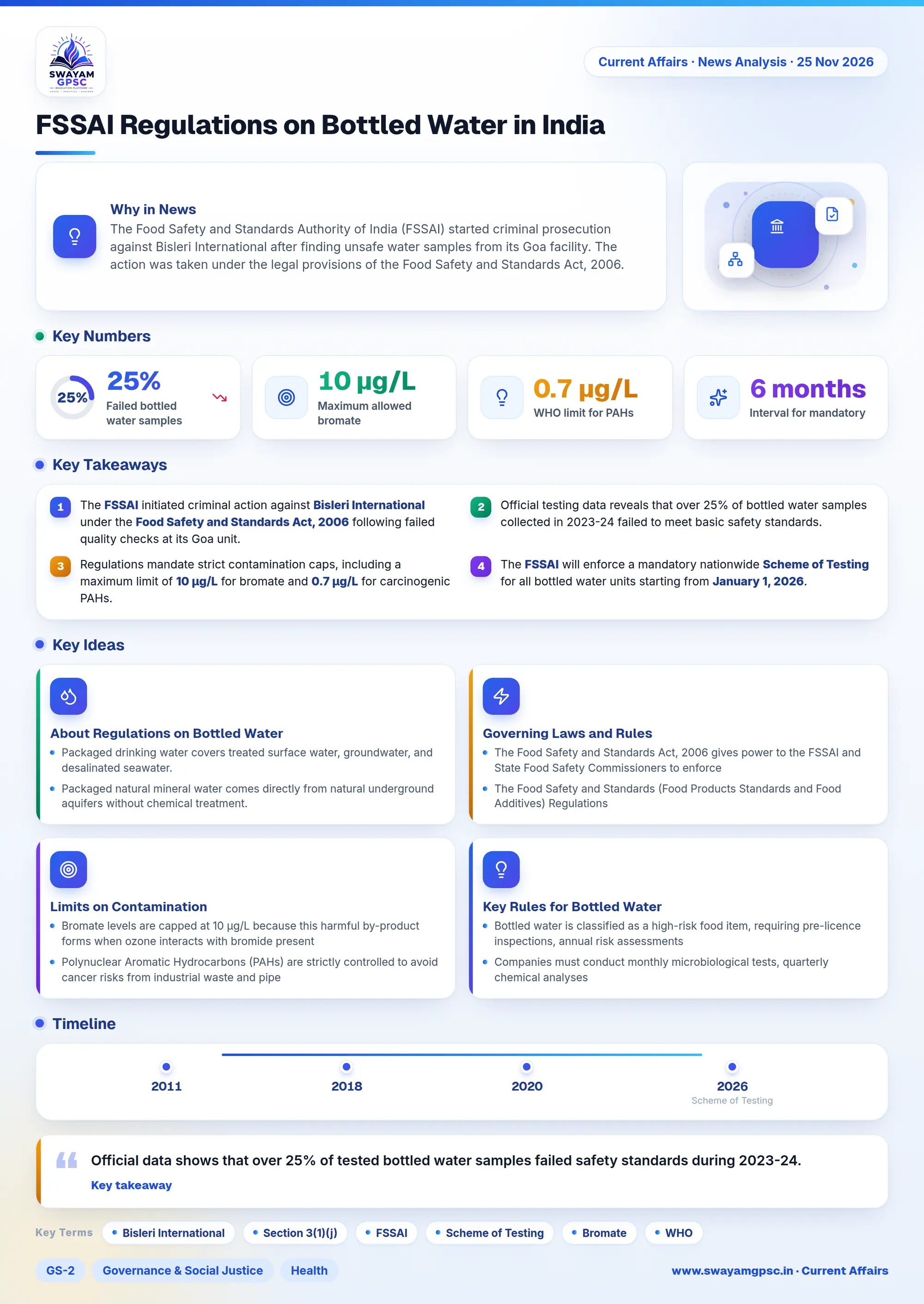
FSSAI Regulations on Bottled Water in India
#GS-2 #Governance & Social Justice #Health #Regulatory Bodies #Food Safety #FSSAI
Key takeaways
- The FSSAI initiated criminal action against Bisleri International under the Food Safety and Standards Act, 2006 following failed quality checks at its Goa unit.
- Official testing data reveals that over 25% of bottled water samples collected in 2023-24 failed to meet basic safety standards.
- Regulations mandate strict contamination caps, including a maximum limit of 10 µg/L for bromate and 0.7 µg/L for carcinogenic PAHs.
- The FSSAI will enforce a mandatory nationwide Scheme of Testing for all bottled water units starting from January 1, 2026.
Why in News
- The Food Safety and Standards Authority of India (FSSAI) started criminal prosecution against Bisleri International after finding unsafe water samples from its Goa facility.
- The action was taken under the legal provisions of the Food Safety and Standards Act, 2006.
About Regulations on Bottled Water in India
- Packaged drinking water covers treated surface water, groundwater, and desalinated seawater.
- Packaged natural mineral water comes directly from natural underground aquifers without chemical treatment.
- Both types of packaged water are classified as food items under Section 3(1)(j) of India's main food safety law.
Governing Laws and Rules
- The Food Safety and Standards Act, 2006 gives power to the FSSAI and State Food Safety Commissioners to enforce quality norms.
- The Food Safety and Standards (Food Products Standards and Food Additives) Regulations, 2011 set mandatory chemical and biological standards.
- Manufacturers must follow the FSS (Packaging) Regulations, 2018 and the FSS (Labelling and Display) Regulations, 2020.
- A mandatory Scheme of Testing introduced by FSSAI will take complete effect from January 1, 2026.
Limits on Contamination
- Bromate levels are capped at 10 µg/L because this harmful by-product forms when ozone interacts with bromide present in raw water.
- Polynuclear Aromatic Hydrocarbons (PAHs) are strictly controlled to avoid cancer risks from industrial waste and pipe linings, with WHO recommending a 0.7 µg/L limit for benzo[a]pyrene.
- Regulations mandate zero tolerance for dangerous disease-causing pathogens in packaged drinking water.
- Strict safety thresholds exist for heavy metals, chemical pesticide residues, and radioactive materials.
Key Rules for Bottled Water Manufacturers
- Bottled water is classified as a high-risk food item, requiring pre-licence inspections, annual risk assessments, and independent audits.
- Companies must conduct monthly microbiological tests, quarterly chemical analyses, and complete safety checks every 6 months in certified laboratories.
- Packaging material must use food-grade plastics with tamper-proof caps to stop harmful chemical leaching into the water.
- Reusable water jars holding 5 litres or more must be inspected for physical damage before refilling.
- Labels must display the FSSAI licence number, water source details, batch number, production date, expiry date, and consumer helpline contact.
Implications and Concerns
- Official data shows that over 25% of tested bottled water samples failed safety standards during 2023-24.
- Experts recommend adding checks for microplastics, nanoplastics, and chemical leakage caused by sunlight exposure.
- Improving municipal tap water systems can reduce consumer dependence on expensive commercial bottled water.