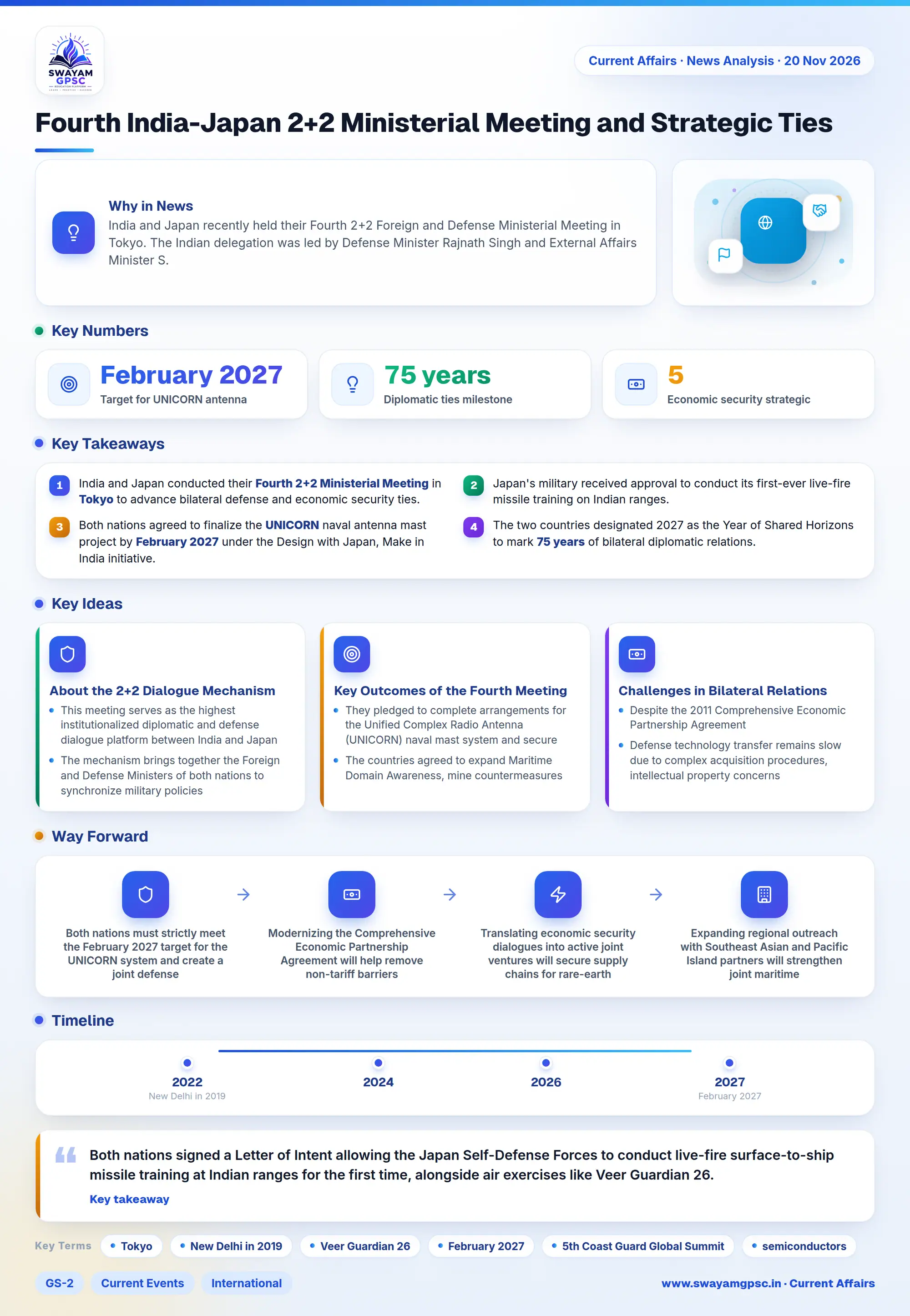
Fourth India-Japan 2+2 Ministerial Meeting and Strategic Ties
#GS-2 #Current Events #International #Bilateral Relations #India-Japan Relations #Defense Cooperation #Indo-Pacific
Key takeaways
- India and Japan conducted their Fourth 2+2 Ministerial Meeting in Tokyo to advance bilateral defense and economic security ties.
- Japan's military received approval to conduct its first-ever live-fire missile training on Indian ranges.
- Both nations agreed to finalize the UNICORN naval antenna mast project by February 2027 under the Design with Japan, Make in India initiative.
- The two countries designated 2027 as the Year of Shared Horizons to mark 75 years of bilateral diplomatic relations.
Why in News
- India and Japan recently held their Fourth 2+2 Foreign and Defense Ministerial Meeting in Tokyo.
- The Indian delegation was led by Defense Minister Rajnath Singh and External Affairs Minister S. Jaishankar, while Foreign Minister Motegi Toshimitsu and Defense Minister Koizumi Shinjiro represented Japan.
About the 2+2 Dialogue Mechanism
- This meeting serves as the highest institutionalized diplomatic and defense dialogue platform between India and Japan under their Special Strategic and Global Partnership.
- The mechanism brings together the Foreign and Defense Ministers of both nations to synchronize military policies, economic security, and Indo-Pacific strategies.
- The dialogue originated after the 2018 Annual Summit between Prime Minister Narendra Modi and former Japanese Prime Minister Shinzo Abe.
- Previous editions of this ministerial meeting took place in New Delhi in 2019, Tokyo in 2022, and New Delhi in 2024, leading up to the Tokyo meeting in November 2026.
Key Outcomes of the Fourth Meeting
- Both nations signed a Letter of Intent allowing the Japan Self-Defense Forces to conduct live-fire surface-to-ship missile training at Indian ranges for the first time, alongside air exercises like Veer Guardian 26.
- They pledged to complete arrangements for the Unified Complex Radio Antenna (UNICORN) naval mast system and secure India's Acceptance of Necessity by February 2027 under the Design with Japan, Make in India initiative.
- The countries agreed to expand Maritime Domain Awareness, mine countermeasures, and disaster relief cooperation while preparing for India to host the 5th Coast Guard Global Summit in February 2027.
- Both governments operationalized the Joint Declaration on Economic Security Cooperation across five key sectors, including semiconductors, critical minerals, ICT, clean energy, and pharmaceuticals.
- They resolved to co-create artificial intelligence ecosystems under the Japan-India AI Cooperation Initiative, enhance AI-driven cybersecurity, expand Space Situational Awareness, and construct backup undersea communication cables.
- India aligned its Indo-Pacific Oceans Initiative and MAHASAGAR frameworks with Japan's Free and Open Indo-Pacific vision while supporting new minilateral formats like the India-Japan-Philippines Track 1.5 Dialogue.
- The ministers condemned cross-border terrorism, mentioning groups like LeT and JeM, supported each other's UNSC bids for 2028-29 and 2033-34, and designated 2027 as the India-Japan Year of Shared Horizons to mark 75 years of diplomatic relations.
Challenges in Bilateral Relations
- Despite the 2011 Comprehensive Economic Partnership Agreement, bilateral trade heavily favors Japan because Indian exports like pharmaceuticals and agriculture face strict non-tariff barriers.
- Defense technology transfer remains slow due to complex acquisition procedures, intellectual property concerns, and protracted pricing discussions, as seen in the US-2 amphibious aircraft talks.
- Flagship infrastructure initiatives experience execution delays caused by land acquisition issues, local regulatory approvals, and currency fluctuations, notably affecting the Mumbai-Ahmedabad High-Speed Rail corridor.
- The two nations hold differing views on Eurasian geopolitics, with Japan actively enforcing G7 sanctions against Russia while India maintains its strategic autonomy and defense ties with Moscow.
Way Forward
- Both nations must strictly meet the February 2027 target for the UNICORN system and create a joint defense research fund for naval shipbuilding and autonomous systems.
- Modernizing the Comprehensive Economic Partnership Agreement will help remove non-tariff barriers, integrate Indian IT talent into Japan, and increase Indian agricultural and generic drug exports.
- Translating economic security dialogues into active joint ventures will secure supply chains for rare-earth processing, semiconductor equipment, and clean energy.
- Expanding regional outreach with Southeast Asian and Pacific Island partners will strengthen joint maritime surveillance and undersea cable infrastructure.
- Using the upcoming 75th anniversary of diplomatic ties in 2027 will help deepen academic exchanges, talent mobility, and sub-national partnership models.