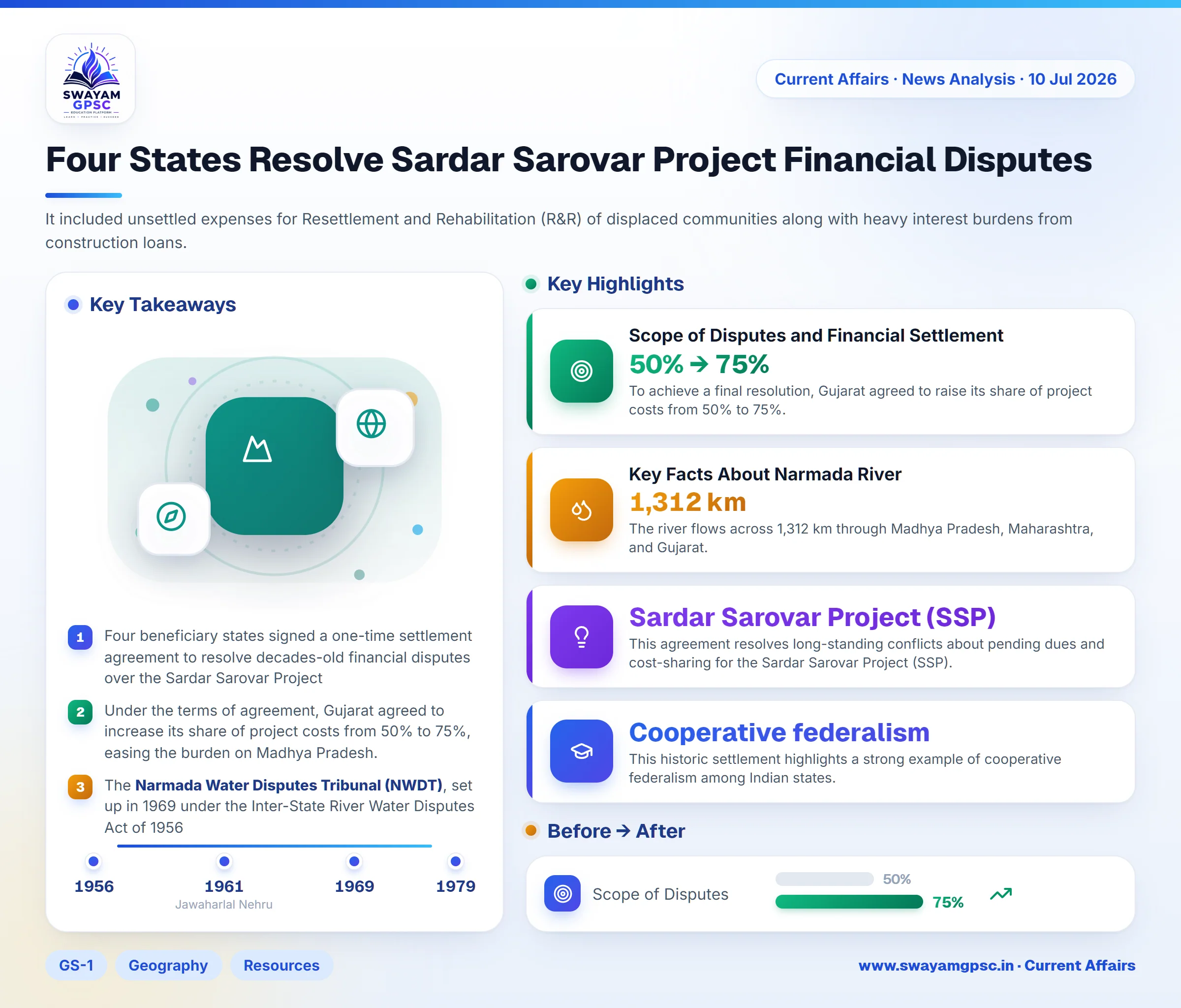
Four States Resolve Sardar Sarovar Project Financial Disputes
#GS-1 #Geography #Resources #GS-2 #Indian Polity & Constitution #Federalism #GS-3 #Economy #Infrastructure #Current Events #National #Gujarat #Sardar Sarovar Project #Narmada River
Key takeaways
- Four beneficiary states signed a one-time settlement agreement to resolve decades-old financial disputes over the Sardar Sarovar Project (SSP).
- Under the terms of agreement, Gujarat agreed to increase its share of project costs from 50% to 75%, easing the burden on Madhya Pradesh.
- The Narmada Water Disputes Tribunal (NWDT), set up in 1969 under the Inter-State River Water Disputes Act of 1956, delivered its final allocation award in 1979.
- The Narmada River stretches over 1,312 km and drains a basin area of nearly 98,800 sq. km across three states.
Why in News
- Four states including Maharashtra, Gujarat, Rajasthan, and Madhya Pradesh signed a one-time settlement agreement to resolve decades-old financial disputes.
- This agreement resolves long-standing conflicts about pending dues and cost-sharing for the Sardar Sarovar Project (SSP).
- This historic settlement highlights a strong example of cooperative federalism among Indian states.
Scope of Disputes and Financial Settlement
- The conflict involved sharing costs for both the Sardar Sarovar Project and the Indira Sagar Project.
- It included unsettled expenses for Resettlement and Rehabilitation (R&R) of displaced communities along with heavy interest burdens from construction loans.
- To achieve a final resolution, Gujarat agreed to raise its share of project costs from 50% to 75%.
- This decision significantly lowers the financial burden on Madhya Pradesh and helps close long-running accounts.
Overview of Sardar Sarovar Project
- The project features a terminal gravity dam built across the Narmada River near Navagam in Gujarat.
- Situated near the Statue of Unity, it is the largest dam planned on the river and ranks among the biggest concrete gravity dams in the world by volume.
- The vision to harness Narmada river waters originated with Sardar Vallabhbhai Patel in 1946.
- Former Prime Minister Jawaharlal Nehru formally laid the foundation stone for this project in 1961.
- The project serves four major partner states: Gujarat, Madhya Pradesh, Maharashtra, and Rajasthan.
- It provides essential irrigation, clean drinking water, and hydroelectric power across vast areas.
- The project transformed arid and drought-hit regions in Gujarat and Rajasthan, boosting farm outputs and raising local land values.
Narmada Water Disputes Tribunal
- The government established the Narmada Water Disputes Tribunal (NWDT) in 1969 under the Inter-State River Water Disputes Act, 1956.
- The tribunal issued its final binding award in 1979 to define water and power allocations among all four states.
- Although water sharing was settled, disagreements over land compensation, rehabilitation spending, and shared construction costs continued for decades.
Key Facts About Narmada River
- The Narmada River is the largest river in Central India and Gujarat.
- It starts from the Amarkantak Plateau in Madhya Pradesh and empties into the Arabian Sea at the Gulf of Khambhat in Gujarat.
- The river flows across 1,312 km through Madhya Pradesh, Maharashtra, and Gujarat.
- It drains a vast catchment area of around 98,800 sq. km, standing out as one of India's main west-flowing rivers.