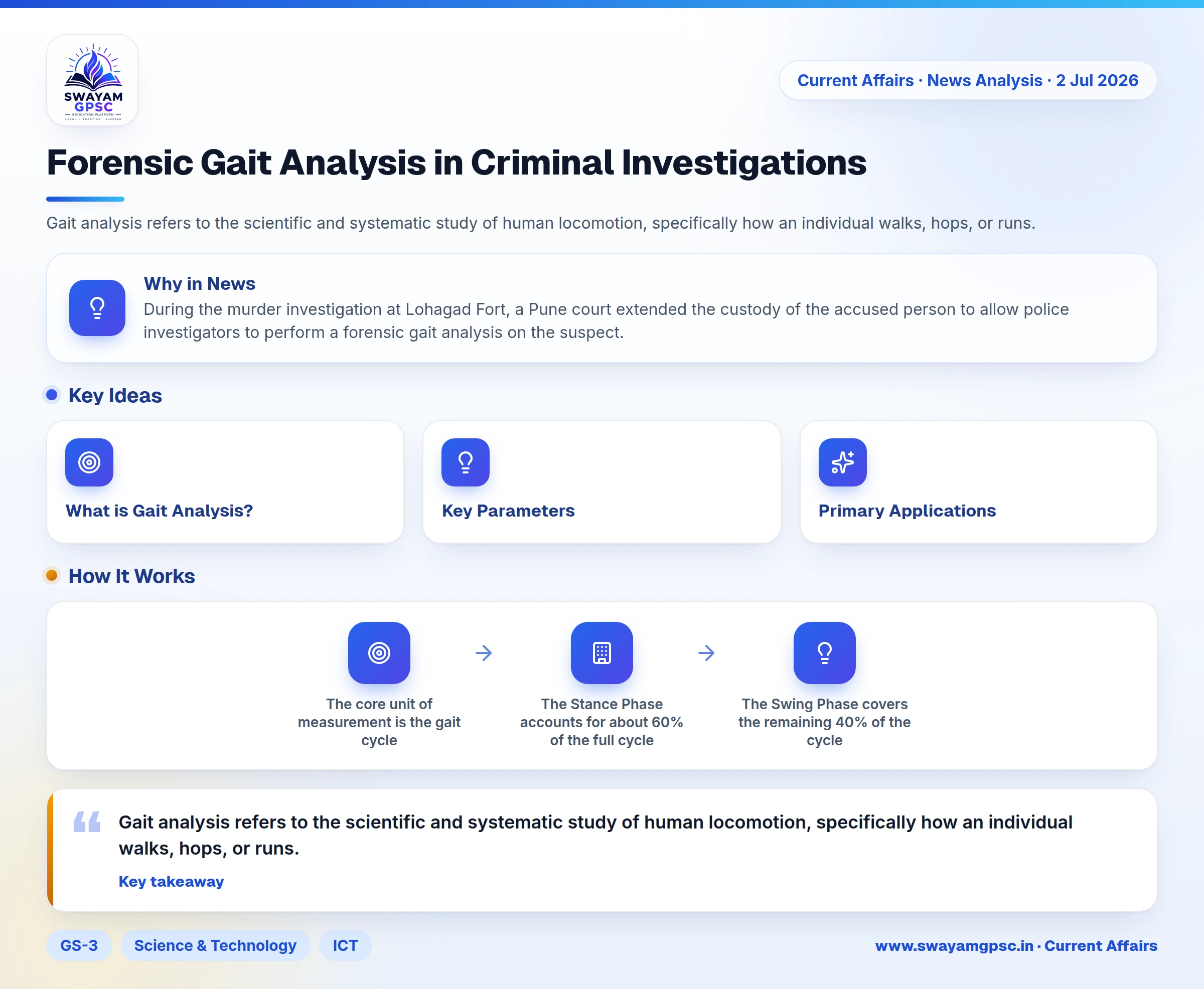
Forensic Gait Analysis in Criminal Investigations
#GS-3 #Science & Technology #ICT #Current Events #National #Forensic Science
Why in News
- During the murder investigation at Lohagad Fort, a Pune court extended the custody of the accused person to allow police investigators to perform a forensic gait analysis on the suspect.
What is Gait Analysis?
- Gait analysis refers to the scientific and systematic study of human locomotion, specifically how an individual walks, hops, or runs.
- This technique analyzes how the nervous system coordinates continuously with bones, muscles, and joints to produce a unique biomechanical signature for every individual.
How It Works
- The core unit of measurement is the gait cycle, which tracks body movements from the moment one foot strikes the ground until that same foot touches the floor again.
- The Stance Phase accounts for about 60% of the full cycle, beginning with a heel strike and ending when the toe pushes off while supporting full body weight.
- The Swing Phase covers the remaining 40% of the cycle, starting when the foot leaves the surface and swings forward without dragging toes on the floor.
Key Parameters
- Spatial Parameters evaluate step length, stride length, walking base width, and toe angle to measure balance, posture, and symmetry.
- Temporal Parameters record cadence in steps per minute, walking speed, and double-support time to test movement rhythm and efficiency.
- Full-body systemic tracking through the Sheffield Tool examines a 15-point movement pattern, covering head, shoulders, arms, torso, hips, knees, and feet.
- Modern instrumentation uses high-speed cameras, pressure mats, force plates, and wearable sensors to capture walking mechanics with high precision.
Primary Applications
- In forensic criminology, gait analysis helps identify suspects from CCTV footage by evaluating walking styles, limps, and posture when face recognition is unavailable.
- In healthcare, medical experts use gait patterns to diagnose Parkinson's disease, stroke, cerebral palsy, dementia, and orthopedic disorders.
- In sports biomechanics, athletes analyze gait cycles to improve running efficiency, avoid injuries, optimize body movement, and design custom footwear.