Floating Solar Photovoltaic Potential in India
#GS-3 #Economy #Infrastructure #Energy #Environment #Sustainable Development #Current Events #National #Gujarat
Key takeaways
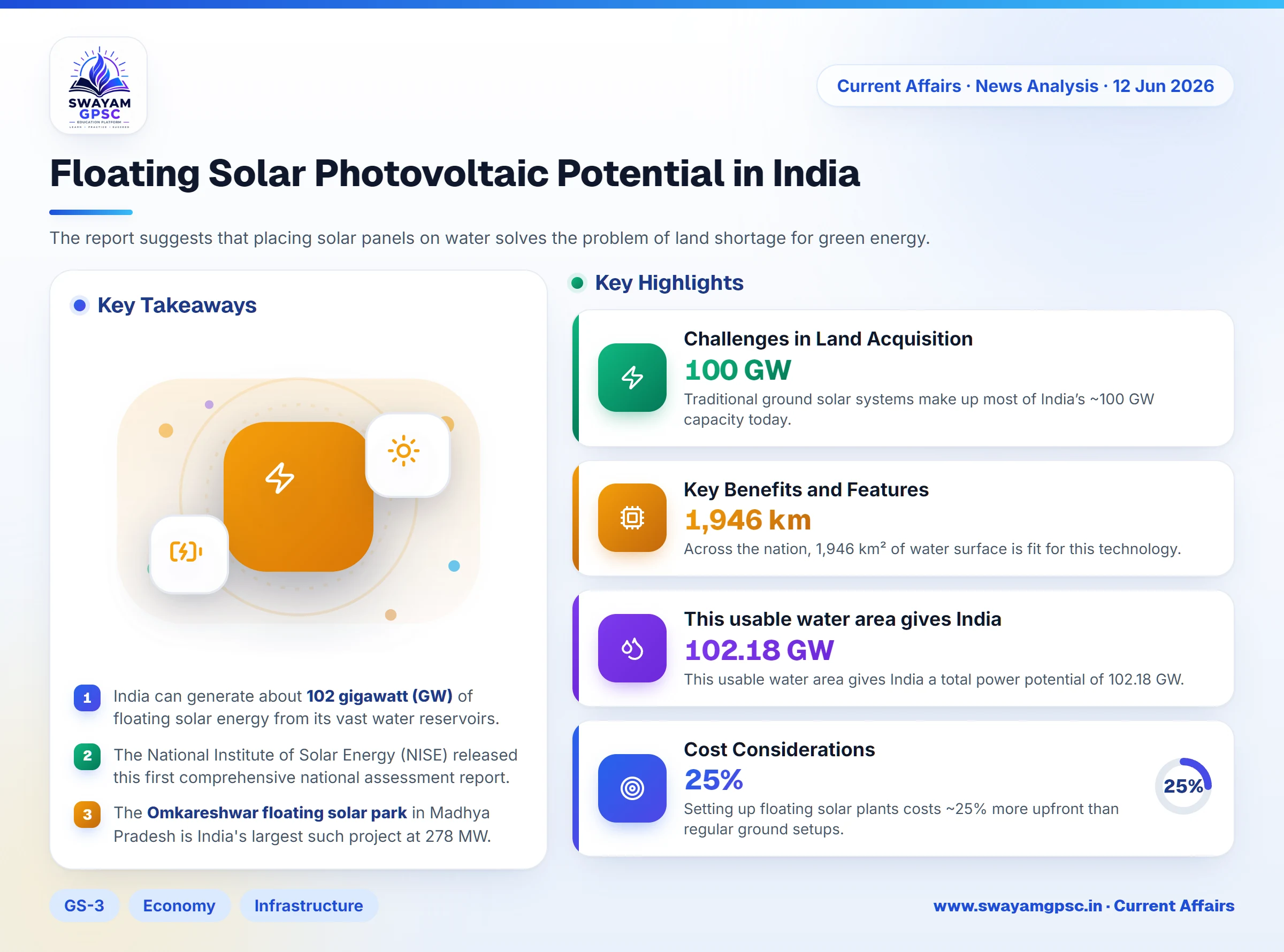
- India can generate about 102 gigawatt (GW) of floating solar energy from its vast water reservoirs.
- The National Institute of Solar Energy (NISE) released this first comprehensive national assessment report.
- The Omkareshwar floating solar park in Madhya Pradesh is India's largest such project at 278 MW.
- Floating solar installations worldwide reached about 9.6 GW by 2024, with Asia leading by nearly 90%.
Why in News
- India can set up about 102 gigawatt (GW) of floating solar power on its water reservoirs.
- This finding comes from the first complete national study by the National Institute of Solar Energy (NISE).
- The National Institute of Solar Energy (NISE) works as an independent body under the Ministry of New and Renewable Energy (MNRE).
- The report suggests that placing solar panels on water solves the problem of land shortage for green energy.
Understanding Floating Solar Energy
- Floating solar parks are solar photovoltaic (PV) installations built on water surfaces instead of land.
- These panels float on water bodies like reservoirs, lakes, or ponds.
Challenges in Land Acquisition
- Traditional ground solar systems make up most of India’s ~100 GW capacity today.
- These ground setups need 3-4 times more land than the panels occupy.
- Buying land is slow and expensive, and it often creates fights with farming and housing needs.
Key Benefits and Features
- Floating solar is completely “land neutral,” which helps the country avoid land fights entirely.
- Across the nation, 1,946 km² of water surface is fit for this technology.
- This usable water area gives India a total power potential of 102.18 GW.
Cost Considerations
- Setting up floating solar plants costs ~25% more upfront than regular ground setups.
- The extra cost comes from special parts like floats, anchoring systems, and waterproofing materials.
Agri-Photovoltaics
- The Ministry of New and Renewable Energy (MNRE) is pushing for agri-photovoltaics across the country.
- This method puts solar panels on tall frames right above farm fields.
- It lets farmers grow crops and make electricity on the exact same piece of land.
Top States in Potential
- Most of India's floating solar potential is concentrated in a few states.
- Maharashtra (16.28 GW) holds the highest potential in the country.
- Madhya Pradesh (14.89 GW) stands as the second largest state for this technology.
- Karnataka (13.69 GW) has a massive share of the national floating solar capacity.
- Odisha (12.81 GW) offers huge water surfaces for solar installations.
- Telangana (10.72 GW) rounds out the top states with high solar potential.
Flagship Projects and Global Context
- The Omkareshwar floating solar park on the Narmada River in Madhya Pradesh is India's largest.
- Its current capacity sits at 278 MW, and it will soon scale up to 600 MW.
- Global floating solar projects reached around 9.6 GW worldwide by 2024.
- Asia accounts for nearly 90% of these global installations.
- China leads the world with its large 120 MW plant on Poyang Lake.
Significance and Future Targets
- Floating solar provides a scalable, land-efficient solution for India's growing energy needs.
- It directly supports India's grand target of achieving 500 GW non-fossil capacity by 2030.
- This technology helps expand renewable energy, keeps power grids stable, and manages water bodies for multiple uses.