First-Ever Fencing of Sundarbans Border
#GS-3 #Environment #Biodiversity #Wildlife #Current Events #National #GS-1 #Geography #Physical Geography #Border Security #Sundarbans
Why in News
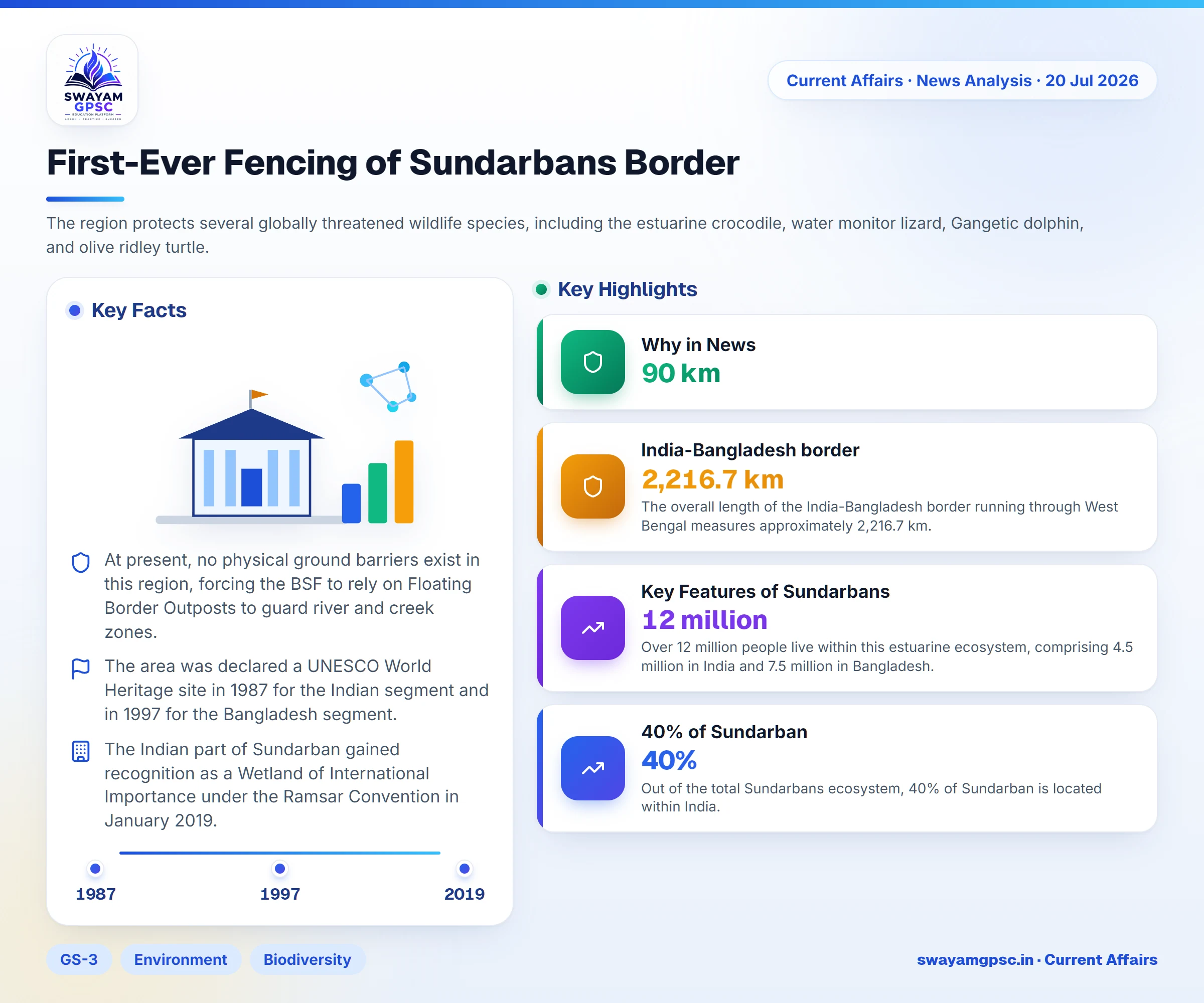
- The Union Ministry of Home Affairs plans to construct a fence along a 90 km stretch of the Sundarbans on the India-Bangladesh border in West Bengal to boost security across challenging terrain.
- The Border Security Force (BSF) has initiated feasibility and technical surveys for this project, where mangroves, tidal swamps, creeks, embankments, and marshy river stretches make border control extremely complex.
- At present, no physical ground barriers exist in this region, forcing the BSF to rely on Floating Border Outposts to guard river and creek zones.
- The overall length of the India-Bangladesh border running through West Bengal measures approximately 2,216.7 km.
Key Features of Sundarbans
- The Sundarbans contains the largest mangrove forest system globally, situated on the vast delta formed by the Ganges, Brahmaputra, and Meghna rivers where they meet the Bay of Bengal.
- This ecological habitat shelters 84 species of flora (including 26 mangrove species) alongside 453 species of fauna, which feature 120 species of fish, 290 species of birds, 42 species of mammals, 35 reptiles, and eight amphibian species.
- Over 12 million people live within this estuarine ecosystem, comprising 4.5 million in India and 7.5 million in Bangladesh.
- The region protects several globally threatened wildlife species, including the estuarine crocodile, water monitor lizard, Gangetic dolphin, and olive ridley turtle.
- Out of the total Sundarbans ecosystem, 40% of Sundarban is located within India.
Environmental Status and Protection
- The area was declared a UNESCO World Heritage site in 1987 for the Indian segment and in 1997 for the Bangladesh segment.
- The Indian part of Sundarban gained recognition as a Wetland of International Importance under the Ramsar Convention in January 2019.
- It serves as a major habitat for Royal Bengal Tigers under the umbrella of Project Tiger.
- The Sundarbans is designated as a Biosphere Reserve, encompassing key protected zones such as Sundarbans National Park (India), Sundarbans East Wildlife Sanctuary (India), Sundarbans South Wildlife Sanctuary (India), Sundarbans West Wildlife Sanctuary (India), and Sundarbans Reserve Forest (Bangladesh).