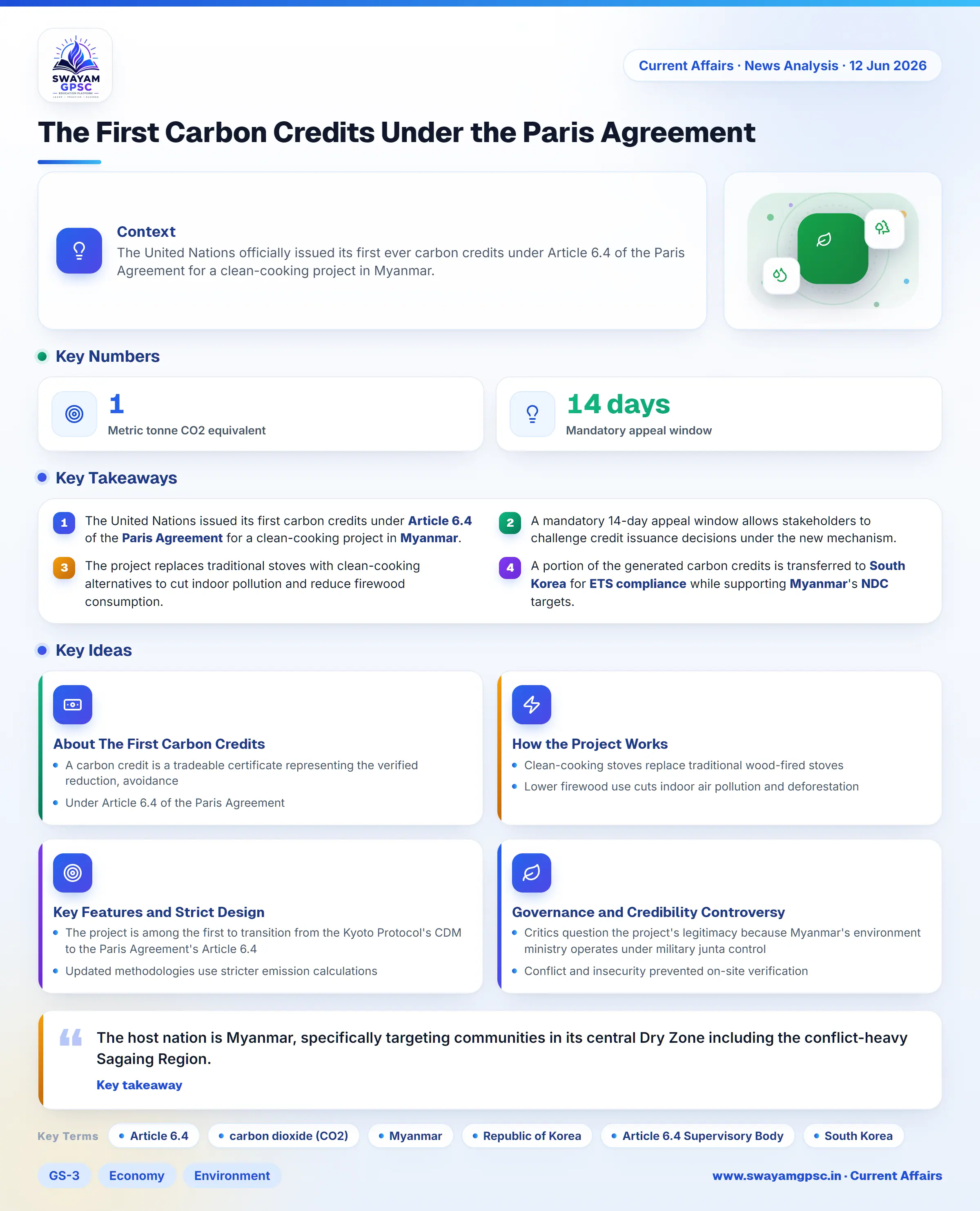
The First Carbon Credits Under the Paris Agreement
#GS-3 #Economy #Environment #Climate Change #Current Events #International
Key takeaways
- The United Nations issued its first carbon credits under Article 6.4 of the Paris Agreement for a clean-cooking project in Myanmar.
- A mandatory 14-day appeal window allows stakeholders to challenge credit issuance decisions under the new mechanism.
- The project replaces traditional stoves with clean-cooking alternatives to cut indoor pollution and reduce firewood consumption.
- A portion of the generated carbon credits is transferred to South Korea for ETS compliance while supporting Myanmar's NDC targets.
Context
- The United Nations officially issued its first ever carbon credits under Article 6.4 of the Paris Agreement for a clean-cooking project in Myanmar.
About The First Carbon Credits Under the Paris Agreement
- A carbon credit is a tradeable certificate representing the verified reduction, avoidance, or removal of one metric tonne of carbon dioxide (CO2) or its greenhouse gas equivalent from the atmosphere.
- Under Article 6.4 of the Paris Agreement, these credits serve as high-integrity assets supervised by a dedicated UN body to funnel international finance toward genuine climate solutions.
- The host nation is Myanmar, specifically targeting communities in its central Dry Zone including the conflict-heavy Sagaing Region.
- The partner nation for this initiative is the Republic of Korea.
- The governing authority is the Article 6.4 Supervisory Body of the UN Paris Agreement Crediting Mechanism.
How the Project Works
- Clean-cooking stoves replace traditional wood-fired stoves, reducing fuel consumption and improving household energy efficiency.
- Lower firewood use cuts indoor air pollution and deforestation, with the resulting emission reductions quantified as carbon savings.
- The UN verifies avoided emissions using updated scientific baselines and issues fewer credits to ensure environmental integrity.
- A portion of credits is transferred to South Korea for ETS compliance, while the remainder supports Myanmar’s NDC goals.
Key Features and Strict Design Safeguards
- The project is among the first to transition from the Kyoto Protocol's CDM to the Paris Agreement's Article 6.4 mechanism.
- Updated methodologies use stricter emission calculations, significantly reducing the number of credits issued compared to older systems.
- A mandatory 14-day appeal window allows governments, communities, and stakeholders to challenge credit issuance decisions.
- The project reduces emissions while improving public health, women's welfare, and local environmental sustainability.
Governance and Credibility Controversy
- Critics question the project's legitimacy because Myanmar's environment ministry operates under military junta control and sanctions concerns.
- Conflict and insecurity prevented on-site verification, forcing reliance on remote assessments that critics consider unreliable.