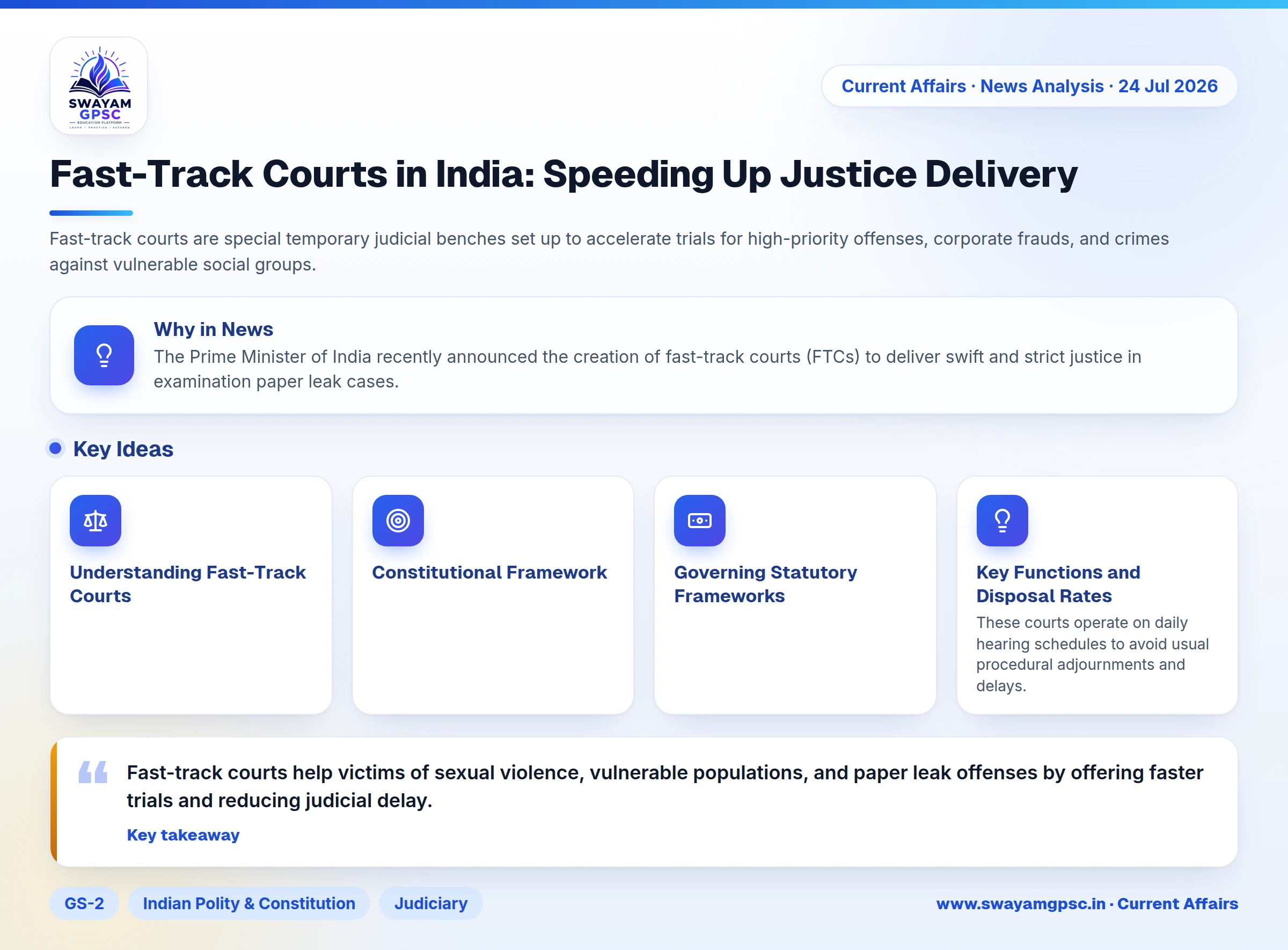
Fast-Track Courts in India: Speeding Up Justice Delivery
#GS-2 #Indian Polity & Constitution #Judiciary #Constitution #Governance & Social Justice #GS-3 #Current Events #National #Fast-Track Courts
Why in News
- The Prime Minister of India recently announced the creation of fast-track courts (FTCs) to deliver swift and strict justice in examination paper leak cases.
Understanding Fast-Track Courts
- Fast-track courts are special temporary judicial benches set up to accelerate trials for high-priority offenses, corporate frauds, and crimes against vulnerable social groups. They aim to clear pending cases and speed up judicial decisions by running daily hearings under firm deadlines.
Constitutional Framework
- Special courts must strictly satisfy Article 14 of the Constitution, which ensures equal treatment before the law.
Governing Statutory Frameworks and Guidelines
- The 14th Finance Commission (2015-2020) recommended establishing 1,800 FTCs to handle severe crimes like murder and kidnapping alongside property disputes pending for over 5 years.
- Under the Nirbhaya Fund Centrally Sponsored Scheme (2019), the government established Fast-Track Special Courts (FTSCs) exclusively for rape cases and offenses under the POCSO Act.
- The Public Examinations (Prevention of Unfair Means) Act, 2024 provides legal support for creating new fast-track courts targeting organized paper leaks and examination fraud.
- The Bharatiya Nagrik Suraksha Sanhita (BNSS) recommends finishing trials within 2 years for general cases and within 2 months for sexual offenses.
Key Functions and Disposal Rates
- Special courts set a target disposal rate of 165 cases per judge every year, which comes to around 41 to 42 cases per quarter.
- Special courts clear an average of 9.5 cases per month, which is nearly three times faster than regular trial courts that average 3.3 cases per month.
- Currently functioning special courts report a strong resolution output, reaching a case disposal rate of about 96%.
- These courts operate on daily hearing schedules to avoid usual procedural adjournments and delays.
Key Implications and Operational Challenges
- Fast-track courts help victims of sexual violence, vulnerable populations, and paper leak offenses by offering faster trials and reducing judicial delay.
- Despite high disposal rates, over 2.4 lakh cases remain pending, proving that lasting reform requires better court infrastructure, more judges, stronger forensic capabilities, and improved investigation techniques.