Extension of Ladakh Autonomous Hill Development Councils to All Seven Districts
#GS-2 #Indian Polity & Constitution #Local Government #Constitution #Federalism #Governance & Social Justice #Good Governance #Indian Society #Tribal Culture #Ladakh #LAHDC
Why in News
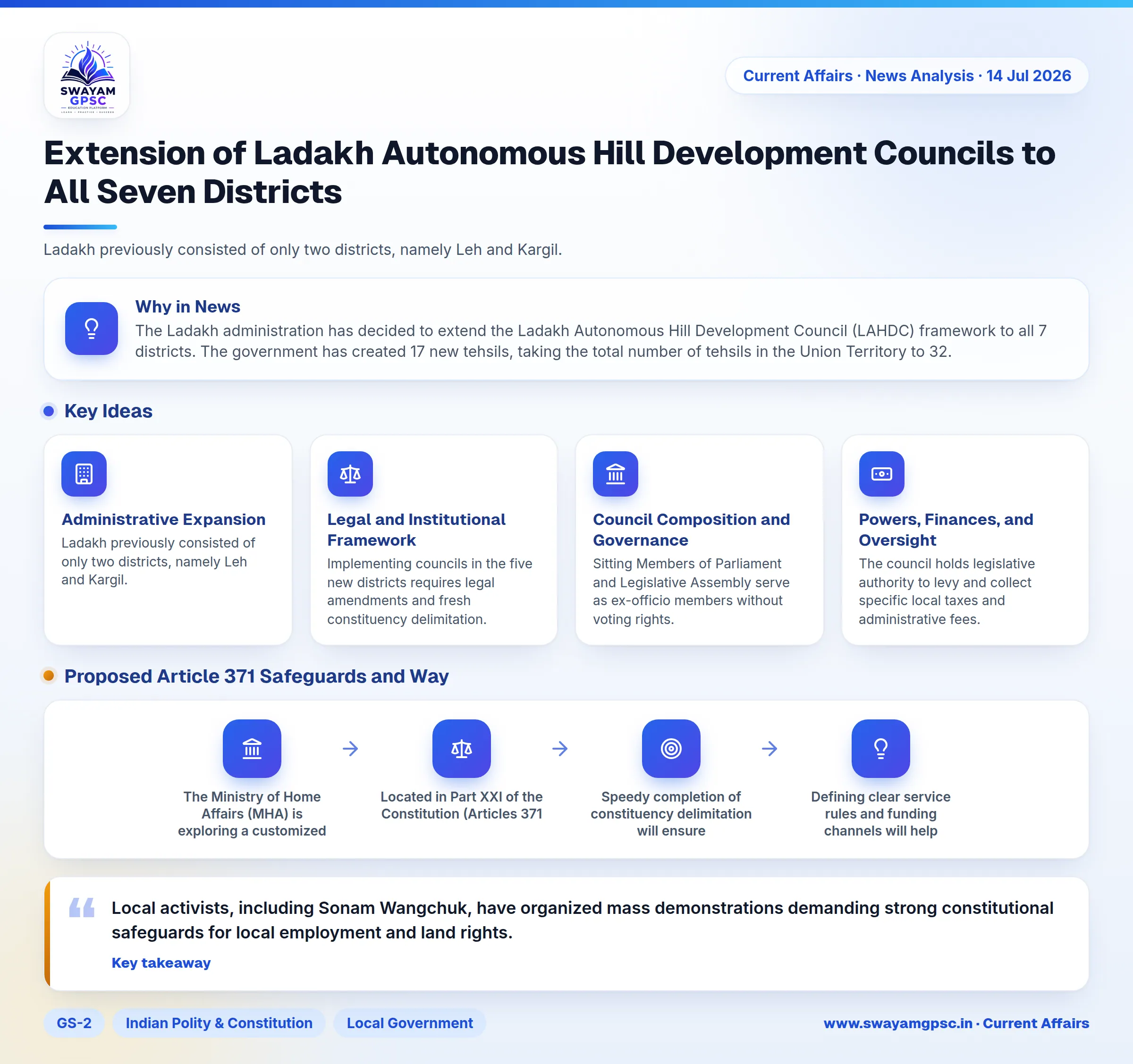
- The Ladakh administration has decided to extend the Ladakh Autonomous Hill Development Council (LAHDC) framework to all 7 districts.
- The government has created 17 new tehsils, taking the total number of tehsils in the Union Territory to 32.
- This reform aims to strengthen democratic decentralization, enhance local governance, and preserve the land, culture, and identity of Ladakh.
Administrative Expansion and Infrastructure Boost
- Ladakh previously consisted of only two districts, namely Leh and Kargil.
- In April 2026, the administration established five new districts: Sham, Nubra, Changthang, Zanskar, and Drass.
- To ensure effective public service delivery in high-altitude zones, the government created four new divisions under the Public Health Engineering (PHE) and Flood Control Department.
- The administration also set up five new divisions under the Public Works Department (PWD) and Pradhan Mantri Gram Sadak Yojana (PMGSY).
Legal and Institutional Framework of LAHDC
- The Ladakh Autonomous Hill Development Councils Act, 1997 provides the statutory basis for establishing autonomous councils and an Inter-District Advisory Council.
- While original legislation in 1995 and 1997 targeted Leh and Kargil, the law permits creating autonomous hill councils in every district.
- Each council functions as a body corporate with perpetual succession, a common seal, and full rights to manage property and enter legal proceedings.
- Implementing councils in the five new districts requires legal amendments and fresh constituency delimitation.
Council Composition and Governance Structure
- Each autonomous council consists of 26 members directly elected from single-member constituencies through adult suffrage.
- The government can nominate up to 4 additional members to ensure representation for women and principal religious minorities.
- Sitting Members of Parliament and Legislative Assembly serve as ex-officio members without voting rights.
- Elected members serve a five-year term, and general council meetings require a minimum quorum of 10 members.
- An Executive Council exercises executive power, headed by a Chairman who serves as the Chief Executive Councillor (CEC).
- The CEC nominates 4 executive members, including at least one representative from a principal religious minority, while the Deputy Commissioner (DC) acts as the Chief Executive Officer (CEO).
Powers, Finances, and Oversight Mechanism
- Councils possess direct authority over land allotment, land use, and management of Khalsa Sarkar (government) land and un-demarcated forests.
- A separate Council Fund managed through public treasuries receives local taxes, central allocation grants, and government loans.
- The council holds legislative authority to levy and collect specific local taxes and administrative fees.
- The Governor retains the power to dissolve a council for incompetence or default after issuing a formal notice.
- Following any dissolution, the administration must officially reconstitute the council within 6 months.
Challenges and Local Demands
- Local activists, including Sonam Wangchuk, have organized mass demonstrations demanding strong constitutional safeguards for local employment and land rights.
- Protesters have consistently demanded inclusion under the Sixth Schedule to guarantee demographic protection.
- Clarifying the precise administrative authority of new councils regarding local recruitment remains a significant operational challenge.
Proposed Article 371 Safeguards and Way Forward
- The Ministry of Home Affairs (MHA) is exploring a customized framework under Article 371 instead of the Sixth Schedule.
- Located in Part XXI of the Constitution (Articles 371 to 371J), these provisions offer special asymmetrical autonomy to protect indigenous land and administrative identity.
- Speedy completion of constituency delimitation will ensure proper democratic representation across all seven districts.
- Defining clear service rules and funding channels will help new councils function effectively at the grassroots level.