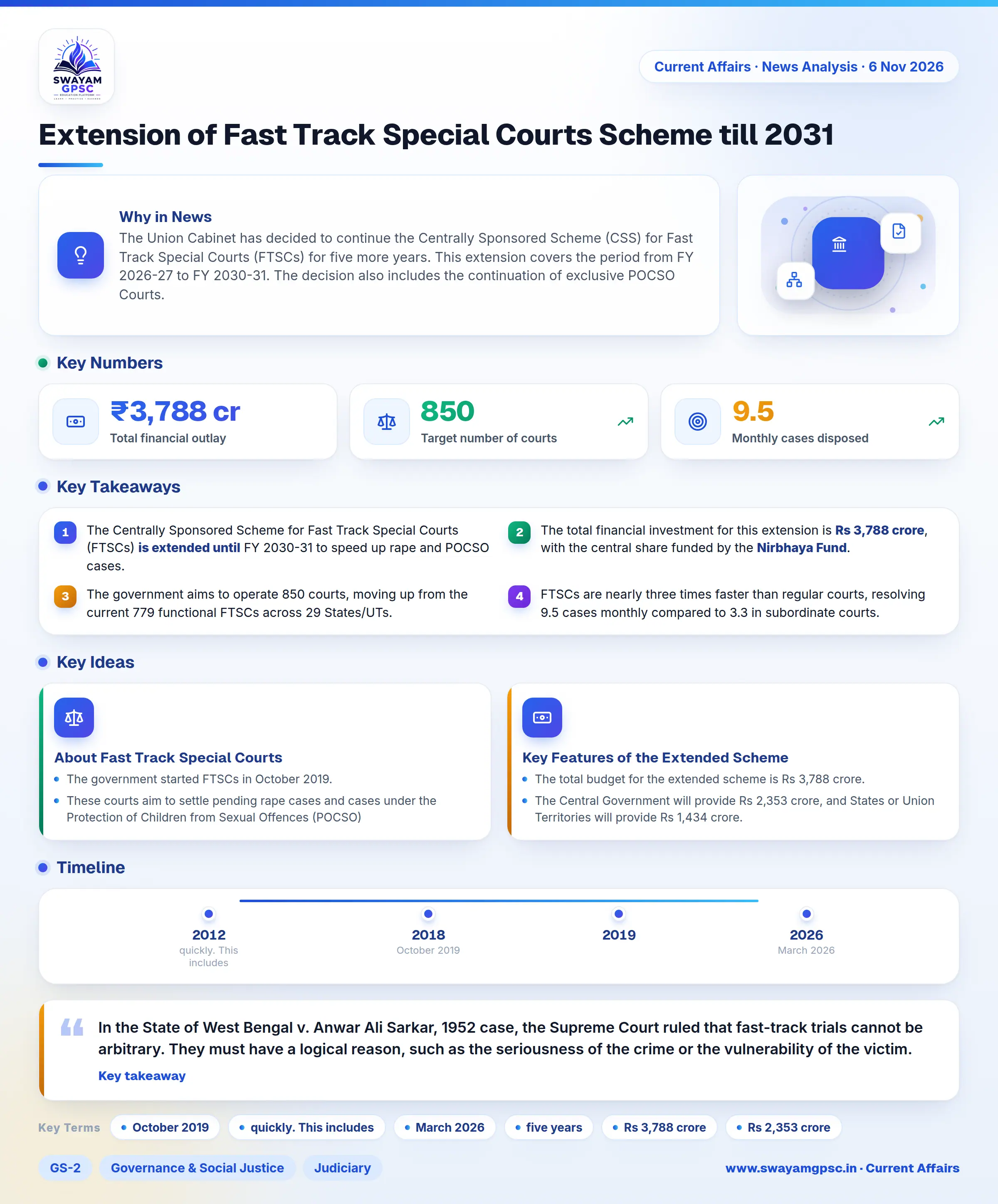
Extension of Fast Track Special Courts Scheme till 2031
#GS-2 #Governance & Social Justice #Judiciary #Current Events #National #Government Policies & Interventions #Dispute Redressal Mechanisms
Key takeaways
- The Centrally Sponsored Scheme for Fast Track Special Courts (FTSCs) is extended until FY 2030-31 to speed up rape and POCSO cases.
- The total financial investment for this extension is Rs 3,788 crore, with the central share funded by the Nirbhaya Fund.
- The government aims to operate 850 courts, moving up from the current 779 functional FTSCs across 29 States/UTs.
- FTSCs are nearly three times faster than regular courts, resolving 9.5 cases monthly compared to 3.3 in subordinate courts.
- The right to a speedy trial is linked to Article 21 of the Constitution as per the Hussainara Khatoon (1979) judgement.
Why in News
- The Union Cabinet has decided to continue the Centrally Sponsored Scheme (CSS) for Fast Track Special Courts (FTSCs) for five more years. This extension covers the period from FY 2026-27 to FY 2030-31. The decision also includes the continuation of exclusive POCSO Courts.
About Fast Track Special Courts (FTSCs)
- The government started FTSCs in October 2019. This happened after the Criminal Law (Amendment) Act, 2018 and directions from the Supreme Court in Suo Motu Writ (Criminal) 2019. The court asked for special courts in districts where more than 100 POCSO cases were pending.
- These courts aim to settle pending rape cases and cases under the Protection of Children from Sexual Offences (POCSO) Act, 2012 quickly. This includes Exclusive POCSO (e-POCSO) Courts that only handle child abuse cases.
- This is the third time the scheme has been extended. Previously, it covered 790 courts until March 2026. Now, it is extended until FY 2030-31.
- The Supreme Court views a speedy trial as a part of Article 21 (Right to Life and Personal Liberty). This was established in the Hussainara Khatoon v. Home Secretary, State of Bihar (1979) case.
- In the State of West Bengal v. Anwar Ali Sarkar, 1952 case, the Supreme Court ruled that fast-track trials cannot be arbitrary. They must have a logical reason, such as the seriousness of the crime or the vulnerability of the victim.
- The 14th Finance Commission (2015-2020) helped expand these courts. It suggested using them for heinous crimes like murder and kidnapping, property disputes older than five years, and cases involving vulnerable people.
- FTSCs are more efficient than regular courts. They resolve about 9.5 cases per month, while regular subordinate courts resolve only 3.3 cases per month.
Key Features of the Extended Scheme
- The total budget for the extended scheme is Rs 3,788 crore.
- The Central Government will provide Rs 2,353 crore, and States or Union Territories will provide Rs 1,434 crore. The entire central share comes from the Nirbhaya Fund.
- The government aims to operate up to 850 fast-track courts nationwide.
- Currently, 29 States and UTs are part of the scheme. They operate 779 FTSCs, and 399 of these are exclusive POCSO courts.
- Each FTSC gets a dedicated Special Public Prosecutor and six support staff members to make the legal process faster.
- The scheme promotes child-friendly courts and Vulnerable Witness Deposition Centres (VWDCs). These help protect the privacy of survivors and reduce their mental stress during testimony.
- The Department of Justice tracks the performance of these courts. They use the FTSC Dashboard, progress reports, and spending statements while working with High Courts and State Governments.