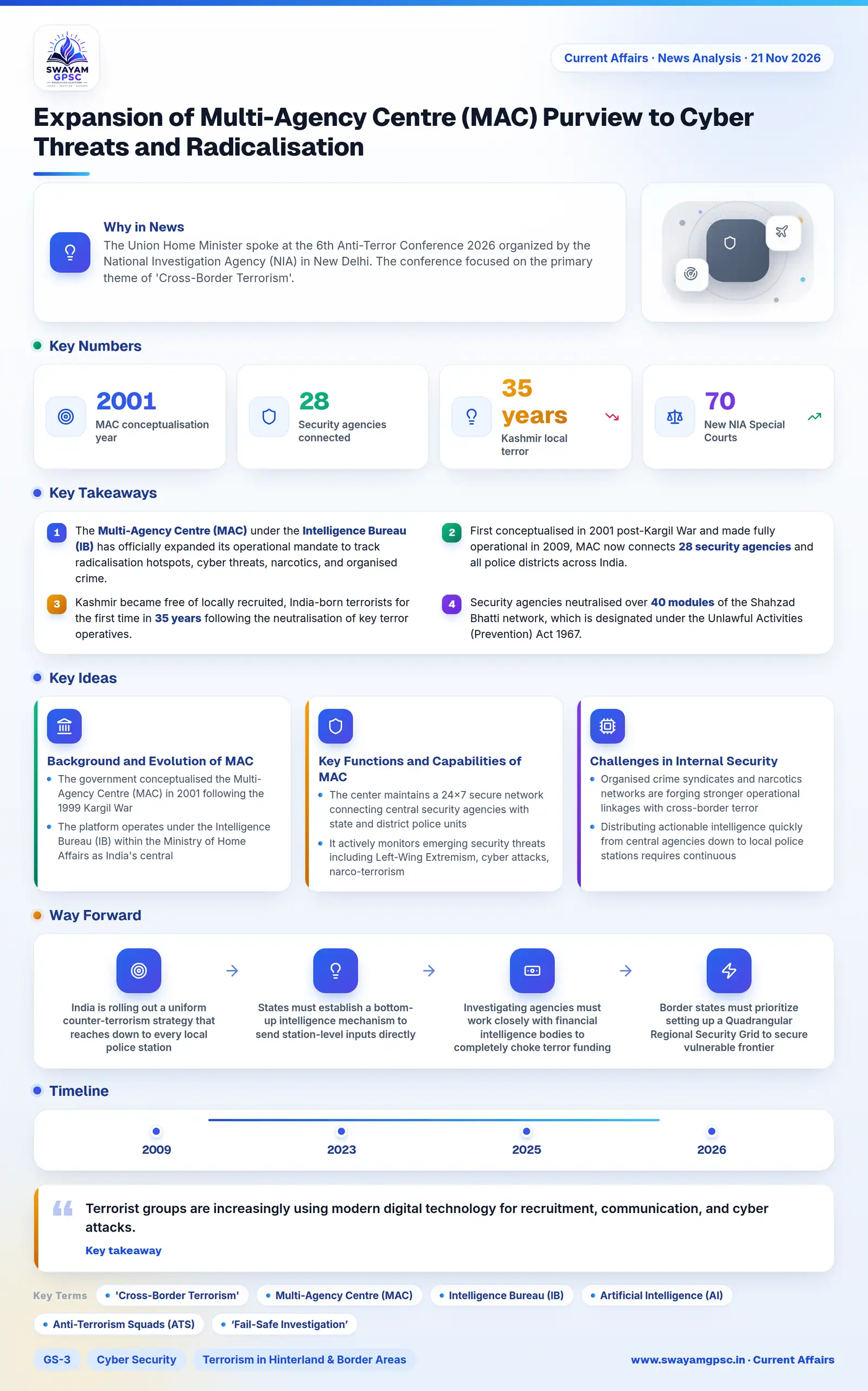
Expansion of Multi-Agency Centre (MAC) Purview to Cyber Threats and Radicalisation
#GS-3 #Security Challenges & their Management in Border Areas #Linkages of Organized Crime with Terrorism #Cyber Security #Terrorism in Hinterland & Border Areas #Internal Security #National Investigation Agency #Intelligence Bureau
Key takeaways
- The Multi-Agency Centre (MAC) under the Intelligence Bureau (IB) has officially expanded its operational mandate to track radicalisation hotspots, cyber threats, narcotics, and organised crime.
- First conceptualised in 2001 post-Kargil War and made fully operational in 2009, MAC now connects 28 security agencies and all police districts across India.
- Kashmir became free of locally recruited, India-born terrorists for the first time in 35 years following the neutralisation of key terror operatives.
- Security agencies neutralised over 40 modules of the Shahzad Bhatti network, which is designated under the Unlawful Activities (Prevention) Act 1967.
- The government is establishing 70 new NIA Special Courts and creating a Quadrangular Regional Security Grid in border states to strengthen security enforcement.
Why in News
- The Union Home Minister spoke at the 6th Anti-Terror Conference 2026 organized by the National Investigation Agency (NIA) in New Delhi.
- The conference focused on the primary theme of 'Cross-Border Terrorism'.
- The Home Minister announced that the Multi-Agency Centre (MAC) has expanded its operational scope to track radicalisation hotspots, cyber threats, narcotics, and organised crime networks.
Background and Evolution of MAC
- The government conceptualised the Multi-Agency Centre (MAC) in 2001 following the 1999 Kargil War and the recommendations of the Kargil Review Committee.
- The platform operates under the Intelligence Bureau (IB) within the Ministry of Home Affairs as India's central intelligence-sharing hub.
- The government strengthened the MAC into a 24x7 operational counter-terrorism network in 2009 after the 2008 Mumbai terror attacks.
- The system links 28 security and intelligence agencies, including RAW, NIA, CAPFs, and State Police via Subsidiary Multi-Agency Centres (SMACs).
- The government restructured the MAC in 2023 using advanced technology to build a National Memory Bank and a centralised intelligence database.
- The network underwent a major expansion in 2025 to connect every police district across India through a secure grid.
Key Functions and Capabilities of MAC
- The center maintains a 24x7 secure network connecting central security agencies with state and district police units for real-time information exchange.
- It actively monitors emerging security threats including Left-Wing Extremism, cyber attacks, narco-terrorism, and online radicalisation.
- The platform utilizes Artificial Intelligence (AI), Machine Learning (ML), and GIS tools to analyze threat patterns and predict security risks.
- It facilitates two-way intelligence sharing between grassroots police stations and central intelligence databases.
- The system integrates security databases to track terror financing channels and prevent potential attacks before they happen.
Challenges in Internal Security Management
- Terrorist groups are increasingly using modern digital technology for recruitment, communication, and cyber attacks.
- Organised crime syndicates and narcotics networks are forging stronger operational linkages with cross-border terror organisations.
- Distributing actionable intelligence quickly from central agencies down to local police stations requires continuous technical upgrades.
- Securing long land borders against illegal structures and cross-border terror financing remains a major challenge.
Institutional Upgrades and State Capabilities
- The Home Minister urged state Anti-Terrorism Squads (ATS) to build specialized cyber-expert units to tackle digital threats.
- The NIA released a specialized publication titled ‘Fail-Safe Investigation’ to standardize high-quality investigative practices.
- The agency launched the digital ‘Pushti’ portal to streamline counter-terrorism operations and case tracking.
- The foundation stone was laid for the new NIA Chandigarh office complex to expand its regional footprint.
- The government approved 70 new NIA Special Courts and provided international training exposure for investigating officers.
Major Counter-Terrorism Milestones
- Following the elimination of Lashkar-e-Taiba terrorist Latif Bhat, Kashmir achieved a milestone of having no locally recruited terrorists for the first time in 35 years.
- Security forces neutralised over 40 modules of the Shahzad Bhatti network across the country.
- The government officially designated the Shahzad Bhatti network as a terrorist organisation under the Unlawful Activities (Prevention) Act 1967.
Way Forward
- India is rolling out a uniform counter-terrorism strategy that reaches down to every local police station across the nation.
- States must establish a bottom-up intelligence mechanism to send station-level inputs directly to the Director-General of Police (DGP).
- Investigating agencies must work closely with financial intelligence bodies to completely choke terror funding channels.
- Border states must prioritize setting up a Quadrangular Regional Security Grid to secure vulnerable frontier areas.
- Authorities must strictly identify and remove illegal religious structures along international borders to prevent security breaches.