Expanding the Pradhan Mantri Bhartiya Janaushadhi Pariyojana Scheme
#GS-2 #Governance & Social Justice #Health #GS-3 #Economy #Infrastructure #PMBJP #Generic Medicines #Public Health Expenditure
Key takeaways
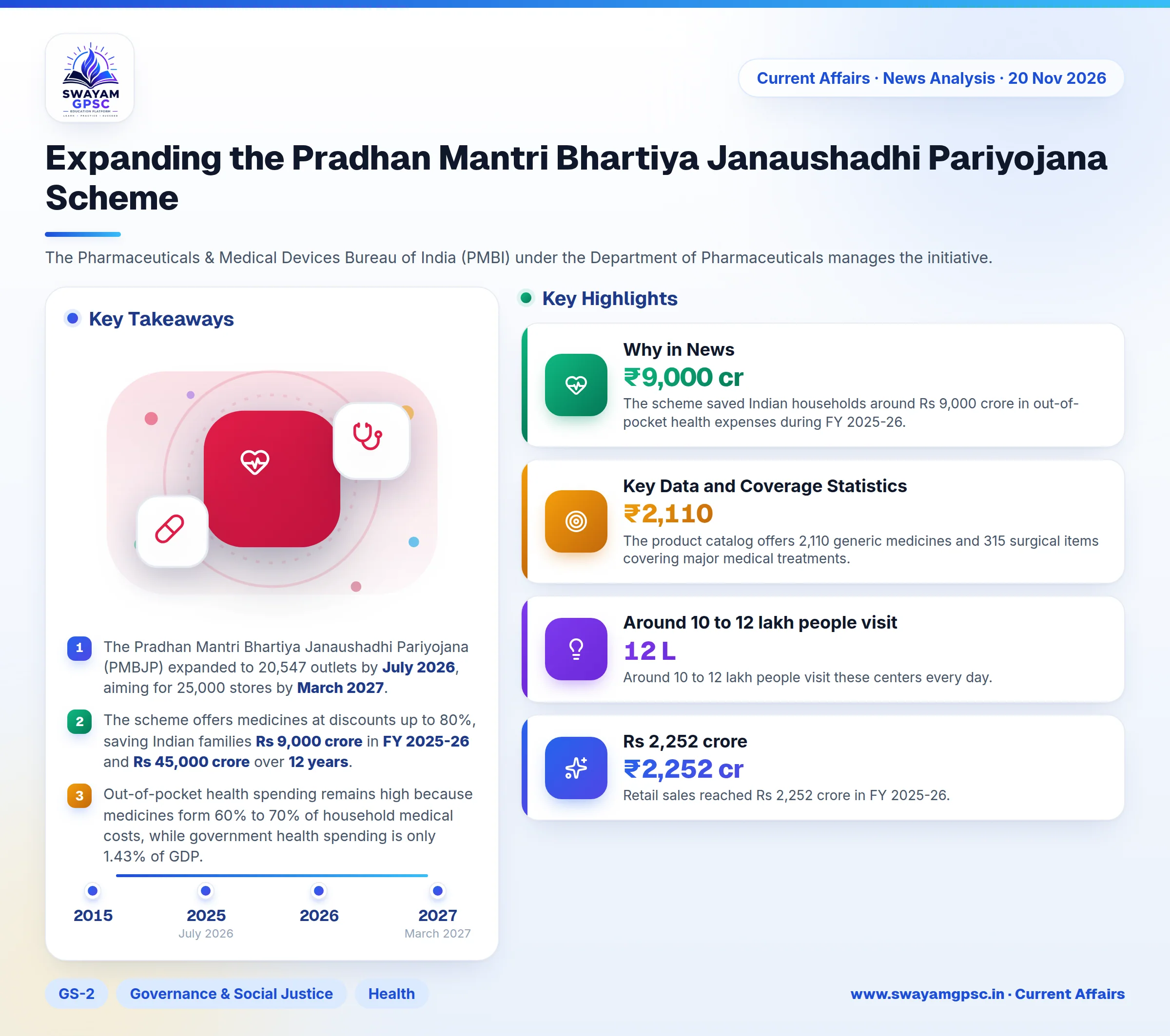
- The Pradhan Mantri Bhartiya Janaushadhi Pariyojana (PMBJP) expanded to 20,547 outlets by July 2026, aiming for 25,000 stores by March 2027.
- The scheme offers medicines at discounts up to 80%, saving Indian families Rs 9,000 crore in FY 2025-26 and Rs 45,000 crore over 12 years.
- Out-of-pocket health spending remains high because medicines form 60% to 70% of household medical costs, while government health spending is only 1.43% of GDP.
- Jan Aushadhi outlets match just 1.7% of India's 12 lakh private pharmacies, facing challenges like doctor resistance and low public awareness.
- To improve adoption, the government must publish lab testing results and upgrade the Jan Aushadhi Sugam app with live stock tracking.
Why in News
- The Pradhan Mantri Bhartiya Janaushadhi Pariyojana (PMBJP) has grown to 20,547 retail outlets across the country.
- The scheme saved Indian households around Rs 9,000 crore in out-of-pocket health expenses during FY 2025-26.
- Despite this progress, limited retail presence and high out-of-pocket medical costs show that the network needs further expansion.
About the Jan Aushadhi Scheme
- The government started this key healthcare program in 2008 and restructured it in 2015.
- The Pharmaceuticals & Medical Devices Bureau of India (PMBI) under the Department of Pharmaceuticals manages the initiative.
- The main objective is to sell high-quality generic medicines and surgical products at low prices through Jan Aushadhi Kendras.
Key Data and Coverage Statistics
- The product catalog offers 2,110 generic medicines and 315 surgical items covering major medical treatments.
- The network expanded to 20,547 outlets by July 2026, up from 17,990 in December 2025.
- The program is moving toward a target of setting up 25,000 outlets by March 2027.
- Around 10 to 12 lakh people visit these centers every day.
- Retail sales reached Rs 2,252 crore in FY 2025-26.
- Medicines sell at an average discount of 80% compared to branded options.
- This discount saved citizens roughly Rs 9,000 crore in FY 2025-26 and Rs 45,000 crore over the past 12 years.
- The scheme buys products only from WHO-GMP certified manufacturers and subjects every batch to mandatory testing.
- The substandard drug rate for these stores stands at 0.34%, compared to 3.70% in ordinary retail pharmacies.
Need for Expanding Jan Aushadhi
- Medicines make up 60% to 70% of total household out-of-pocket healthcare costs in India.
- Insurance schemes like PM-JAY cover hospital stays but mostly exclude daily outpatient drug expenses.
- Government health spending remains low at 1.43% of GDP for 2023-24, well below the 2.5% policy goal.
- The 20,547 existing centers equal only 1.7% of India's 12 lakh private pharmacies, leaving large gaps in rural areas.
- Attracting customers from all income levels will increase daily sales, speed up inventory movement, and make the outlets financially stable.
Challenges
- Many doctors doubt generic drug quality and resist writing generic prescriptions, leading the National Medical Commission (NMC) to pause its generic prescription order.
- A study in Port Blair revealed that only 6% of outpatients asked their doctors for generic alternatives.
- Public campaigns remain limited, creating a false belief that these stores serve only low-income families.
- A survey in Port Blair found that only one-third of outpatients knew about the scheme, while over half did not know which medicines were sold.
- Frequent stockouts of critical medicines for long-term illnesses force patients to go back to expensive private pharmacies.
- When patients cannot find their full prescription at a center, they lose trust in generic outlets altogether.
- The program reports a low 0.34% failure rate, but it does not publish detailed lab testing methods or reports, leaving doctors and patients skeptical.
Way Forward
- Independent research groups should conduct nationwide surveys to measure public awareness, doctor habits, and medicine stock levels.
- The bureau should publish Indian Pharmacopoeia Commission (IPC) batch reports and lab details to prove medicine quality.
- The Jan Aushadhi Sugam mobile app needs real-time stock updates and auto-refill features to prevent medicine shortages.
- Publicity campaigns should market these outlets as smart-value pharmacies for all income groups, backed by strong public funding.
Conclusion
- The Pradhan Mantri Bhartiya Janaushadhi Pariyojana uses India's strong drug manufacturing capacity to reduce medicine costs by up to 80%.
- To provide nationwide relief, the government must address doctor skepticism, fix supply shortages, and build store visibility.
- Publishing quality test reports and adding live digital inventory tracking will help lower out-of-pocket health costs across India.