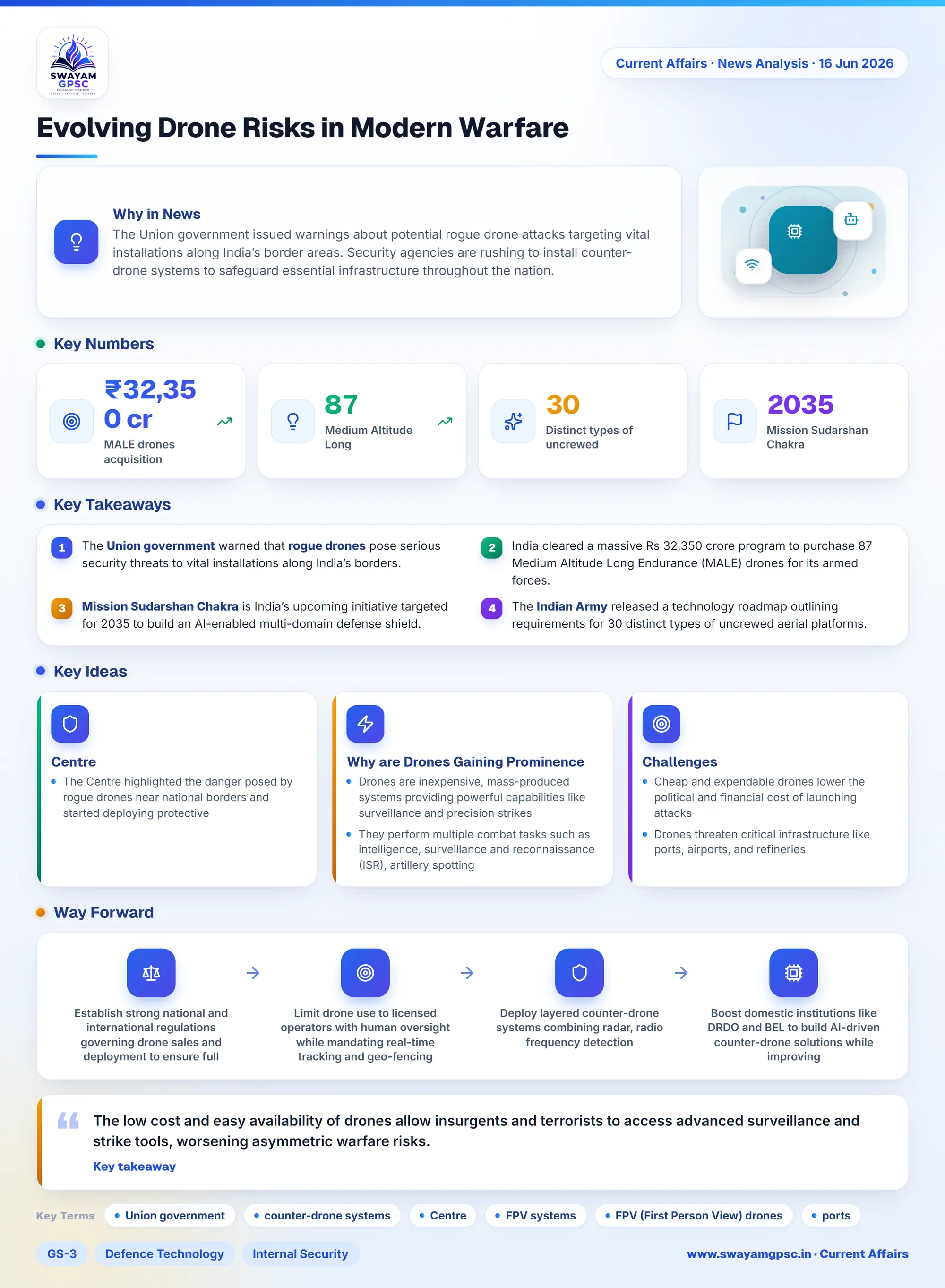
Evolving Drone Risks in Modern Warfare
#GS-3 #Defence Technology #Internal Security #Infrastructure #Science & Technology #Economy
Key takeaways
- The Union government warned that rogue drones pose serious security threats to vital installations along India’s borders.
- India cleared a massive Rs 32,350 crore program to purchase 87 Medium Altitude Long Endurance (MALE) drones for its armed forces.
- Mission Sudarshan Chakra is India’s upcoming initiative targeted for 2035 to build an AI-enabled multi-domain defense shield.
- The Indian Army released a technology roadmap outlining requirements for 30 distinct types of uncrewed aerial platforms.
Why in News
- The Union government issued warnings about potential rogue drone attacks targeting vital installations along India’s border areas.
- Security agencies are rushing to install counter-drone systems to safeguard essential infrastructure throughout the nation.
- This urgent action follows global conflicts in Ukraine and West Asia, where inexpensive commercial drones have transformed modern military tactics.
Summary
- The Centre highlighted the danger posed by rogue drones near national borders and started deploying protective anti-drone systems through joint efforts of the BSF, CISF, DRDO, Intelligence Bureau, and Airports Authority of India.
- This development matches a worldwide change in combat where affordable drones, FPV systems, loitering munitions, and electronic warfare tools drive military operations in active combat zones.
Why are Drones Gaining Prominence in Modern Warfare
- Drones are inexpensive, mass-produced systems providing powerful capabilities like surveillance and precision strikes at a fraction of the cost of traditional weapons.
- They perform multiple combat tasks such as intelligence, surveillance and reconnaissance (ISR), artillery spotting, electronic warfare, logistics support, and deep-strike missions.
- Modern drones are easily modified and deployed in large numbers, letting both militaries and non-state actors adjust quickly to changing battlefield needs.
- FPV (First Person View) drones and loitering munitions turn commercial devices into accurate kamikaze weapons capable of destroying high-value targets.
- The creation of fibre-optic and electronic warfare-resistant drones reduces vulnerability to jamming, ensuring success even in heavily contested airspace.
- Continuous battlefield surveillance makes rear areas and logistics hubs constantly vulnerable to sudden attacks.
Challenges
- The low cost and easy availability of drones allow insurgents and terrorists to access advanced surveillance and strike tools, worsening asymmetric warfare risks.
- Cheap and expendable drones lower the political and financial cost of launching attacks, which increases the chances of conflict escalation between states.
- Drones threaten critical infrastructure like ports, airports, and refineries, while also facilitating cross-border smuggling of weapons and drugs.
- Small, low-altitude drones easily bypass traditional radars, and swarm attacks can overwhelm standard air defence systems.
- Drone operations face cyber interference and civilian collateral risks, while fast technological shifts create serious gaps in global legal frameworks.
Key Developments in India’s Counter-Drone Preparedness
- The Indian Army released a detailed Technology Roadmap for Unmanned Aerial Systems (UAS) and Loitering Munitions, listing requirements for 30 distinct types of uncrewed platforms.
- This strategy plans to field thousands of short, medium, and long-range uncrewed systems across every military corps.
- The government approved a large program worth Rs 32,350 crore to acquire 87 Medium Altitude Long Endurance (MALE) drones for the Army, Navy, and Air Force.
- While filling immediate needs with foreign systems like the MQ-9B Predator / SkyGuardian, India is developing indigenous alternatives like the TAPAS-BH-201 and Rustom series.
- Through iDEX and the ADITI scheme, the government gives direct financial grants to private startups to solve complex military engineering problems.
- Mission Sudarshan Chakra, planned for completion by 2035, is India’s proposed AI-enabled multi-domain defense shield combining hard-kill weapons and soft-kill electronic jammers.
Way Forward
- Establish strong national and international regulations governing drone sales and deployment to ensure full adherence to humanitarian law.
- Limit drone use to licensed operators with human oversight while mandating real-time tracking and geo-fencing systems to stop misuse.
- Deploy layered counter-drone systems combining radar, radio frequency detection, and electronic jammers around vital installations and borders.
- Boost domestic institutions like DRDO and BEL to build AI-driven counter-drone solutions while improving coordination among ministries.
- Improve security personnel training in drone countermeasures and enforce strict monitoring of civilian drone registries.