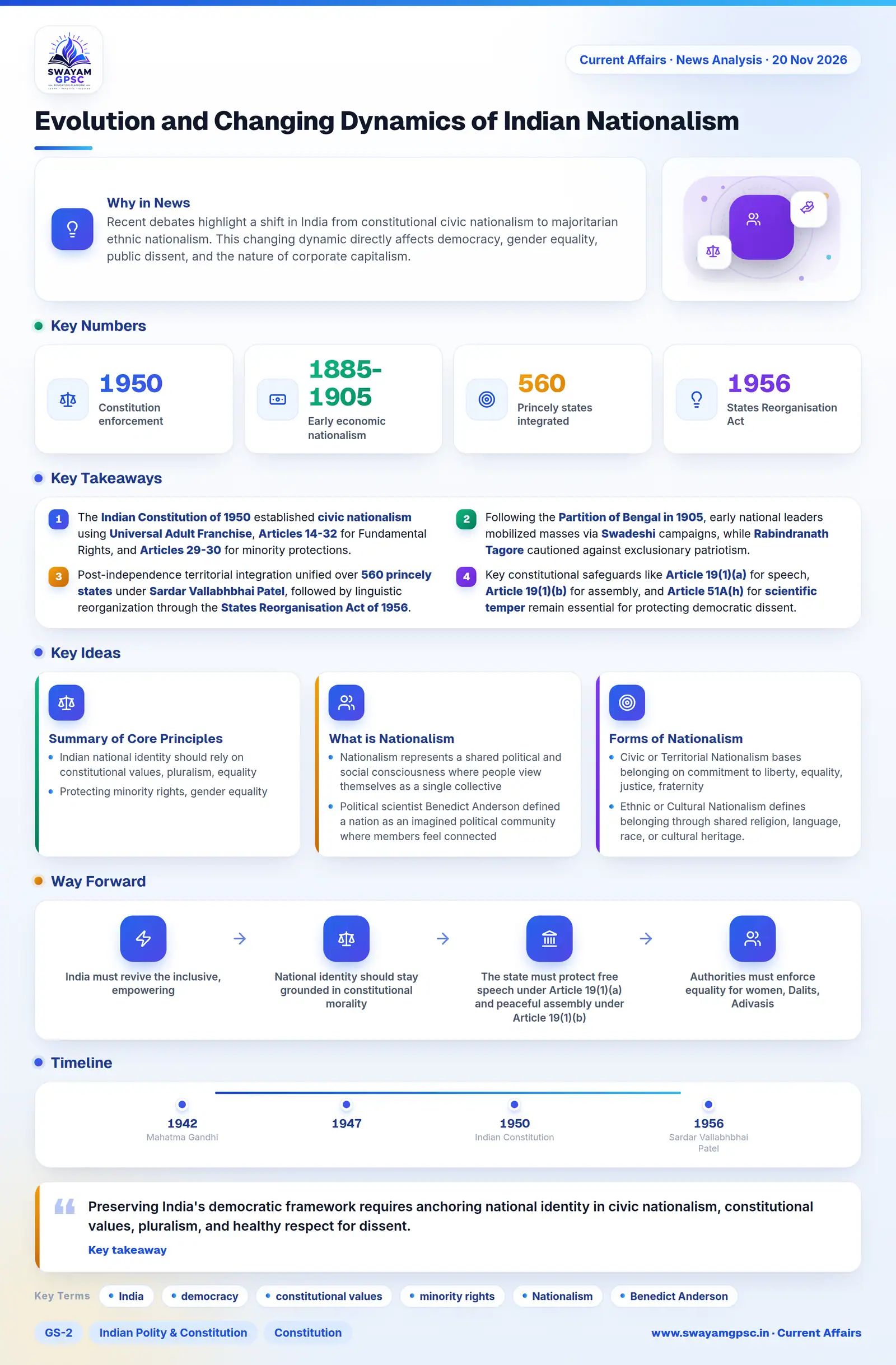
Evolution and Changing Dynamics of Indian Nationalism
#GS-2 #Indian Polity & Constitution #Constitution #Governance & Social Justice #Social Audit #Vulnerable Sections #GS-1 #Indian Society #Diversity #Women #Social Justice #Current Events #National
Key takeaways
- The Indian Constitution of 1950 established civic nationalism using Universal Adult Franchise, Articles 14-32 for Fundamental Rights, and Articles 29-30 for minority protections.
- Following the Partition of Bengal in 1905, early national leaders mobilized masses via Swadeshi campaigns, while Rabindranath Tagore cautioned against exclusionary patriotism.
- Post-independence territorial integration unified over 560 princely states under Sardar Vallabhbhai Patel, followed by linguistic reorganization through the States Reorganisation Act of 1956.
- Key constitutional safeguards like Article 19(1)(a) for speech, Article 19(1)(b) for assembly, and Article 51A(h) for scientific temper remain essential for protecting democratic dissent.
Why in News
- Recent debates highlight a shift in India from constitutional civic nationalism to majoritarian ethnic nationalism.
- This changing dynamic directly affects democracy, gender equality, public dissent, and the nature of corporate capitalism.
Summary of Core Principles
- Indian national identity should rely on constitutional values, pluralism, equality, and fraternity rather than cultural uniformity.
- Protecting minority rights, gender equality, and dissent is crucial while pursuing inclusive and environmentally sustainable development.
What is Nationalism
- Nationalism represents a shared political and social consciousness where people view themselves as a single collective bound by solidarity.
- Political scientist Benedict Anderson defined a nation as an imagined political community where members feel connected despite never meeting.
- National identity rests on four main elements: shared beliefs, historical memories, common territory, and political ideals.
- A single religion, language, race, or ethnicity is not mandatory for forming a cohesive nation.
- Contemporary scholars note that multiple visions of a nation coexist, with majoritarian models often competing against constitutional-pluralist ideals.
Forms of Nationalism
- Civic or Territorial Nationalism bases belonging on commitment to liberty, equality, justice, fraternity, and the Constitution.
- Ethnic or Cultural Nationalism defines belonging through shared religion, language, race, or cultural heritage.
- Civic nationalism remains inclusive and pluralistic, accommodating diverse faiths, languages, and food habits while protecting marginalised groups.
- Ethnic nationalism acts as an exclusionary and homogenising force, privileging a dominant identity and creating risks for minorities.
- Civic models anchor themselves in Fundamental Rights, institutional checks, scientific temper, and peaceful dissent.
- Ethnic models risk equating political loyalty with patriotism, which can slide toward authoritarianism when pushed to extremes.
- The Indian Constitution of 1950 and Jawaharlal Nehru in The Discovery of India reflected civic nationalism.
- Cultural-nationalist frameworks like V.D. Savarkar's concept of Hindutva embody ethnic nationalism.
Evolution During the Freedom Struggle
- Early leaders like Dadabhai Naoroji, Romesh Chandra Dutt, and G.K. Gokhale created an economic critique of British rule to unite citizens around shared grievances between 1885 and 1905.
- Following the Partition of Bengal in 1905, leaders like Bal Gangadhar Tilak, Bipin Chandra Pal, and Lala Lajpat Rai expanded mass mobilization through Swadeshi and Boycott campaigns.
- Rabindranath Tagore cautioned against narrow patriotism, stating that humanity was his ultimate spiritual refuge rather than strict national boundaries.
- Tagore criticized modern nation-states as profit-driven systems, advocating samaj (community), social cooperation, and moral autonomy over rejection of foreign cultures.
- Between 1919 and 1947, Mahatma Gandhi led the Non-Cooperation Movement (1920), Civil Disobedience (1930), and Quit India (1942) to build an inclusive anti-imperialist movement championing Hindu-Muslim unity.
- Leaders like Dr. B.R. Ambedkar, Periyar, Bhagat Singh, and Subhas Chandra Bose emphasized that political freedom required ending caste, class, and gender hierarchies.
- In The Discovery of India, Jawaharlal Nehru highlighted a deep underlying unity holding the nation together across centuries despite its diverse outward forms.
Post-Independence Evolution
- Adopted in 1950, the Indian Constitution drafted under Dr. B.R. Ambedkar anchored nationalism in civic rights through Universal Adult Franchise, Articles 14-32, and minority protections under Articles 29-30.
- Sardar Vallabhbhai Patel unified over 560 princely states, while the States Reorganisation Act of 1956 accommodated linguistic identities to strengthen unity.
- Post-1947 nation-building under Jawaharlal Nehru prioritized modern institutions, public-sector projects, and scientific temper, which became a Fundamental Duty under Article 51A(h) in 1976.
- India accommodated regional aspirations using asymmetric federalism under the Fifth Schedule, Sixth Schedule, Article 371, and accords like the Mizoram Accord of 1986.
- Democratic accommodation through regional autonomy offers an alternative to demands for separate statehood, avoiding minority exclusion.
Key Dimensions of the Changing Dynamic
- Critics highlight a systematic transition from civic nationalism to ethnic majoritarianism, visible in vigilante violence related to food choices and traditional occupations.
- Modern nationalism often assumes an aggressive, masculinized tone that restricts women's autonomy and criticizes public protests led by women.
- Large infrastructure projects like the Chenab Rail Bridge, Statue of Unity, and Kashi Vishwanath Corridor are promoted as central symbols of national pride.
- Critics caution that focus on mega-spectacles can distract from core issues like community displacement, uncleaned water access, and poor labor conditions.
- The Janmabhoomi-Karmabhoomi approach describes how diaspora groups maintain cultural ties to their origin while remaining loyal to host nations.
- Analysts point to a link between majoritarian ideologies and corporate capitalism, where cultural distractions reduce focus on economic inequality.
Way Forward
- India must revive the inclusive, empowering, and anti-imperialist civic nationalism established during the freedom movement.
- National identity should stay grounded in constitutional morality, defining citizenship through shared values of justice, liberty, equality, and fraternity.
- The state must protect free speech under Article 19(1)(a) and peaceful assembly under Article 19(1)(b), separating legitimate government critique from disloyalty.
- Authorities must enforce equality for women, Dalits, Adivasis, and minorities while taking strict legal action against vigilante violence.
- Infrastructure development needs Environmental Impact Assessments, fair compensation, public consultations, and funding for social sectors like health and education.
- Educational systems should foster scientific temper under Article 51A(h) and critical thinking to combat misinformation and division.
- Democratic nationalism should accommodate multiple overlapping identities of religion, language, gender, and region within a single equal citizenship framework.
Conclusion
- Preserving India's democratic framework requires anchoring national identity in civic nationalism, constitutional values, pluralism, and healthy respect for dissent.