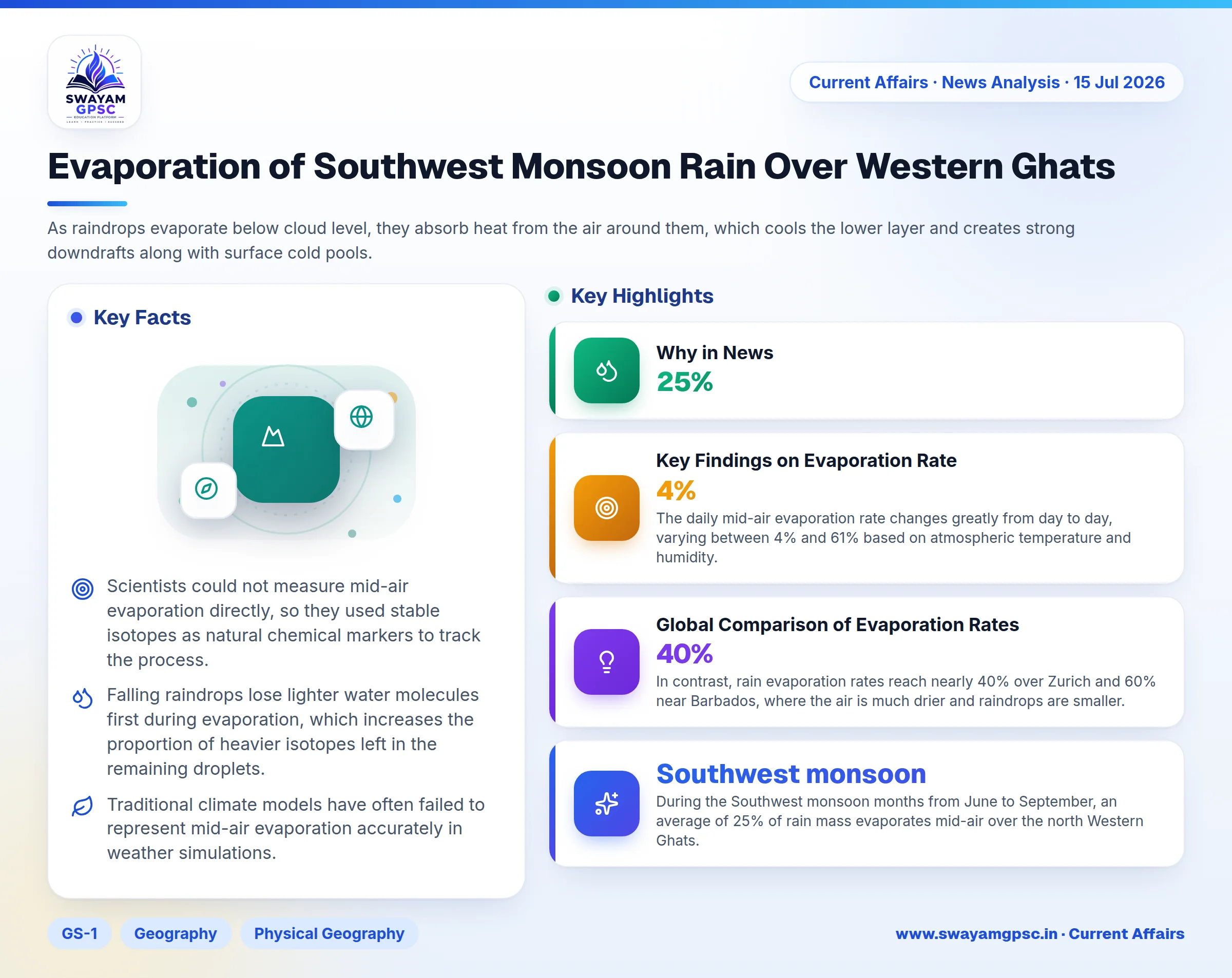
Evaporation of Southwest Monsoon Rain Over Western Ghats
#GS-1 #Geography #Physical Geography #GS-3 #Environment #Climate Change #Science & Technology #Current Events #National #Monsoon #IITM Pune
Why in News
- A new study by the Indian Institute of Tropical Meteorology (IITM), Pune shows that almost 25% of India's Southwest monsoon rain over the Western Ghats evaporates in mid-air before reaching the ground.
Key Findings on Evaporation Rate
- During the Southwest monsoon months from June to September, an average of 25% of rain mass evaporates mid-air over the north Western Ghats.
- The daily mid-air evaporation rate changes greatly from day to day, varying between 4% and 61% based on atmospheric temperature and humidity.
Mechanism and Weather Impact
- As raindrops evaporate below cloud level, they absorb heat from the air around them, which cools the lower layer and creates strong downdrafts along with surface cold pools.
- These cold pools alter local atmospheric convection and shape future rainfall patterns, making this evaporation process crucial for predicting storms and rain accurately.
Global Comparison of Evaporation Rates
- India's 25% evaporation rate is relatively low compared to global figures because intense monsoon rains have larger drops and the surrounding air is very humid.
- In contrast, rain evaporation rates reach nearly 40% over Zurich and 60% near Barbados, where the air is much drier and raindrops are smaller.
Isotopic Tracing Methodology
- Scientists could not measure mid-air evaporation directly, so they used stable isotopes as natural chemical markers to track the process.
- Falling raindrops lose lighter water molecules first during evaporation, which increases the proportion of heavier isotopes left in the remaining droplets.
- The IITM, Pune runs a nine-site rainwater-isotope network extending from the Himalayas to the Northeast and down to Port Blair in the Andaman and Nicobar Islands to trace how monsoon rains form and move.
Significance for Climate Modelling
- Traditional climate models have often failed to represent mid-air evaporation accurately in weather simulations.
- By using the one-dimensional Below Cloud Interaction Model, researchers can now refine hydrological models and significantly improve forecasts for rainfall and extreme weather events.