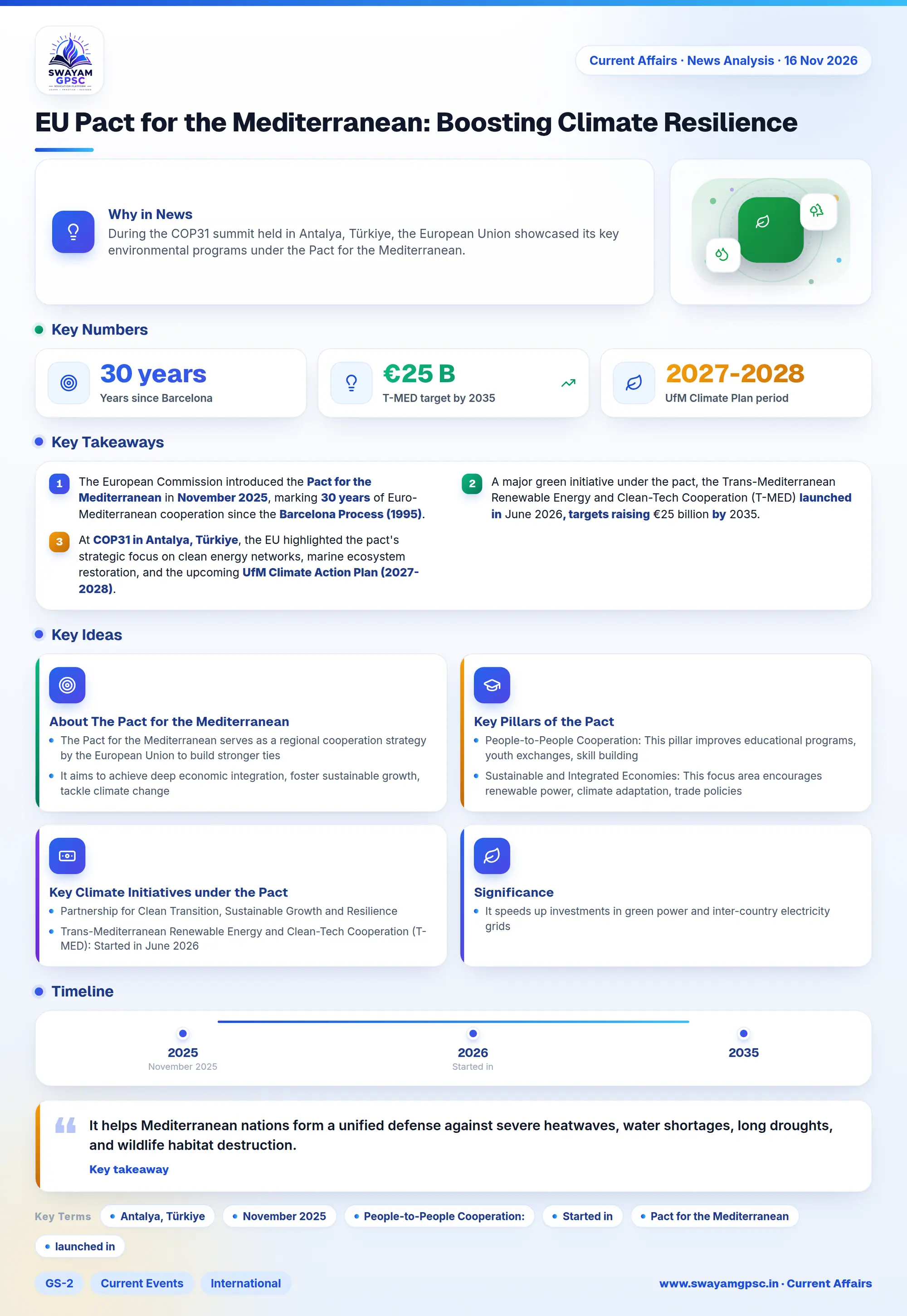
EU Pact for the Mediterranean: Boosting Climate Resilience
#GS-2 #Current Events #International #GS-3 #Environment #Climate Change #Sustainable Development #Energy
Key takeaways
- The European Commission introduced the Pact for the Mediterranean in November 2025, marking 30 years of Euro-Mediterranean cooperation since the Barcelona Process (1995).
- A major green initiative under the pact, the Trans-Mediterranean Renewable Energy and Clean-Tech Cooperation (T-MED) launched in June 2026, targets raising €25 billion by 2035.
- At COP31 in Antalya, Türkiye, the EU highlighted the pact's strategic focus on clean energy networks, marine ecosystem restoration, and the upcoming UfM Climate Action Plan (2027-2028).
Why in News
- During the COP31 summit held in Antalya, Türkiye, the European Union showcased its key environmental programs under the Pact for the Mediterranean.
- The presentation focused primarily on accelerating clean energy adoption, building climate resilience, encouraging eco-friendly investments, and protecting marine ecosystems.
About The Pact for the Mediterranean
- The Pact for the Mediterranean serves as a regional cooperation strategy by the European Union to build stronger ties with Southern Mediterranean countries.
- It aims to achieve deep economic integration, foster sustainable growth, tackle climate change, and improve direct connections between citizens.
- The European Commission officially introduced this plan in November 2025, marking 30 years since the original Barcelona Process (1995) created Euro-Mediterranean relations.
- The core goal is to transform the Mediterranean zone into a stable, wealthy, and adaptive region by sharing clean energy technology and expanding trade relationships.
Key Pillars of the Pact for the Mediterranean
- People-to-People Cooperation: This pillar improves educational programs, youth exchanges, skill building, scientific research, and cultural ties to give everyone equal social opportunities.
- Sustainable and Integrated Economies: This focus area encourages renewable power, climate adaptation, trade policies, investment flows, and the blue economy to boost local growth.
- Security, Preparedness and Migration Management: This pillar expands collaborative efforts to maintain regional peace, handle natural disasters quickly, manage migration flows, and tackle safety risks.
Key Climate Initiatives under the Pact
- Partnership for Clean Transition, Sustainable Growth and Resilience: This program supports regional projects aimed at climate adaptation, saving water resources, promoting circular economy systems, and preserving natural habitats.
- Trans-Mediterranean Renewable Energy and Clean-Tech Cooperation (T-MED): Started in June 2026, this project intends to raise up to €25 billion by 2035 to build cross-border green power networks and clean technologies.
- Blue Mediterranean Health and Wealth Initiative: This scheme aids sustainable fishing practices, protects coastal jobs, and restores ocean ecosystems through programs like the Blue Mediterranean Partnership, BlueInvest, and the Blue Mediterranean Mission.
- UfM Climate Action Plan (2027-2028): This framework helps member nations turn their global climate promises into concrete, funded projects while deepening regional teamwork.
- Youth and Civil Society Participation: This measure involves young citizens, local businesses, and community organizations directly in creating environmental policy through workshops and consultation groups.
Significance
- It helps Mediterranean nations form a unified defense against severe heatwaves, water shortages, long droughts, and wildlife habitat destruction.
- It speeds up investments in green power and inter-country electricity grids, which lowers reliance on fossil fuels and secures regional energy supplies.