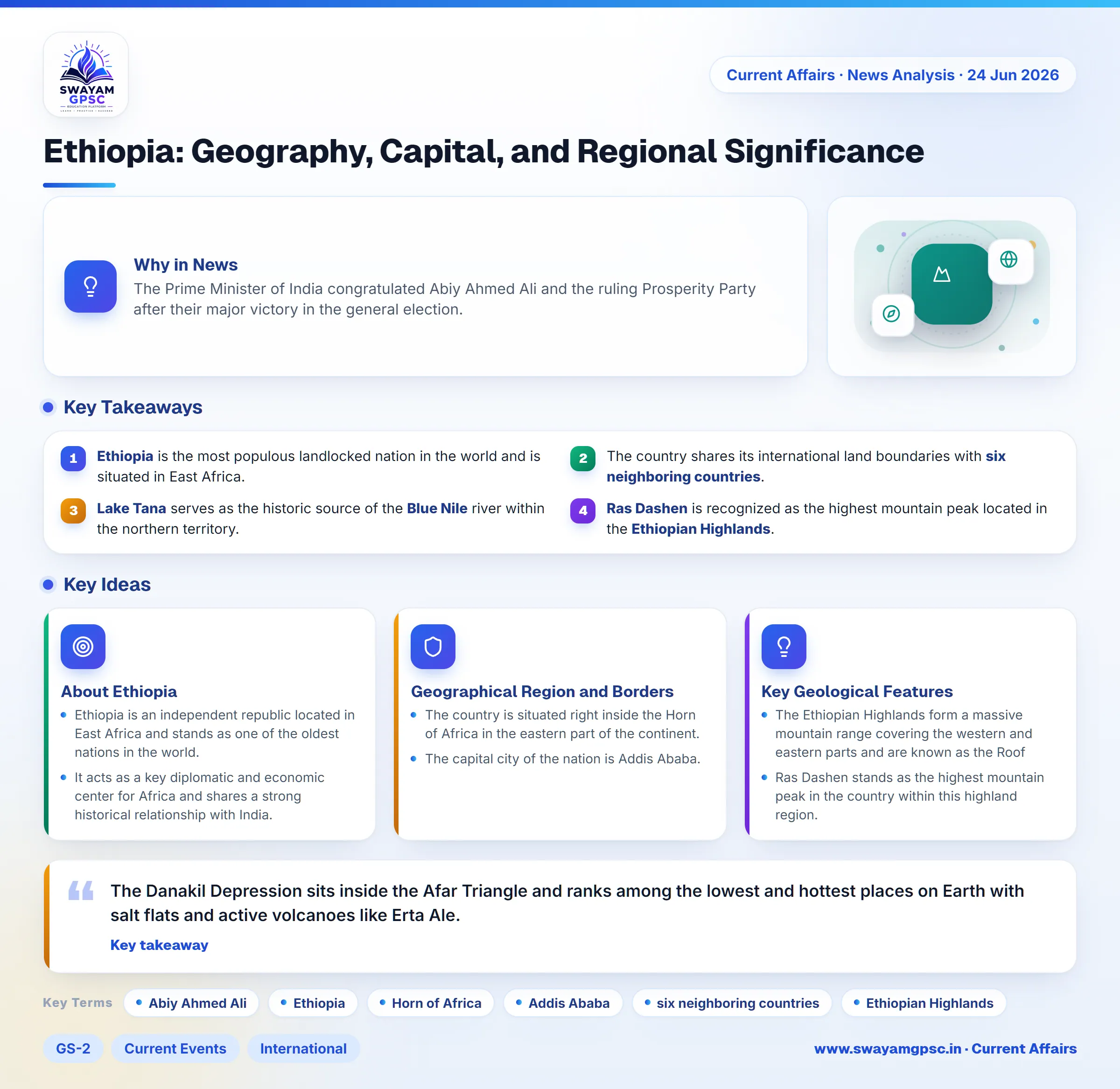
Ethiopia: Geography, Capital, and Regional Significance
#GS-2 #Current Events #International #Geography #Physical Geography
Key takeaways
- Ethiopia is the most populous landlocked nation in the world and is situated in East Africa.
- The country shares its international land boundaries with six neighboring countries.
- Lake Tana serves as the historic source of the Blue Nile river within the northern territory.
- Ras Dashen is recognized as the highest mountain peak located in the Ethiopian Highlands.
Why in News
- The Prime Minister of India congratulated Abiy Ahmed Ali and the ruling Prosperity Party after their major victory in the general election.
About Ethiopia
- Ethiopia is an independent republic located in East Africa and stands as one of the oldest nations in the world.
- It acts as a key diplomatic and economic center for Africa and shares a strong historical relationship with India.
Geographical Region and Borders
- The country is situated right inside the Horn of Africa in the eastern part of the continent.
- The capital city of the nation is Addis Ababa.
- Ethiopia holds the title of the most populous landlocked nation across the globe.
- It shares its land boundaries with six neighboring countries which include Eritrea, Djibouti, Somalia, Kenya, South Sudan, and Sudan.
Key Geological Features
- The Ethiopian Highlands form a massive mountain range covering the western and eastern parts and are known as the Roof of Africa.
- Ras Dashen stands as the highest mountain peak in the country within this highland region.
- The Great Rift Valley runs diagonally across the nation, splitting the highlands and featuring large lakes along with volcanic sites.
- The Danakil Depression sits inside the Afar Triangle and ranks among the lowest and hottest places on Earth with salt flats and active volcanoes like Erta Ale.
- Lake Tana in the northwest acts as the main source of the Blue Nile river, supplying most of the water to the downstream Nile.
- The peripheral lowlands near Somalia and Sudan feature dry savannas and shrublands.