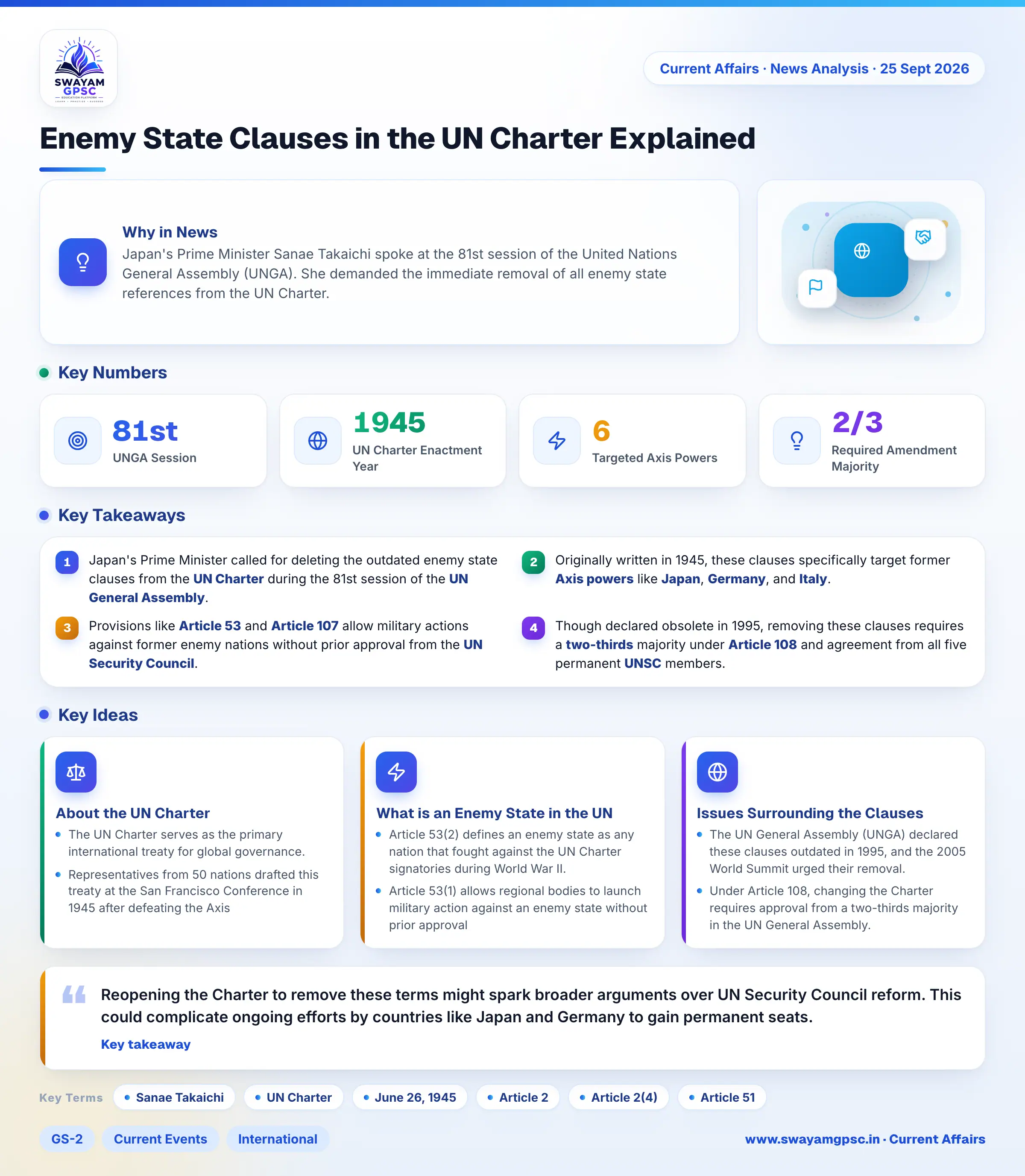
Enemy State Clauses in the UN Charter Explained
#GS-2 #Current Events #International #UN Charter #UN Security Council #Enemy State Clauses #Prelims
Key takeaways
- Japan's Prime Minister called for deleting the outdated enemy state clauses from the UN Charter during the 81st session of the UN General Assembly.
- Originally written in 1945, these clauses specifically target former Axis powers like Japan, Germany, and Italy.
- Provisions like Article 53 and Article 107 allow military actions against former enemy nations without prior approval from the UN Security Council.
- Though declared obsolete in 1995, removing these clauses requires a two-thirds majority under Article 108 and agreement from all five permanent UNSC members.
Why in News
- Japan's Prime Minister Sanae Takaichi spoke at the 81st session of the United Nations General Assembly (UNGA). She demanded the immediate removal of all enemy state references from the UN Charter.
About the UN Charter
- The UN Charter serves as the primary international treaty for global governance. It establishes state sovereignty, bans unlawful force, and outlines the rights of member nations.
- Representatives from 50 nations drafted this treaty at the San Francisco Conference in 1945 after defeating the Axis Powers.
- Member nations signed the document on June 26, 1945. It officially came into force on October 24, 1945, after ratification by the five permanent members of the Security Council and other signatories.
- The Charter aims to prevent future world wars and protect basic human rights. It also works to promote global social progress and economic stability.
- Under Article 2, the Charter protects the sovereign equality of all member states. It strictly forbids member countries from interfering in the domestic affairs of other nations.
- Article 2(4) prohibits nations from using or threatening force against the territorial integrity or political independence of any state.
- Article 51 grants nations the inherent right to individual or collective self-defence if an armed attack occurs until the UN Security Council steps in.
- Chapter VII gives the 15-member UN Security Council (UNSC) binding power to enforce sanctions, trade embargoes, or military action to preserve peace.
What is an Enemy State in the UN Charter
- Article 53(2) defines an enemy state as any nation that fought against the UN Charter signatories during World War II. This definition specifically targets former Axis powers, including Japan, Germany, Italy, Bulgaria, Hungary, and Romania.
- Article 53(1) allows regional bodies to launch military action against an enemy state without prior approval from the UN Security Council to stop future aggression.
- Article 107 creates an exception that allows victorious Allied nations to take post-war enforcement actions against enemy states without violating the Charter.
- Article 77(1)(b) governs how the UN trusteeship system applies to territories taken away from enemy nations after the war.
Issues Surrounding the Clauses
- The UN General Assembly (UNGA) declared these clauses outdated in 1995, and the 2005 World Summit urged their removal. Despite these declarations, the clauses remain inside the official text.
- Under Article 108, changing the Charter requires approval from a two-thirds majority in the UN General Assembly. In addition, two-thirds of all member countries, including all five permanent Security Council members, must ratify the change.
- Reopening the Charter to remove these terms might spark broader arguments over UN Security Council reform. This could complicate ongoing efforts by countries like Japan and Germany to gain permanent seats.