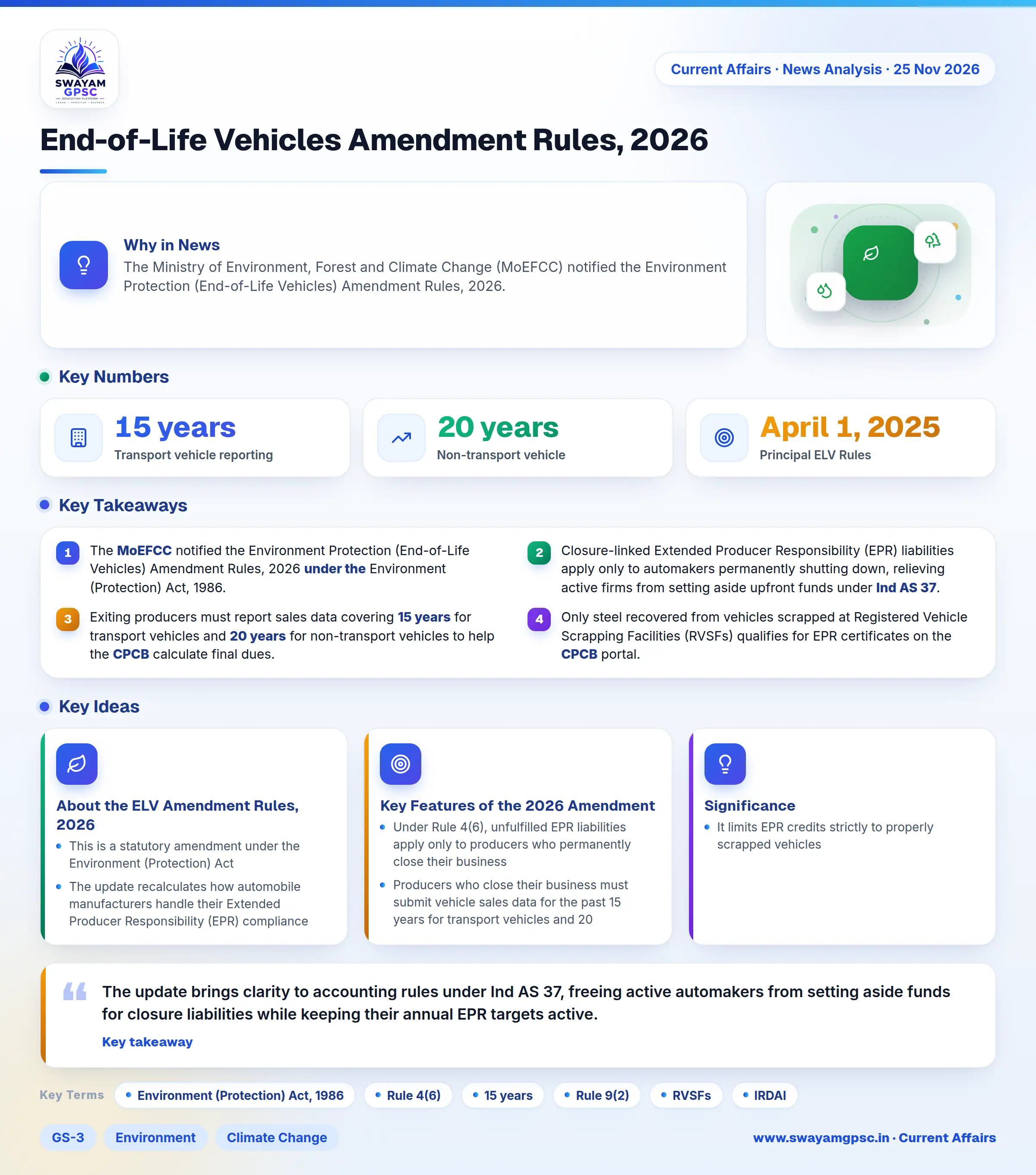
End-of-Life Vehicles Amendment Rules, 2026
#GS-3 #Environment #Climate Change #Sustainable Development #ELV Amendment Rules 2026 #EPR #CPCB
Key takeaways
- The MoEFCC notified the Environment Protection (End-of-Life Vehicles) Amendment Rules, 2026 under the Environment (Protection) Act, 1986.
- Closure-linked Extended Producer Responsibility (EPR) liabilities apply only to automakers permanently shutting down, relieving active firms from setting aside upfront funds under Ind AS 37.
- Exiting producers must report sales data covering 15 years for transport vehicles and 20 years for non-transport vehicles to help the CPCB calculate final dues.
- Only steel recovered from vehicles scrapped at Registered Vehicle Scrapping Facilities (RVSFs) qualifies for EPR certificates on the CPCB portal.
- The updated rules remove mandatory recycled steel content targets for new cars and drop proposed scrapping mandates for insurance companies regulated by IRDAI.
Why in News
- The Ministry of Environment, Forest and Climate Change (MoEFCC) notified the Environment Protection (End-of-Life Vehicles) Amendment Rules, 2026.
- This new notification clarifies that closure-linked Extended Producer Responsibility (EPR) liabilities apply only to automakers who permanently shut down operations.
About the ELV Amendment Rules, 2026
- This is a statutory amendment under the Environment (Protection) Act, 1986 that modifies the main Environment Protection (End-of-Life Vehicles) Rules, 2025, which came into effect on April 1, 2025.
- The update recalculates how automobile manufacturers handle their Extended Producer Responsibility (EPR) compliance and track steel scrap.
- The primary goal is to lower extra financial burdens on active car manufacturers while ensuring proper vehicle scrapping.
- It also aims to promote scrapping through registered facilities and streamline how the Central Pollution Control Board (CPCB) enforces EPR guidelines.
Key Features of the 2026 Amendment Rules
- Under Rule 4(6), unfulfilled EPR liabilities apply only to producers who permanently close their business, so active companies do not have to set aside money upfront for these liabilities.
- Producers who close their business must submit vehicle sales data for the past 15 years for transport vehicles and 20 years for non-transport vehicles so the CPCB can calculate their final liabilities.
- Under Rule 9(2), only steel recovered from vehicles scrapped at Registered Vehicle Scrapping Facilities (RVSFs) qualifies for EPR certificates, excluding other industrial steel scrap.
- Active manufacturers must meet annual steel-scrapping targets based on past sales by buying EPR certificates generated by RVSFs on the centralized CPCB portal.
- The rules drop proposed requirements that would have forced insurance companies to send total-loss vehicles to registered scrapping facilities under IRDAI supervision.
- The amendment removes the requirement for carmakers to use a minimum percentage of recycled steel in new vehicles, giving them more manufacturing flexibility.
- The framework keeps its focus entirely on steel scrap without adding extra EPR rules for tyres, batteries, electronic waste, plastics, or used oil, which remain under their own separate waste rules.
Significance
- The update brings clarity to accounting rules under Ind AS 37, freeing active automakers from setting aside funds for closure liabilities while keeping their annual EPR targets active.
- It limits EPR credits strictly to properly scrapped vehicles, preventing the misuse of industrial scrap and supporting safe, formal vehicle recycling.