Empowering the Poor: A Decade of Inclusive Transformation
#GS-2 #Poverty #Issues Relating to Poverty & Hunger #Economy #Governance & Social Justice #Infrastructure #Health #Education #Women
Key takeaways
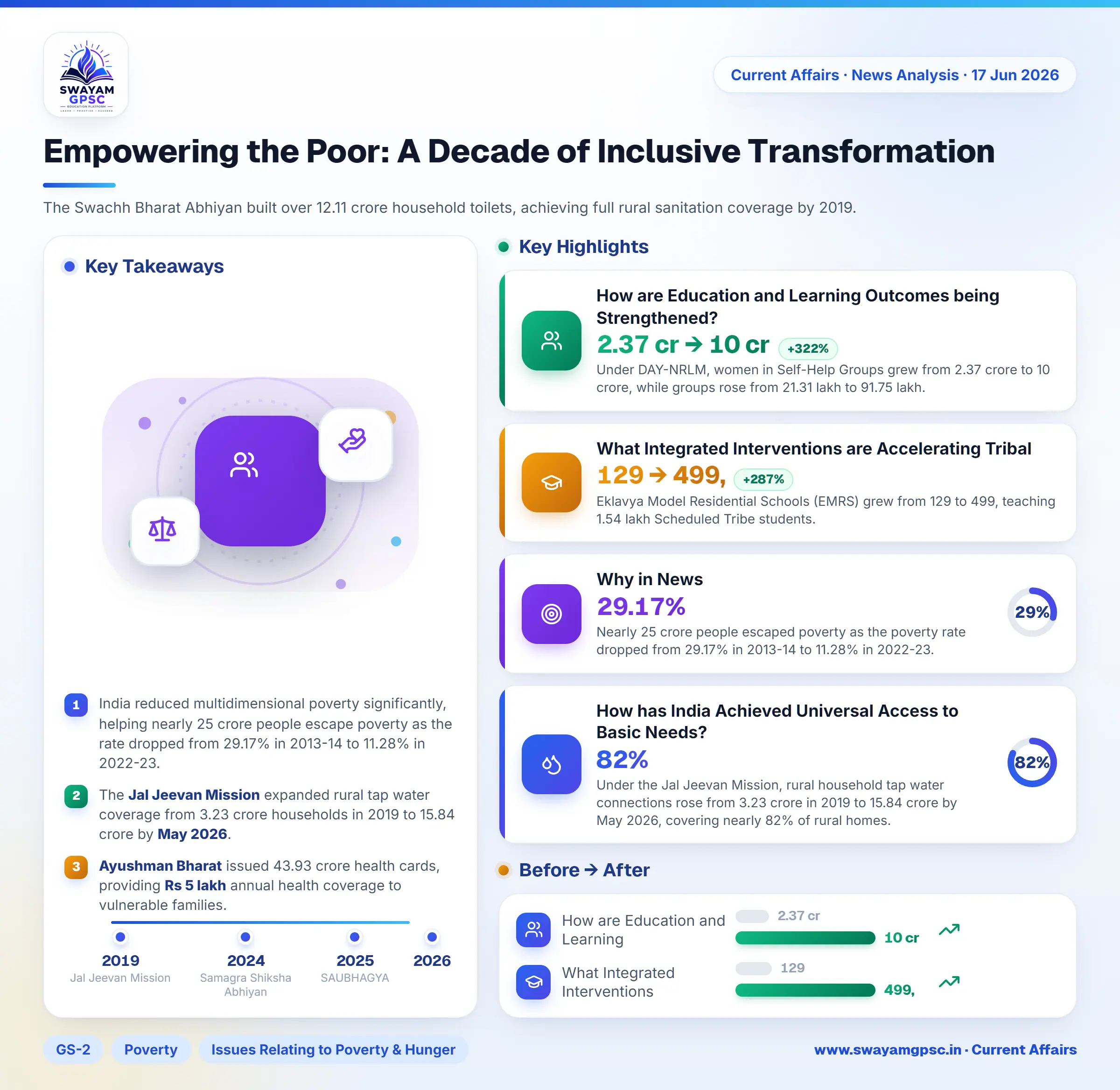
- India reduced multidimensional poverty significantly, helping nearly 25 crore people escape poverty as the rate dropped from 29.17% in 2013-14 to 11.28% in 2022-23.
- The Jal Jeevan Mission expanded rural tap water coverage from 3.23 crore households in 2019 to 15.84 crore by May 2026.
- Ayushman Bharat issued 43.93 crore health cards, providing Rs 5 lakh annual health coverage to vulnerable families.
- The PM Jan Dhan Yojana reached 58.16 crore beneficiaries, while the Unified Payments Interface (UPI) system routinely handles over 2,100 crore monthly transactions.
Why in News
- India reduced multidimensional poverty significantly over the past decade through welfare schemes, digital systems, and infrastructure growth.
- Nearly 25 crore people escaped poverty as the poverty rate dropped from 29.17% in 2013-14 to 11.28% in 2022-23.
- This progress shows a clear move from simply reducing hardship to building human capabilities and economic strength.
How has India Achieved Universal Access to Basic Needs?
- Under the Jal Jeevan Mission, rural household tap water connections rose from 3.23 crore in 2019 to 15.84 crore by May 2026, covering nearly 82% of rural homes.
- More than 9.23 lakh schools and 9.66 lakh Anganwadi Centres now have running tap water.
- The Swachh Bharat Abhiyan built over 12.11 crore household toilets, achieving full rural sanitation coverage by 2019.
- Over 5 lakh villages reached ODF Plus (Model) status by managing solid and liquid waste properly.
- The Pradhan Mantri Ujjwala Yojana gave over 10.57 crore free LPG connections to poor women to stop indoor air pollution.
- Through SAUBHAGYA and other programs, 100% village electrification was reached by 2025.
- Average daily electricity in villages went up from 12.5 hours in 2014 to 22.6 hours in 2025.
- PMAY-Urban completed over 98.10 lakh houses while PMAY-Gramin finished 3.03 crore rural homes.
- Most of these new houses are registered in women's names to help them own assets.
- The Pradhan Mantri Gram Sadak Yojana connected 99.6% of eligible villages with all-weather roads for better market and school access.
What are the Key Advancements in Public Health and Food Security?
- Ayushman Bharat, the largest public health scheme in the world, issued 43.93 crore health cards offering an annual cover of Rs 5 lakh.
- The Ayushman Bharat Digital Mission created 88.33 crore digital health accounts (ABHA) and linked 97.81 crore health records.
- Programs like the Janani Suraksha Yojana helped lower the Maternal Mortality Ratio (MMR) from 130 per 100,000 live births during 2014-16 down to 88 in 2021-23.
- The Pradhan Mantri Garib Kalyan Anna Yojana (PMGKAY) provides free foodgrains to over 81 crore people using digitized ration shops.
How are Education and Learning Outcomes being Strengthened?
- The Samagra Shiksha Abhiyan reduced female primary school dropout rates from 4.6% in 2013-14 to 0.3% in 2024-25.
- Beti Bachao Beti Padhao raised the national sex ratio to 1,020 and pushed female secondary school enrollment to 80.2%.
- Kasturba Gandhi Balika Vidyalayas increased residential schooling for disadvantaged girls, enrolling 7.11 lakh students by 2024.
- Digital platforms like SWAYAM and DIKSHA made learning easier, with SWAYAM alone recording over 5.80 crore enrollments.
- Under DAY-NRLM, women in Self-Help Groups grew from 2.37 crore to 10 crore, while groups rose from 21.31 lakh to 91.75 lakh.
- The Lakhpati Didi initiative helped 3.07 crore rural women start successful businesses.
- The PMKVY skill program trained over 1.64 crore youth, focusing on new fields like AI and Industry 4.0.
- MGNREGA provided over 3,036 crore person-days of work since 2014.
- The eShram portal registered 31.64 crore unorganized workers to give them social security.
- The PM Jan Dhan Yojana opened bank accounts for 58.16 crore people, and PM MUDRA Yojana gave 66% of its loans to women.
- The BharatNet project brought high-speed broadband to 2.19 lakh Gram Panchayats.
- The Unified Payments Interface (UPI) system changed digital payments by handling over 2,100 crore monthly transactions.
What Integrated Interventions are Accelerating Tribal Development?
- The PM-JANMAN Mission focuses on 75 Particularly Vulnerable Tribal Groups (PVTGs) by providing housing, water, power, and mobile clinics.
- Eklavya Model Residential Schools (EMRS) grew from 129 to 499, teaching 1.54 lakh Scheduled Tribe students.
- The government sanctioned 1,146 Van Dhan Vikas Kendras to help tribals earn more from forest produce.
Conclusion
- India changed its welfare approach from basic handouts to complete socio-economic growth.
- By focusing on women, local businesses, and digital tools, the country is helping its weakest citizens.
- This decade moved the nation from Antyodaya to Sarvodaya, building a stronger and fairer society.