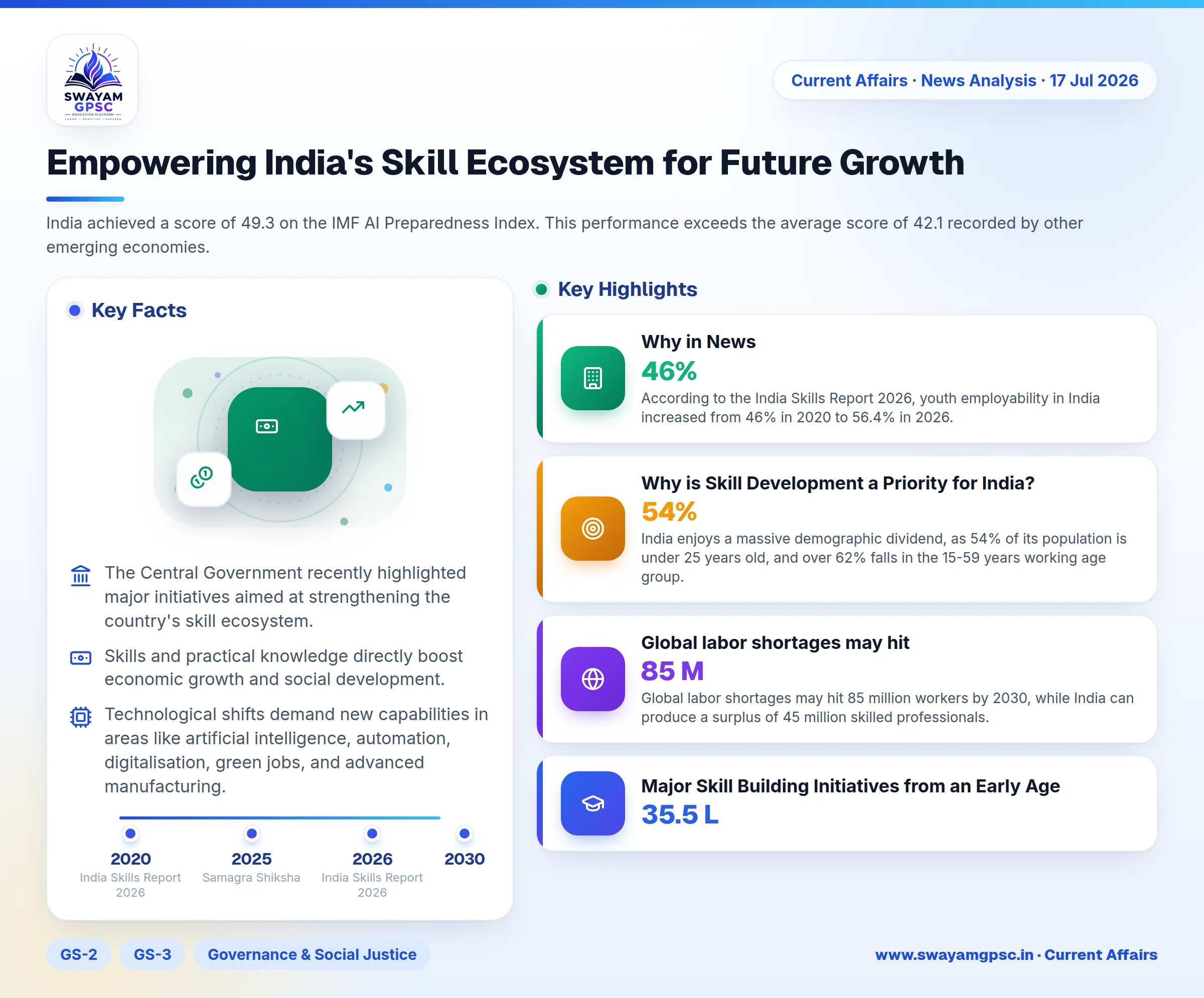
Empowering India's Skill Ecosystem for Future Growth
#GS-2 #GS-3 #Governance & Social Justice #Education #Economy #Employment #Infrastructure #Science & Technology #Artificial Intelligence #Current Events #National #Skill Development #Women Empowerment
Why in News
- The Central Government recently highlighted major initiatives aimed at strengthening the country's skill ecosystem. These efforts cover everything from classroom learning to enterprise creation.
- According to the India Skills Report 2026, youth employability in India increased from 46% in 2020 to 56.4% in 2026. This progress supports the national goal of reaching 100% skilled workforce with meaningful jobs by 2047.
Why is Skill Development a Priority for India?
- Skills and practical knowledge directly boost economic growth and social development. Better skilling leads to higher productivity, higher incomes, and reduced poverty.
- Technological shifts demand new capabilities in areas like artificial intelligence, automation, digitalisation, green jobs, and advanced manufacturing.
- India achieved a score of 49.3 on the IMF AI Preparedness Index. This performance exceeds the average score of 42.1 recorded by other emerging economies.
- India enjoys a massive demographic dividend, as 54% of its population is under 25 years old, and over 62% falls in the 15-59 years working age group.
- Global labor shortages may hit 85 million workers by 2030, while India can produce a surplus of 45 million skilled professionals.
- A life-cycle approach ensures continuous learning from primary school through higher education, workplace apprenticeships, and lifelong career reskilling.
Major Skill Building Initiatives from an Early Age
- The Samagra Shiksha initiative supports school education and offers skill courses aligned with SDG-4 across 25,140 schools, benefiting 35.5 lakh students in 138 job roles as of December 2025.
- Under the Hub and Spoke Model, around 975 spoke schools access training facilities located in central hub schools to expand practical skill learning.
- The government established 1,200 vocational skill labs across 400 Jawahar Navodaya Vidyalayas and 200 Eklavya Model Residential Schools.
- By June 2026, the government developed 13,092 PM SHRI Schools across 776 districts to showcase modern education under NEP 2020.
- More than 10,000 Atal Tinkering Laboratories operate across 722 districts, engaging over 1.1 crore students in hands-on innovation.
- The Skilling for AI Readiness (SOAR) program registered 2.30 lakh students from Classes VI to XII by February 2026.
- The National Skills Qualifications Framework (NSQF) structures qualifications across eight outcome-based levels, validating both formal and informal learning experiences.
- This framework connects general education with vocational training, allowing seamless credit transfers and lifelong skill progression for students.
- Launched under the IndiaAI Mission in November 2025, the YUVA AI for ALL course recorded 85.27 lakh enrollments by July 2026.
- The Vidyanjali Programme has onboarded 8,44,925 schools and 5,62,296 volunteers to mentor over 2.04 crore students.
Major Upskilling and Reskilling Initiatives in India
- Launched in 2015, the Skill India Mission provides industry-relevant training aligned with NSQF through national portals and training centers.
- Key programs under the mission include Pradhan Mantri Kaushal Vikas Yojana, Jan Shikshan Sansthan, National Apprenticeship Promotion Scheme, and the Craftsman Training Scheme.
- Under PMKVY 4.0, over 28.17 lakh candidates received training across 36 sectors and 738 districts by June 2026.
- The PMKVY 4.0 scheme operates as a demand-driven model designed to meet specific industry needs across all Indian states.
- The Jan Shikshan Sansthan (JSS) scheme offers community-based vocational training to school dropouts and neo-literates using full central government funding.
- Since 2018, JSS trained 36.52 lakh beneficiaries, including 4.8 lakh tribal beneficiaries, with women representing over 82% of participants.
- Courses in JSS focus on local crafts like tailoring and handicrafts, while the UdyamKart platform helps artisans sell their items.
- Under NAPS 2.0, the government pays 25% of monthly stipend costs up to ₹1,500 per month per apprentice.
- Over 54.41 lakh apprentices gained industry experience across automotive, IT, retail, and manufacturing sectors since 2016.
- Between April 2025 and March 2026, the government disbursed over ₹562.75 crore through 40.10 lakh Direct Benefit Transfer transactions to apprentices.
- The Craftsman Training Scheme (CTS) delivers long-term vocational education across 169 courses in 13,888 ITIs nationwide.
- Authorities introduced 14 new CTS courses and updated 22 existing courses over the past three years to align with modern industry requirements.
- Total enrollment in ITIs expanded from 12.51 lakh in FY 2022-23 to 14.70 lakh in FY 2025-26.
- Launched in 2025, PM-SETU aims to upgrade 1,000 Government ITIs into high-tech skill hubs across the country.
- The PM-SETU architecture connects 200 Hub ITIs with 800 Spoke ITIs alongside 5 National Centres of Excellence.
- The PM-SETU scheme aims to train 20 lakh youth over five years in service sector and multi-skilled trades.
- By May 2026, 32 States and UTs set up steering committees, and Andhra Pradesh launched the first operational cluster in Visakhapatnam.
- The FutureSkills Pillar under the IndiaAI Mission builds advanced technical capabilities through fellowships and specialized academic courses.
- The initiative is building 570 AI and Data Labs across Tier 2 and Tier 3 cities to widen technology access.
- Created by MeitY and NASSCOM, FutureSkills Prime offers online certifications in emerging digital technologies.
- Launched in 2025, the Pradhan Mantri Viksit Bharat Rozgar Yojana provides a one-time incentive of up to ₹15,000 for new EPFO-registered employees.
- Employers receive up to ₹3,000 per month for two years for every new job created with sustained employment.
- By June 2026, this scheme generated 15 lakh employment opportunities with ₹2,400 crore distributed in benefits.
Initiatives Related to Nurturing Entrepreneurship
- The PM Vishwakarma scheme offers end-to-end support to traditional artisans through skill upgrades, free toolkits, credit, and market connections.
- The scheme prioritizes marginalized groups, including women, SCs, STs, OBCs, persons with disabilities, and artisans from hilly or island regions.
- Trainees receive a stipend of ₹500 per day while attending skill programs under the PM Vishwakarma scheme.
- By June 2026, over 24.50 lakh applicants finished basic training, and banks sanctioned ₹5,165.84 crore in soft loans.
- The Startup India portal provides free online courses covering finance, programming, business management, and marketing.
- These courses build practical managerial and business skills for young founders launching new ventures.
- The Ministry of Skill Development runs specialized programs through NIESBUD in Noida and IIE in Guwahati.
- These premier institutions provide direct mentorship, incubation support, and practical enterprise training to budding entrepreneurs.
- The Ministry of MSME runs dedicated Entrepreneurship Skill Development Programmes (ESDP) to encourage self-employment among youth.
- These ESDP initiatives focus directly on women, SC, ST, BPL, and disabled candidates to ensure inclusive business ownership.
Skilling Initiatives in Union Budget 2026-27
- The Khelo India Mission incorporates sports science and structured coaching development pathways for young athletes.
- A new pilot project aims to train 10,000 tourist guides using a standardized 12-week hybrid course.
- New NSQF-aligned programs will train 1.5 lakh multi-skilled caregivers to support elder care and health services.
- The Budget announced 3 new All India Institutes of Ayurveda and a new National Institute of Design in eastern India.
- The government will set up AVGC Content Creator Labs in 15,000 schools and 500 colleges to boost digital creative skills.
- Five University Townships will be built near major industrial corridors to integrate higher education with skill training.
Initiatives Related to Empowering Women through Skilling
- The AI Careers for Women, 2025 program offers a 320-hour training course in artificial intelligence for rural female undergraduate students.
- This project operates through 25 AI Centres of Excellence established under a hub-and-spoke model.
- The program has already reached over 10,000 students, including 2,500+ in Hub Colleges and 7,500+ in Spoke Colleges.
- Launched in February 2025, the Swavalambini program is a joint effort between MSDE and NITI Aayog's Women Entrepreneurship Platform.
- The primary goal of Swavalambini is to build business confidence among women through awareness and targeted training.
- Implementation is underway in Assam, Meghalaya, Mizoram, Uttar Pradesh, and Telangana.
- In FY 2025-26, the IIE trained 82 faculty members, reached 1,200 participants, and mentored 602 women entrepreneurs.
- Launched in June 2025, the NAVYA scheme focuses on young adolescent girls in aspirational districts.
- The scheme empowers girls aged 16-18 years by teaching market-relevant skills that build economic independence.
- The NAVYA scheme operates across 27 districts in 19 States, targeting 3,850 girls under PMKVY 4.0.
- Training covers modern roles such as digital marketing, cybersecurity, AI tools, and green jobs alongside life skills.
- These dedicated efforts help increase female workforce participation and foster rural women leadership.
Conclusion
- India's skill ecosystem is successfully shifting toward a lifelong learning model that connects basic education directly with industry demands.
- By preparing its workforce for emerging technologies and global jobs, India builds a strong foundation for a Viksit Bharat by 2047.
Frequently Asked Questions
- What is India's life-cycle approach to skill development? It means providing continuous training at every stage of life, from school education to workplace reskilling.
- What is NSQF? The National Skills Qualifications Framework organizes learning qualifications into structured levels based on practical knowledge and skill competencies.
- What is PM-SETU? It is a national scheme designed to modernize 1,000 Government ITIs into industry-aligned skill hubs.
- Why is women-centric skilling important? It drives gender equality, increases female workforce participation, and helps women achieve financial independence.
- How does skilling support Viksit Bharat 2047? Skilled human resources boost industrial output, economic growth, global competitiveness, and technological innovation.