Empowering Farmers for Sustainable and Inclusive Agriculture
#GS-3 #Economy #Agriculture #Agricultural Marketing #E-Technology in the Aid of Farmers #Direct & Indirect Farm Subsidies #Public Distribution System (PDS) #Economics of Animal-Rearing #Food Processing #Infrastructure #Sustainable Development
Key takeaways
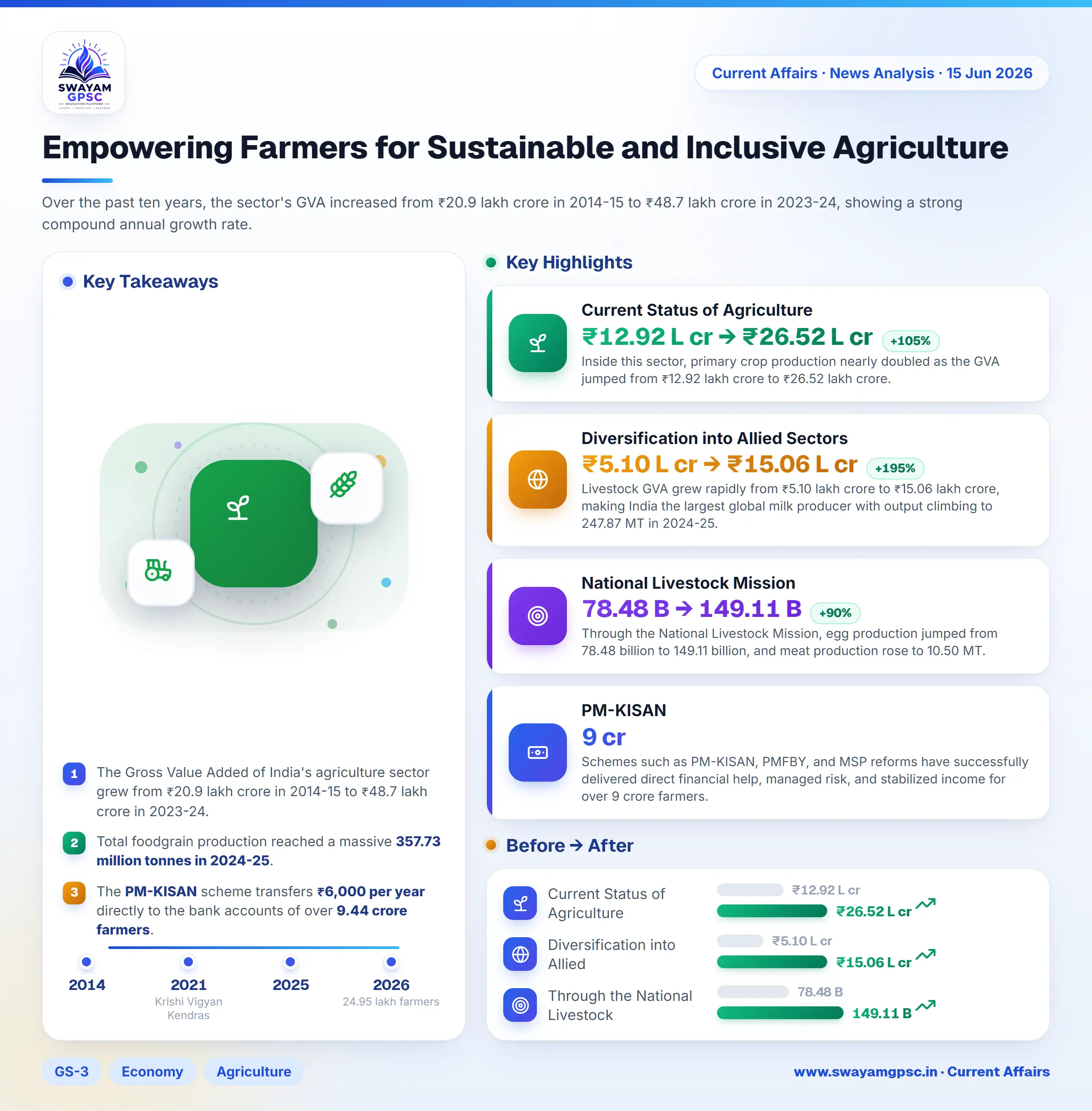
- The Gross Value Added of India's agriculture sector grew from ₹20.9 lakh crore in 2014-15 to ₹48.7 lakh crore in 2023-24.
- Total foodgrain production reached a massive 357.73 million tonnes in 2024-25.
- The PM-KISAN scheme transfers ₹6,000 per year directly to the bank accounts of over 9.44 crore farmers.
- Ground Level Credit for agriculture expanded from ₹7.30 lakh crore to ₹28.67 lakh crore in 2024-25.
Why in News
- India's agricultural sector has changed a lot over the past 12 years. It has moved past simple welfare support and now focuses on boosting productivity, securing incomes, improving market access, and building strong rural infrastructure.
- Major government programs like PM-KISAN, PMFBY, e-NAM, and wider MSP operations have successfully given farmers stable earnings and reliable market guarantees.
Summary
- Schemes such as PM-KISAN, PMFBY, and MSP reforms have successfully delivered direct financial help, managed risk, and stabilized income for over 9 crore farmers.
- Government investments in the Agriculture Infrastructure Fund (AIF), e-NAM, Mega Food Parks, and expanded credit options have improved the link between farms and markets while providing quick access to affordable loans.
- Empowering farmers means solving problems related to low incomes, climate changes, lack of credit, poor infrastructure, and technology gaps by using better digital tools and sustainable farming methods.
Current Status of Agriculture
- The agriculture and allied sectors contribute around 18% of India's Gross Value Added (GVA), which proves they form a vital foundation of our national economy.
- Over the past ten years, the sector's GVA increased from ₹20.9 lakh crore in 2014-15 to ₹48.7 lakh crore in 2023-24, showing a strong compound annual growth rate.
- Inside this sector, primary crop production nearly doubled as the GVA jumped from ₹12.92 lakh crore to ₹26.52 lakh crore.
- Higher government spending drove this progress, with annual budgetary allocations rising from ₹27,663 crore in 2013-14 to ₹1,40,528.78 crore for 2026-27.
Crop Production and Food Security
- Total foodgrain production in India climbed from 265.05 million tonnes in 2013-14 to 357.73 million tonnes in 2024-25, driven by better output in rice, wheat, maize, and millets.
- The National Food Security and Nutrition Mission supported this jump by providing quality seeds and encouraging modern farming practices.
- India is now the world's largest rice producer, while wheat production hit a record high of 117.94 million tonnes in 2024-25.
- Oilseeds hit a peak production of 42.99 Mt in 2024-25, which is 56% higher than the 27.51 Mt recorded in 2014-15.
- Because of higher local production, reliance on imported edible oils dropped from 63.2% in 2015-16 to 56.25% in 2023-24.
- The horticulture sector now generates nearly 37% of the crop sector's Gross Value Output, showing that farmers are successfully shifting toward high-value crops.
Farmer Welfare and Social Security
- The Pradhan Mantri Kisan Samman Nidhi (PM-KISAN) scheme transfers ₹6,000 per year directly to the bank accounts of eligible farmer families, helping over 9.44 crore farmers.
- More than 25% of these direct benefits went to women beneficiaries, making the scheme inclusive for rural households.
- The Pradhan Mantri Fasal Bima Yojana (PMFBY) offers an affordable crop insurance shield that protects cultivators from sowing to harvesting losses.
- The scheme works on the One Nation, One Crop, One Premium rule to keep insurance rates uniform across the country.
- Every year, the scheme successfully provides crop insurance cover to over 4 crore farmers.
- Under the Pradhan Mantri Kisan Maan-Dhan Yojana (PM-KMY), elderly farmers receive a monthly pension of ₹3,000 after turning 60 years old, with about 24.95 lakh farmers enrolled by February 2026.
- The Minimum Support Price (MSP) acts as a safety net by giving farmers a guaranteed price for 22 mandated crops announced every year.
- Since 2018-19, the government has kept the MSP at a minimum of 50 percent above the actual cost of production.
- Total public procurement backed by MSP during the 2014-2026 period was 3.5 times higher than what was recorded between 2004 and 2014.
Diversification into Allied Sectors
- Livestock GVA grew rapidly from ₹5.10 lakh crore to ₹15.06 lakh crore, making India the largest global milk producer with output climbing to 247.87 MT in 2024-25.
- Through the National Livestock Mission, egg production jumped from 78.48 billion to 149.11 billion, and meat production rose to 10.50 MT.
- The Pradhan Mantri Matsya Sampada Yojana (PMMSY) helped push fisheries production up to 19.78 MT, while forming 2,195 Farmer Producer Organisations for fishers.
- Honey production grew under the National Beekeeping & Honey Mission, and ethanol procurement for the Ethanol Blended Petrol Programme surged to 904 crore litres, meeting the 20% blending target.
Technology, Digitalization, and Sustainability
- Under the Digital Agriculture Mission, authorities have created 7.63 crore Farmer IDs and digitized 23.5 crore crop plots to make service delivery transparent.
- Digital platforms like AgriStack and the Farmer Registry use geo-referenced land records to plan farming strategies and identify genuine beneficiaries quickly.
- The Kisan e-Mitra platform uses digital tools to give farmers instant weather updates, crop advice, and pest control tips.
- The Namo Drone Didi Scheme brings drone technology to villages, helping women entrepreneurs provide precise crop monitoring and pesticide spraying services.
- The PM-KUSUM scheme encourages clean energy by installing 10 lakh standalone solar pumps and solarizing 13 lakh grid-connected pumps.
- The government has issued 26 crore Soil Health Cards, set up 6.85 lakh seed villages, and launched programs like PKVY and the National Mission on Natural Farming to promote chemical-free farming.
- Agricultural scientists have released 2,996 climate-resilient crop varieties and expanded integrated farming to 1.04 lakh households to fight weather shocks.
- The Pradhan Mantri Krishi Sinchayee Yojana (PMKSY) focuses on micro-irrigation to ensure every single drop of water is used efficiently on farms.
- Between 2021 and 2025, Krishi Vigyan Kendras (KVKs) trained 1.27 crore farmers to adopt modern and sustainable agricultural practices.
Credit, Financial Inclusion, and Institutional Support
- The Kisan Credit Cards (KCCs) scheme acts as a single window for farmers to secure quick loans for their daily farming needs.
- Total Ground Level Credit for agriculture climbed steeply from ₹7.30 lakh crore in 2013-14 to ₹28.67 lakh crore in 2024-25.
- The Ministry of Cooperation has modernized rural credit by computerizing 79,630 Primary Agricultural Credit Societies (PACS).
- By 2026, the country registered 10,000 Farmer Producer Organisations (FPOs) to give small farmers better bargaining power in the market.
- The e-NAM digital trading platform has integrated 1,656 mandis, connecting 1.8 crore farmers for transparent online trading.
- The Agriculture Infrastructure Fund (AIF) has sanctioned ₹84,202 crore for 1.68 lakh projects to build cold chains and warehouses.
- The number of Mega Food Parks jumped from just 2 in 2014 to 41 by 2025, drastically reducing food wastage.
- India's agricultural exports climbed from USD 37.29 billion in 2013-14 to USD 51.1 billion in 2024-25.
- Processed food exports rose significantly, and seafood exports doubled to USD 7.52 billion, reaching over 130 countries worldwide.
Challenges
- Farmers face severe price swings when selling perishable goods, and small farmers who make up 86% of landholdings struggle due to having very little land to spare.
- MSP benefits mostly reach paddy and wheat growers in states like Punjab, Haryana, and western Uttar Pradesh, leaving other states behind.
- Unpredictable weather patterns, droughts, and heatwaves damage crops and reduce daily farm productivity.
- Remote areas still suffer from a lack of timely and affordable bank loans despite overall credit growth.
- Overusing groundwater in northwestern India and dumping too much chemical urea into fields is destroying long-term soil health.
Way Forward
- The government must expand direct income support schemes like PM-KISAN and strengthen crop insurance claims through the Krishi Rakshak Helpline.
- Formal financial institutions must give easy access to Kisan Credit Cards so remote farmers can avoid local lenders.
- Building more cold storages through the Agriculture Infrastructure Fund will help stop post-harvest crop losses right at the farm gate.
- Training programs through KVKs must teach farmers how to use drone technology and modern climate-resilient tools.
- Promoting organic farming through PKVY and saving water with PMKSY will make Indian agriculture truly sustainable.