Employment and Youth Aspirations in India: Viksit Bharat Vision
#Economy #Employment #Infrastructure #Poverty #Education #Governance #Current Events #GS-2 #GS-3 #Governance & Social Justice
Key takeaways
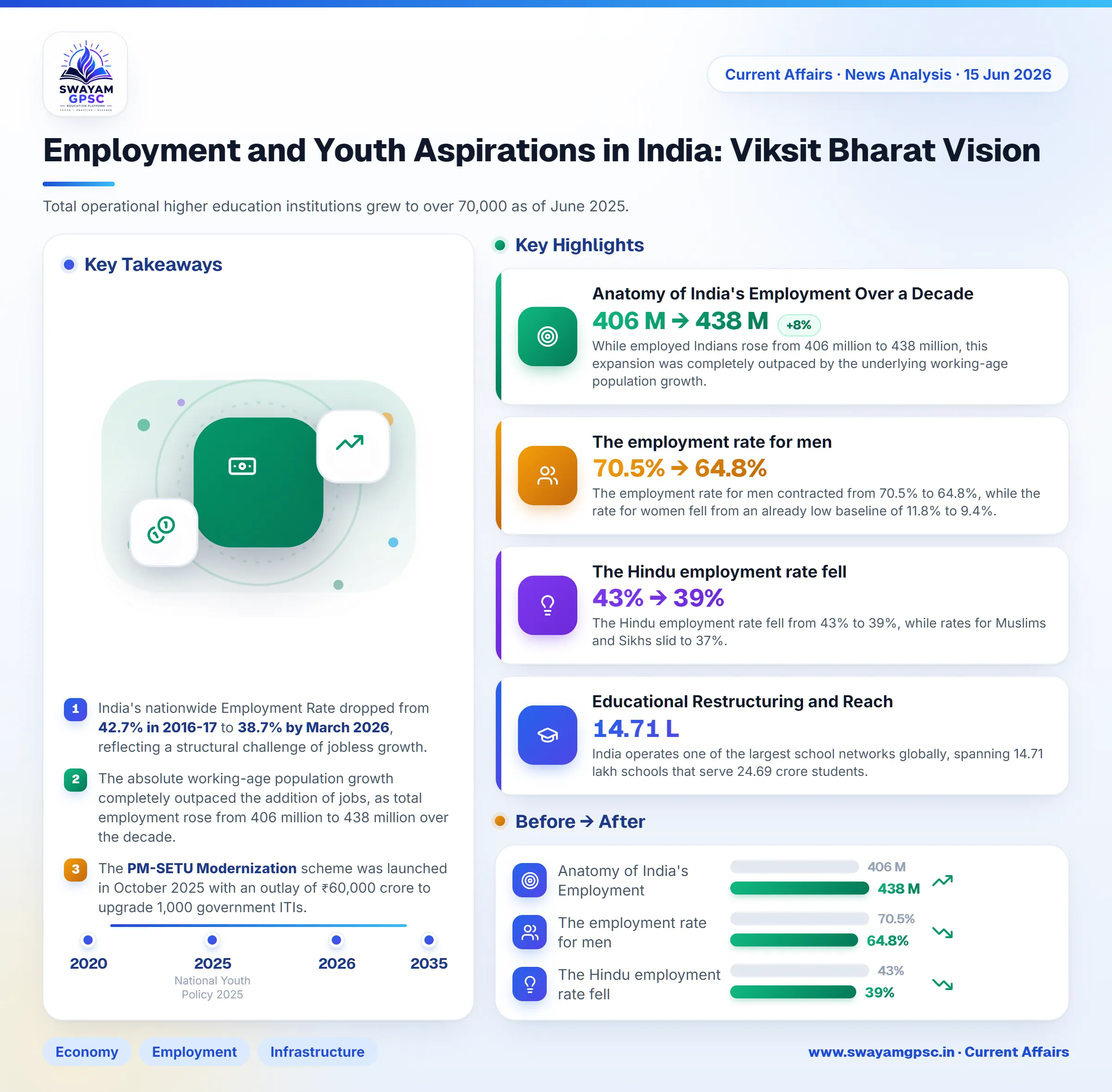
- India's nationwide Employment Rate dropped from 42.7% in 2016-17 to 38.7% by March 2026, reflecting a structural challenge of jobless growth.
- The absolute working-age population growth completely outpaced the addition of jobs, as total employment rose from 406 million to 438 million over the decade.
- The PM-SETU Modernization scheme was launched in October 2025 with an outlay of ₹60,000 crore to upgrade 1,000 government ITIs.
- DPIIT-recognized startups surged to over 2.3 lakh ventures by June 2026, creating 23 lakh jobs with nearly half originating from Tier-II and Tier-III cities.
- The Prime Minister Internship Scheme offers over 63,000 vacancies across 25 plus sectors backed by a monthly stipend of ₹9,000.
Context and Vision Overview
- Rising concerns over employment quality and youth aspirations highlight a decade-long decline in India's employment rate despite steady economic growth.
- India is executing a structural shift to treat its massive young population as active co-creators of national development rather than passive beneficiaries.
- The newly proposed National Youth Policy 2025 framework builds upon foundational guidelines to prioritize future-ready skills, digital participation, and sustainable enterprise.
Educational Restructuring and Reach
- India operates one of the largest school networks globally, spanning 14.71 lakh schools that serve 24.69 crore students.
- Total operational higher education institutions grew to over 70,000 as of June 2025.
- The Academic Bank of Credits platform has onboarded 2,469 institutions and issued over 32 crore student IDs for cross-institutional credit portability.
- The APAAR ID registry generated 15.48 crore verified student identifiers to accumulate continuous academic and skill credits.
- Medical colleges expanded to 818 in 2025-26, scaling total operational MBBS and postgraduate capacity to 1,28,976 and 85,822 seats respectively.
- Over 10,000 Atal Tinkering Labs empowered 1.1 crore school students to build 16 lakh technological prototypes.
Skilling, Internships, and Formalization
- The PM-SETU Modernization scheme launched in October 2025 with an estimated outlay of ₹60,000 crore to modernize 1,000 government Industrial Training Institutes using a hub-and-spoke model.
- The Pradhan Mantri Kaushal Vikas Yojana trained millions of candidates, including over 27 lakh candidates across 40 specialized sectors under its latest phase.
- The National Apprenticeship Program engaged over 54.41 lakh apprentices since 2016 with support from a 25% direct state stipend contribution.
- The Prime Minister Internship Scheme offers over 63,000 structured internship vacancies across 25 plus sectors with a monthly stipend of ₹9,000.
- Official Employees' Provident Fund Organisation data reveals that over 3.45 crore youth aged 18-28 joined the formal organized workforce between April 2020 and June 2025.
Startups, Inclusivity, and Digital Platforms
- DPIIT-recognized startups expanded to over 2.3 lakh ventures by June 2026, creating 23 lakh aggregate jobs.
- Privately held tech startups valued above $1 billion multiplied from 4 in 2014 to over 120 firms by early 2026, exceeding a combined valuation of $350 billion.
- Nearly 50 percent of all recognized startups now emerge from Tier-II and Tier-III cities to balance regional economic growth.
- Stand-Up India loan approvals for women, SC, and ST founders surged to ₹61,020.41 crore by March 2025.
- The Mera Yuva Bharat network acts as a unified digital platform and logged over 2.19 crore registered youth by June 2026.
Sports and Preventative Healthcare
- The KIRTI program executed 1.8 lakh data-driven talent assessments across 1,067 specialized district centers, supporting elite athletes with annual grants.
- Clinical counseling utilization at Adolescent Friendly Health Clinics grew from 39 lakh in 2014-15 to 1.7 crore in 2024-25.
- The Tele-MANAS 24/7 tele-counseling helpline successfully managed over 39.52 lakh calls to address youth mental health challenges without stigma.
Key Trends in Youth Development
- The implementation of the NEP 2020 introduces multiple entry and exit pathways to achieve a 50 percent Gross Enrolment Ratio by 2035.
- Flagship skilling missions integrate on-the-job training in high-growth sectors like artificial intelligence, green energy, and drone aviation.
- District Skill Committees across 776 districts help align local workforce training directly with regional business needs.
- Expanding global academic partnerships through dual degrees and overseas campuses significantly boosts India's global academic footprint.
Challenges in Youth Welfare and Employment
- Many technical and humanities graduates still lack the practical workflow skills required by employers despite internship programs.
- The rapid growth of the digital economy requires ongoing updates to legal protections and financial safety nets for young gig workers.
- Early-stage businesses face delayed operational approvals at municipal levels despite centralized funding portals.
- Integrating young veterans into civil service roles requires long-term coordination between central ministries and state police forces.
Anatomy of India's Employment Over a Decade
- The nationwide Employment Rate dropped from 42.7% in 2016-17 to 38.7% by the end of March 2026.
- While employed Indians rose from 406 million to 438 million, this expansion was completely outpaced by the underlying working-age population growth.
- The employment rate for men contracted from 70.5% to 64.8%, while the rate for women fell from an already low baseline of 11.8% to 9.4%.
- Joblessness remains a severe problem across education levels, with the graduate cohort employment rate slipping from 51% down to 49%.
- The Hindu employment rate fell from 43% to 39%, while rates for Muslims and Sikhs slid to 37%.
Key Trends in Indian Employment
- The Indian economy experiences jobless growth where high corporate output does not result in broad-based formal employment.
- Job opportunities for young groups have tightened, leading to widespread youth dissatisfaction and intense competition for government roles.
- The exit of discouraged unemployed individuals from the active labor force routinely shrinks the labor force participation rate, distorting official unemployment figures.
- The slide in employment rates impacted all layers of society without sparing any specific caste or religious bracket.
- Frequent adjustments to official survey methodologies caused analysts to rely on private datasets like the CMIE for long-term tracking.
Positive Indicators in the Labor Market
- Specific high-value sub-sectors like digital public infrastructure and advanced logistics hubs continue to add specialized technical roles.
- The 25 to 29 and 55 to 59 age brackets recorded minor, localized increases in their employment rates over the decade.
- Certain demographics, such as the Christian community cohort, bucked the broader trend by registering marginal improvements.
- The absolute employment pool recovered from pandemic contractions, returning to 438 million active jobs.
Challenges in Job Generation
- India's corporate-heavy economic model proves that rapid GDP growth is not a sufficient condition for generation-level job creation.
- Advanced economies turning inward through protectionist trade barriers make export-led employment strategies difficult to execute.
- Generative artificial intelligence tools pose a direct threat to standard tech operations and service sectors that traditionally absorbed educated youth.
- Existing state policies are engineered primarily to maximize raw GDP value rather than incentivize labor-intensive manufacturing clusters.
- A severe shortage of skilled white-collar roles leaves qualified engineering graduates trapped in cycles of chronic underemployment.
Way Forward
- Expand the rollout of Skilling for AI Readiness modules across rural schools to equip students with core machine-learning skills early on.
- Boost the capacity of the Startup India Seed Fund Scheme to ensure early-stage entrepreneurs in Tier-III towns have proof-of-concept capital.
- Implement the Viksit Bharat Rozgar Yojana to incentivize businesses to create formal-sector roles for first-time job seekers.
- Use the Ayushman Bharat Digital Mission to create portable digital health records for young workers moving across state borders.
- Shift economic planning focus from raw GDP growth percentages toward setting explicit, legally binding targets for employment generation.
- Redesign fiscal incentives and tax breaks to directly reward companies that demonstrate measurable increases in local human payrolls and technical apprenticeships.