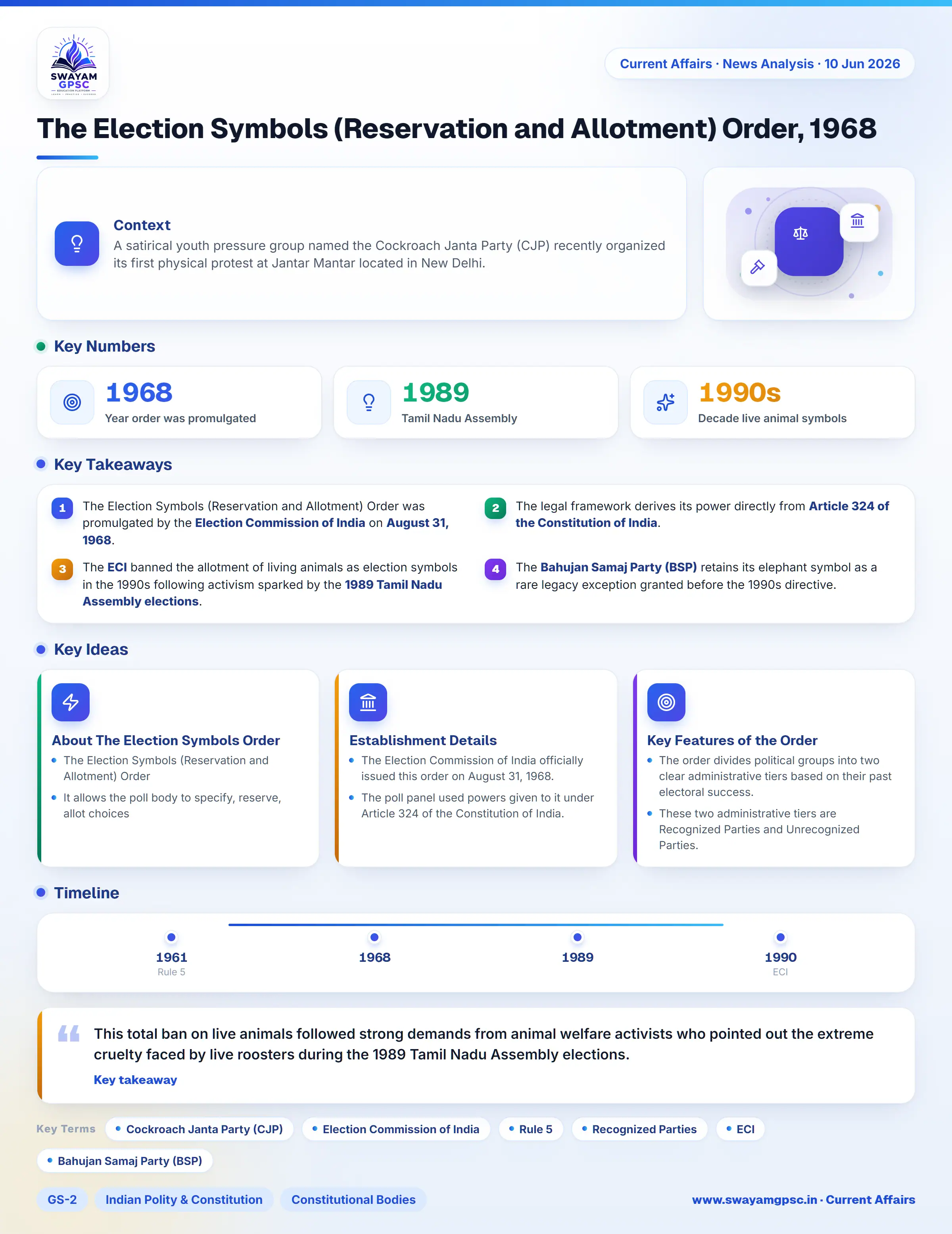
The Election Symbols (Reservation and Allotment) Order, 1968
#GS-2 #Indian Polity & Constitution #Constitutional Bodies #Election Symbols Order #Election Commission of India
Key takeaways
- The Election Symbols (Reservation and Allotment) Order was promulgated by the Election Commission of India on August 31, 1968.
- The legal framework derives its power directly from Article 324 of the Constitution of India.
- The ECI banned the allotment of living animals as election symbols in the 1990s following activism sparked by the 1989 Tamil Nadu Assembly elections.
- The Bahujan Samaj Party (BSP) retains its elephant symbol as a rare legacy exception granted before the 1990s directive.
Context
- A satirical youth pressure group named the Cockroach Janta Party (CJP) recently organized its first physical protest at Jantar Mantar located in New Delhi.
About The Election Symbols Order
- The Election Symbols (Reservation and Allotment) Order, 1968 functions as a complete legal framework that gives power to the Election Commission of India (ECI).
- It allows the poll body to specify, reserve, allot choices for, and regulate election symbols used by political parties and independent candidates.
- This order acts as the core rulebook for handling the visual identities of political contestants during all parliamentary and legislative assembly elections.
Establishment Details
- The Election Commission of India officially issued this order on August 31, 1968.
- The poll panel used powers given to it under Article 324 of the Constitution of India.
- These powers were read along with Rule 5 and Rule 10 of the Conduct of Elections Rules, 1961.
Key Features of the Order
- The order divides political groups into two clear administrative tiers based on their past electoral success.
- These two administrative tiers are Recognized Parties and Unrecognized Parties.
- Candidates from recognized National and State parties receive their party's exclusive and permanently reserved symbol automatically.
- Other candidates across the country or state cannot use these reserved symbols under any circumstances.
- The ECI manages and updates a dynamic list of free symbols specifically for unrecognized parties and independent candidates.
- These free symbols include everyday household items, fruits, and vegetables like an air-conditioner, balloon, jackfruit, or TV remote.
- The poll body distributes these free symbols on a fluid, first-come-first-served application basis rather than guaranteeing them.
- The ECI stopped assigning living creatures as symbols during the 1990s.
- This total ban on live animals followed strong demands from animal welfare activists who pointed out the extreme cruelty faced by live roosters during the 1989 Tamil Nadu Assembly elections.
- Parties that gained formal recognition and received an animal symbol before the 1990s directive can keep their legacy icons as rare exceptions.
- The most notable example of this legacy exception is the Bahujan Samaj Party (BSP) and its elephant symbol.