Economic Threat of El Nino to India
#GS-1 #GS-3 #Important Geophysical Phenomena #Water Resources #Food Security #Economy #Agriculture #Infrastructure #Climate Change #Environment
Key takeaways
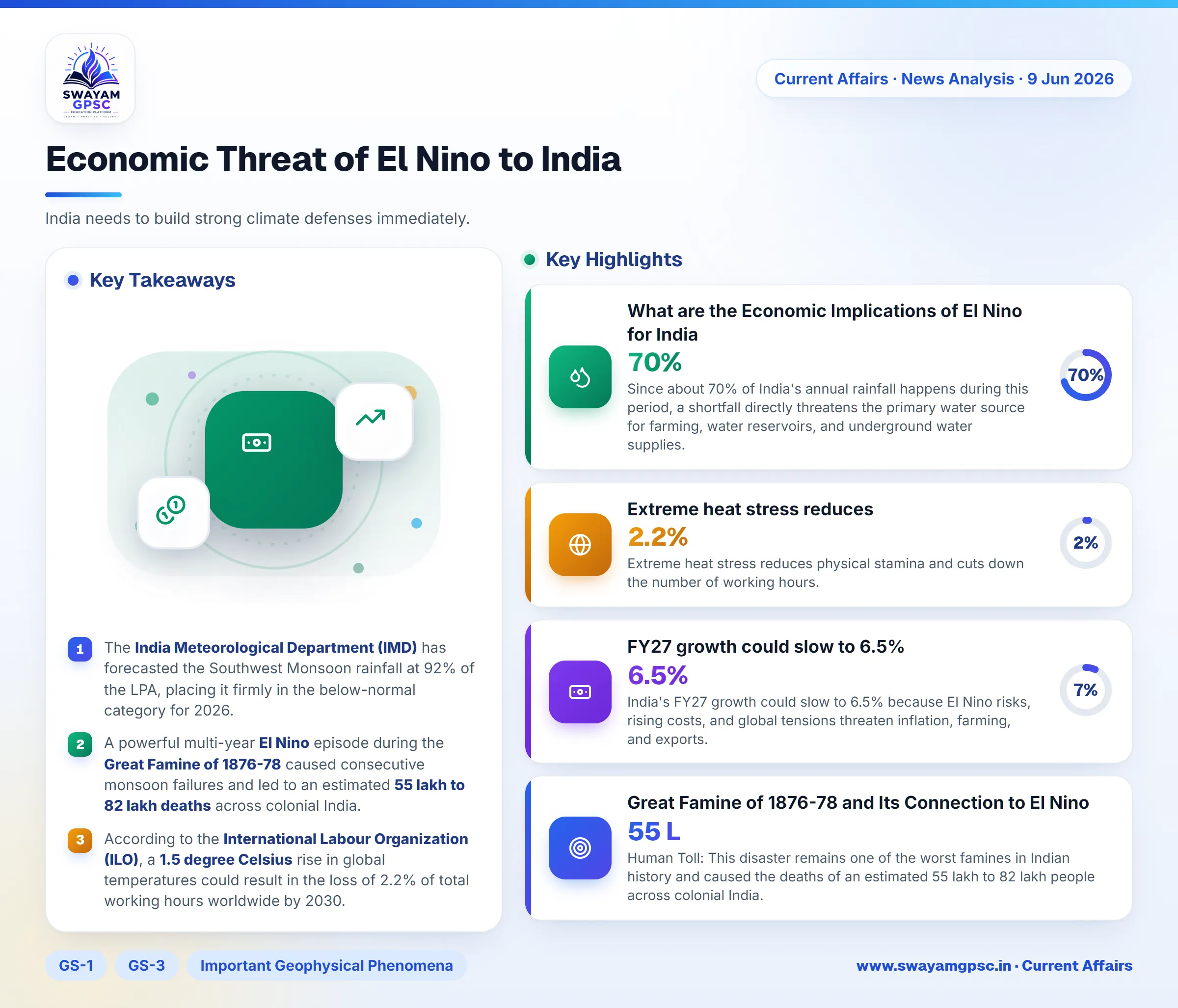
- The India Meteorological Department (IMD) has forecasted the Southwest Monsoon rainfall at 92% of the LPA, placing it firmly in the below-normal category for 2026.
- A powerful multi-year El Nino episode during the Great Famine of 1876-78 caused consecutive monsoon failures and led to an estimated 55 lakh to 82 lakh deaths across colonial India.
- According to the International Labour Organization (ILO), a 1.5 degree Celsius rise in global temperatures could result in the loss of 2.2% of total working hours worldwide by 2030.
- The US National Oceanic and Atmospheric Administration (NOAA) report indicates an 82% probability of El Nino emerging during May-July 2026 with a 96% chance of persisting through the winter.
Why in News
- India is currently facing a delayed southwest monsoon alongside emerging El Nino conditions in the equatorial Pacific. Experts are noticing worrying similarities between this climate pattern and the historical Great Famine of 1876-78.
- The India Meteorological Department (IMD) has issued a forecast for a below-normal monsoon season. This climate disruption highlights how ocean changes can spark severe economic troubles across the country.
Summary
- An El Nino event and a likely weak monsoon in 2026 can damage farm production and drive up food prices. This situation will shrink rural earnings and threaten India's overall economic growth and livelihood security.
- India needs to build strong climate defenses immediately. Key steps include promoting drought-resistant farming, improving irrigation, reviving old water bodies, implementing heat action plans, and using nature-based solutions to handle future climate shocks.
What are the Economic Implications of El Nino for India
- Monsoon Deficit: El Nino usually weakens the easterly trade winds which upsets normal global weather patterns and cuts down India's Southwest Monsoon rains.
- Since about 70% of India's annual rainfall happens during this period, a shortfall directly threatens the primary water source for farming, water reservoirs, and underground water supplies.
- Agricultural Shock: Around half of India's net sown area is rain-fed. A late or weak monsoon hurts the planting and growth of important Kharif crops like rice, cotton, soybeans, and pulses.
- Surging Input Costs: Farmers must pump out groundwater when rain fails. This causes a steep rise in input costs, especially for the diesel and electricity needed to run irrigation pumps.
- Income Erosion: Lower crop harvests combined with higher farming expenses severely squeeze the profit margins of small and marginal farmers and create widespread rural distress.
- Inflationary Spiral: When farm output drops, food shortages create an immediate supply shock. Prices for everyday food items like cereals, vegetables, and pulses shoot up quickly.
- Household Squeeze: Food makes up a very large share of the Consumer Price Index (CPI) basket in India. High food prices heavily damage the purchasing power of ordinary households.
- Families have to spend most of their money just to buy basic food, which leaves very little cash for other goods and services.
- Heat Economy: A large part of India's workforce is in the informal sector and works outdoors, such as construction workers, street vendors, and delivery staff.
- Extreme heat stress reduces physical stamina and cuts down the number of working hours. According to the International Labour Organization (ILO), a 1.5 degree Celsius rise in global temperatures could lead to the loss of 2.2% of total working hours worldwide by 2030, which equals nearly 80 million full-time jobs.
- Urban Heat Island Effect: Unplanned concrete construction and the destruction of green spaces trap heat inside cities. This makes urban areas much hotter than the surrounding countryside.
- Asymmetrical Adaptive Capacity: Richer people can easily protect themselves using air conditioning and reliable water supplies. In contrast, poor people living in crowded slums face extreme heat and water shortages, which deepens existing social and economic gaps.
- RBI's Macroeconomic Dilemma: The economy faces a double threat of slowing growth from weak rural demand and rising inflation from food shortages.
- India's FY27 growth could slow to 6.5% because El Nino risks, rising costs, and global tensions threaten inflation, farming, and exports.
- Policy Trap: To control high inflation, the Reserve Bank of India (RBI) usually has to raise interest rates. However, higher interest rates make loans expensive, which hurts business investments, stops company expansion, and slows down the economy even further.
Great Famine of 1876-78 and Its Connection to El Nino
- The El Nino Link: Nearly 150 years ago, a strong multi-year El Nino event caused monsoon failures across the Indian subcontinent one after another, leading to the Great Famine.
- Human Toll: This disaster remains one of the worst famines in Indian history and caused the deaths of an estimated 55 lakh to 82 lakh people across colonial India.
- Nizam's Dominion (Telangana Region): According to a historical report on the famine in the Nizam's Dominions (1876-78), the disaster caused widespread suffering and claimed more than 60,000 lives in that princely state.
- British Presidencies: The monsoon failure caused severe damage in the British-run Madras and Bombay Presidencies, resulting in extreme human suffering, desperate survival measures, and mass migration.
- Tank System Buffer: Unlike areas under direct British rule, the Telangana region had a huge network of traditional community water tanks. These tanks helped reduce the worst effects of the drought.
- These community water bodies served as local hubs for government-run famine relief work and provided drinking water security, proving the great value of local water storage systems.
What is El Nino
- About: El Nino means The Little Boy in Spanish. It is a weather pattern marked by the unusual warming of sea surface temperatures in the eastern and central equatorial Pacific Ocean.
- It is the warm phase of a larger natural climate cycle known as the El Niño-Southern Oscillation (ENSO).
- Working: Under normal conditions, strong trade winds blow from east to west across the Pacific Ocean near the equator and push warm surface water toward Asia and Australia.
- To replace this warm water, cold and nutrient-rich water rises from the deep ocean along the western coast of South America, a process known as upwelling.
- During El Nino conditions, these trade winds become very weak or even blow in the opposite direction.
- Without strong winds pushing it west, the warm surface water flows back toward the Americas and stops cold deep water from rising.
- Impacts: In India, El Nino changes global weather patterns and weakens the trade winds over the Indian Ocean. This usually leads to less rainfall, higher temperatures, and agricultural droughts across the country.
- In the Americas, warmer waters cause heavy evaporation and intense rainfall, which often leads to severe floods and landslides along the western coasts.
- In Australia and Southeast Asia, it causes severe droughts, water shortages, and forest fires.
- In marine ecosystems, reduced upwelling cuts off nutrient supplies, which harms fish populations and fishing industries.
- Meteorological Forecast for 2026: The US National Oceanic and Atmospheric Administration's ENSO Diagnostic Discussion Report (2026) shows an 82% probability of El Nino developing between May and July 2026, with a 96% chance that it will last through the 2026-27 winter.
- The India Meteorological Department's Long Range Forecast estimates the Southwest Monsoon rainfall at 92% of the LPA, which clearly falls into the below-normal category.
What Strategic Measures can be Taken to Mitigate the Impact of El Nino in India
- Contingency Crop Planning: State agriculture departments must quickly put into action District Agriculture Contingency Plans (DACPs) prepared by ICAR.
- This means replacing water-heavy crops like paddy and sugarcane with short-duration, drought-resistant varieties of pulses, oilseeds, and millets known as Shree Anna.
- Precision and Micro-Irrigation: The government must speed up the use of drip and sprinkler systems under the Pradhan Mantri Krishi Sinchayee Yojana (PMKSY) - Per Drop More Crop component to lower the water use in farming.
- Decentralized Water Governance: The historic success of the Nizam's tank system highlights the importance of modern schemes like Mission Amrit Sarovar and Mission Kakatiya (Telangana), proving that restoring old tanks is vital for climate adaptation.
- Beyond Meteorology: El Nino cannot be treated as a simple weather event. It is an economic and developmental challenge that needs safety nets like crop insurance, heat-resistant crops, and early warnings for small farmers.
- Statutory Heat Action Plans (HAPs): Local authorities must legally enforce Heat Action Plans (HAPs). This includes changing work hours for outdoor workers, providing shaded work areas, and offering wage compensation or climate insurance for extreme heat days.
- Urban Greening and Infrastructure: Cities must adopt Cool Roof policies and build green-blue infrastructure by restoring urban wetlands and planting more trees to fight the Urban Heat Island effect.
- Ecosystem-Based Adaptation (EBA): Town planners must use natural ecosystems like wetlands, city forests, and water bodies to lower climate risks, improve groundwater recharge, and build environmental strength.
Conclusion
- El Nino proves how climate shocks can directly harm economic growth and daily livelihoods.
- To prevent past tragedies, India must move away from just giving relief after a disaster and instead focus on proactive adaptation by building climate-smart farming systems and protecting vulnerable workers from weather dangers.