Ease of Living: Key Government Initiatives and Outcomes
#GS-2 #GS-3 #Governance & Social Justice #Good Governance #Infrastructure #Government Policies & Interventions #National
Why in News
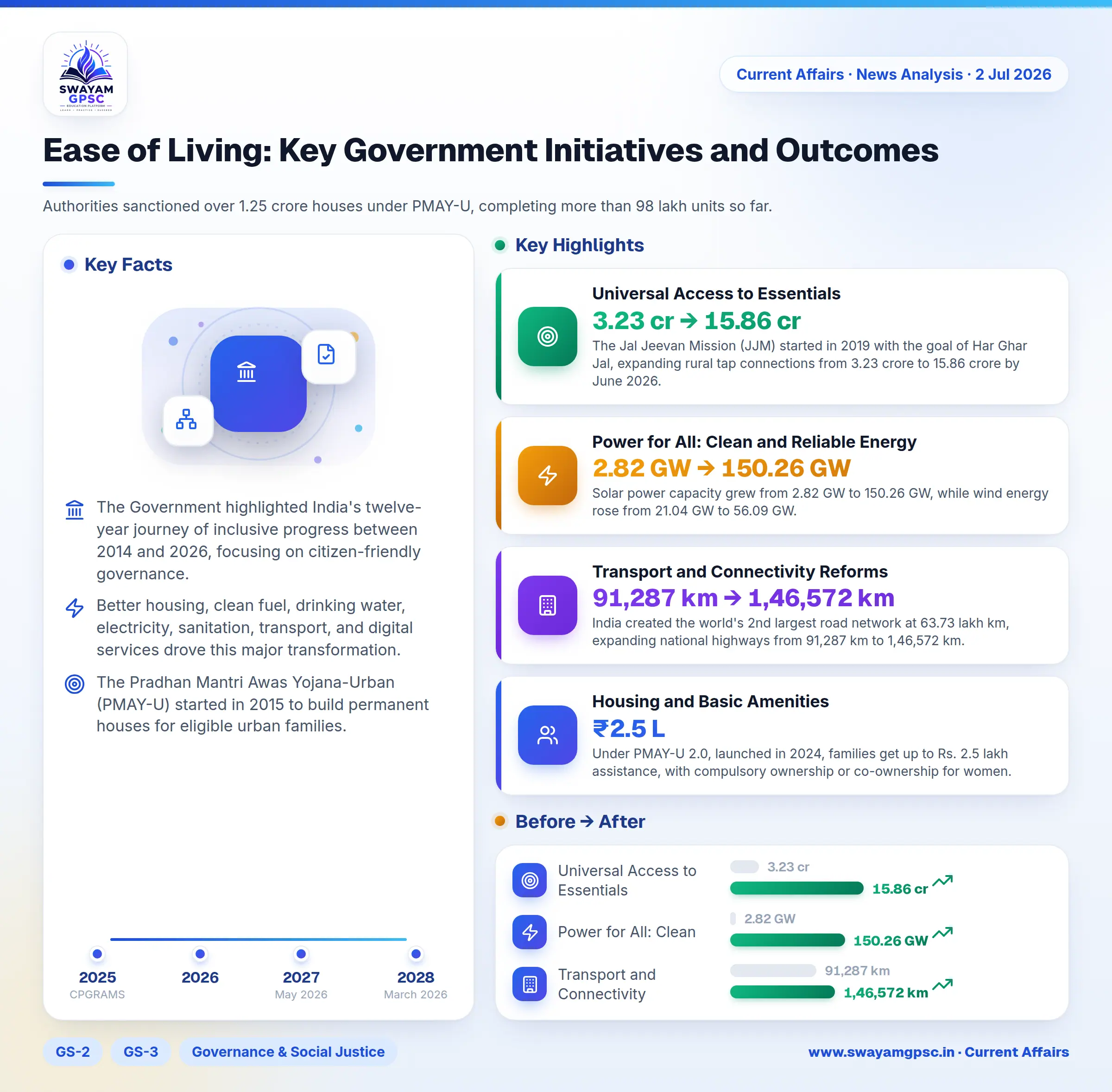
- The Government highlighted India's twelve-year journey of inclusive progress between 2014 and 2026, focusing on citizen-friendly governance.
- Better housing, clean fuel, drinking water, electricity, sanitation, transport, and digital services drove this major transformation.
Housing and Basic Amenities
- The Pradhan Mantri Awas Yojana-Urban (PMAY-U) started in 2015 to build permanent houses for eligible urban families.
- Under PMAY-U 2.0, launched in 2024, families get up to Rs. 2.5 lakh assistance, with compulsory ownership or co-ownership for women.
- Authorities sanctioned over 1.25 crore houses under PMAY-U, completing more than 98 lakh units so far.
- The Pradhan Mantri Awas Yojana-Gramin (PMAY-G) started in 2016, offering Rs. 1.20 lakh in plains and Rs. 1.30 lakh in hilly regions.
- Out of 3.98 crore targeted rural houses between 2016 and 2026, officials sanctioned 3.91 crore and completed 3.05 crore units.
- Women own or joint-own nearly 75% of all sanctioned rural houses under this flagship housing programme.
- Rural housing projects combine directly with water, electricity, and toilet schemes through inter-departmental convergence.
- Launched in 2015, AMRUT upgraded basic urban facilities like water supply, sewerage, and green spaces in 500 cities.
- Launched in 2021, AMRUT 2.0 expanded urban rejuvenation to all 4,800 towns with an outlay of Rs. 2.99 lakh crore.
- Sanctioned projects under AMRUT and AMRUT 2.0 reached Rs. 2.79 lakh crore, compared to Rs. 62,983 crore under the pre-2015 urban mission.
Universal Access to Essentials
- Launched in May 2016, PMUY provided clean LPG cooking gas connections to millions of rural households.
- The scheme achieved its initial 8 crore connection target by September 2019 before expanding through Ujjwala 2.0.
- Over 10.57 crore gas connections were issued under PMUY, raising national LPG coverage from 55.9% in 2014 to 107.2% in 2026.
- The Jal Jeevan Mission (JJM) started in 2019 with the goal of Har Ghar Jal, expanding rural tap connections from 3.23 crore to 15.86 crore by June 2026.
- The mission freed 9 crore women from carrying drinking water and saw 1.81 lakh villages certified as Har Ghar Jal.
- Water quality testing strengthened through 2,843 laboratories and field testing training for 24.80 lakh women.
- In March 2026, the government extended the mission till December 2028 under JJM 2.0 with Rs. 8.69 lakh crore total budget.
- The Swachh Bharat Mission-Gramin (SBM-G) raised rural sanitation coverage from 39% in 2014 to 100% in 2019.
- By June 2026, rural areas built 12.14 crore household toilets and 2.76 lakh community sanitary blocks.
- Over 5.69 lakh villages achieved ODF Plus status, while most villages set up solid and liquid waste management systems.
- Between 2014 and 2026, SBM-Urban built 63 lakh household toilets and 6 lakh community toilets across towns.
- Urban waste processing surged from 16% in 2014 to 82% in 2026, while door-to-door garbage collection reached 98%.
- The World Health Organization estimated that clean sanitation saved 3 lakh lives from diarrhoeal deaths in 2019 compared to 2014.
Power for All: Clean and Reliable Energy
- India double its total power generation capacity from 248 GW in 2014 to over 532 GW by March 2026.
- Renewable energy capacity expanded from 76.38 GW in 2014 to 274.69 GW in March 2026, placing India 3rd globally.
- Solar power capacity grew from 2.82 GW to 150.26 GW, while wind energy rose from 21.04 GW to 56.09 GW.
- Average daily rural power supply improved from 12.5 hours in 2014 to 22.6 hours in 2026, with urban supply reaching 23.4 hours.
- The national power transmission grid expanded to over 5 lakh circuit kilometres, operating as the world's largest single-frequency grid.
- Launched in 2017, the SAUBHAGYA scheme provided electricity connections to 2.86 crore un-electrified households before closing in March 2022.
- Launched in February 2024, PM Surya Ghar Muft Bijli Yojana offers up to Rs. 78,000 subsidy and 300 free electricity units monthly.
- Over 40 lakh households installed rooftop solar panels by May 2026, targeting 1 crore homes by 2027.
- Under the UJALA scheme, distribution of 37 crore LED bulbs saved households Rs. 19,153 crore annually in power bills.
Financial Inclusion and Empowerment
- Launched in August 2014, PMJDY opened bank accounts for unbanked citizens as part of the Jan Dhan-Aadhaar-Mobile initiative.
- Jan Dhan accounts grew from 14.72 crore in 2015 to over 58 crore in 2026, holding total deposits exceeding Rs. 3 lakh crore.
- In FY 2024-25, the government transferred Rs. 6.9 lakh crore directly into bank accounts across 327 direct benefit schemes.
- Banks issued 40.60 crore RuPay debit cards with built-in accident insurance cover to secure poor families financially.
- Launched in 2015, Pradhan Mantri Mudra Yojana provided collateral-free loans to micro-enterprises.
- The scheme sanctioned 57.7 crore loans worth Rs. 40 lakh crore, with 66% of total funds going to women entrepreneurs.
- Nearly half of all MUDRA loan beneficiaries belong to SC, ST, and OBC communities across the country.
- The Tarun Plus category introduced in FY 2024-25 raised the maximum loan limit to Rs. 20 lakh for repeat borrowers.
Transport and Connectivity Reforms
- India created the world's 2nd largest road network at 63.73 lakh km, expanding national highways from 91,287 km to 1,46,572 km.
- Major connectivity projects like Atal Tunnel, Dhola-Sadiya Bridge, Sudarshan Setu, and Dwarka Expressway boosted regional mobility and logistics.
- Under Pradhan Mantri Gram Sadak Yojana, all-weather road length reached 4.11 lakh km, connecting 99.6% of target rural habitations.
- Railway electrification reached 99.6% by March 2026, while safety technology like Kavach reduced annual accidents from 135 down to 16.
- Indian Railways introduced 162 Vande Bharat services and launched Amrit Bharat trains for affordable long-distance travel.
- Under the UDAN scheme, active operational airports grew from 74 in 2014 to 165 by 2026, serving 1.64 crore passengers.
- Operational metro networks expanded from 248 km across 5 cities to 1,155 km across 26 cities, making India's network the 3rd largest globally.
Governance Reforms
- The Jan Vishwas Act, 2023 replaced criminal penalties with civil fines for minor business compliance defaults.
- The Jan Vishwas Act, 2026 expanded decriminalisation to 717 provisions across 79 central laws to end harassment.
- The CPGRAMS portal resolved 6 lakh public grievances between 2025 and 2026, achieving a 69.8% citizen satisfaction rate.
- The MyGov engagement platform expanded to 60 million registered users across 28 states for direct participatory governance.
- Launched in 2021, the PM GatiShakti platform onboarded 58 ministries using 3,204 GIS layers for coordinated infrastructure planning.
Conclusion
- Citizen-centric and technology-driven governance models delivered rapid social development across urban and rural India.
- Providing basic services, robust infrastructure, and digital inclusion has set a firm base for achieving Viksit Bharat 2047.