E85 Fuel Rollout in India
#GS-3 #Economy #Infrastructure #Agriculture #Environment #Energy #Sustainable Development #Rapid Fire CA #Quick Facts For Prelims
Key takeaways
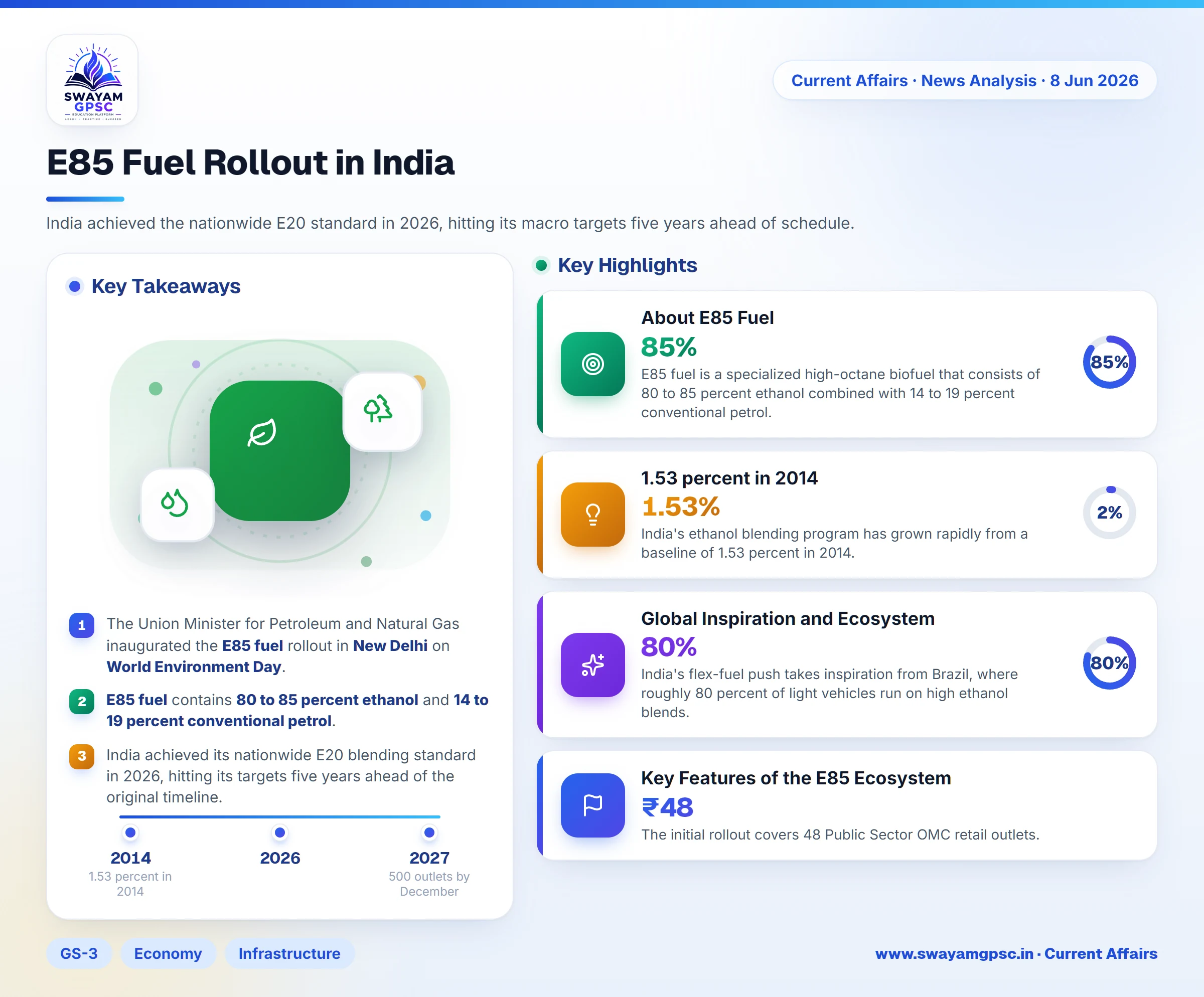
- The Union Minister for Petroleum and Natural Gas inaugurated the E85 fuel rollout in New Delhi on World Environment Day.
- E85 fuel contains 80 to 85 percent ethanol and 14 to 19 percent conventional petrol.
- India achieved its nationwide E20 blending standard in 2026, hitting its targets five years ahead of the original timeline.
- E85 is priced nearly ₹20 per litre lower than conventional petrol to provide direct savings to consumers.
- The rollout aims to expand from 48 retail outlets to 5,000 outlets by December 2027 to support India's 26 percent ethanol blending target by 2030-31.
Why in News
- The Union Minister for Petroleum and Natural Gas recently introduced the E85 fuel rollout in New Delhi on World Environment Day.
- This launch marks a major milestone in India's ongoing transition toward flexible fuel technology.
About E85 Fuel
- E85 fuel is a specialized high-octane biofuel that consists of 80 to 85 percent ethanol combined with 14 to 19 percent conventional petrol.
- It is built exclusively for modified internal combustion engines rather than standard petroleum cars.
- India's ethanol blending program has grown rapidly from a baseline of 1.53 percent in 2014.
- India achieved the nationwide E20 standard in 2026, hitting its macro targets five years ahead of schedule.
Global Inspiration and Ecosystem
- India's flex-fuel push takes inspiration from Brazil, where roughly 80 percent of light vehicles run on high ethanol blends.
- The dual objective of introducing E85 is to pass domestic economic benefits to drivers and lower India's heavy crude oil import bill.
- It also establishes a sustainable alternative to accelerate urban decarbonization across the country.
Key Features of the E85 Ecosystem
- Standard petrol and E20 vehicles will continue to operate normally, but E85 is reserved strictly for flex-fuel vehicles (FFVs) capable of handling blends from E20 to E100.
- Only three vehicle models compatible with this fuel are currently available in the Indian market.
- The initial rollout covers 48 Public Sector OMC retail outlets.
- The government plans to expand this to 500 outlets by December 2026 and 5,000 outlets by December 2027.
- Fuel dispensers will feature clear warning labels stating that only E85-compliant cars can use the pump to prevent accidental misfueling.
- E85 is priced nearly ₹20 per litre lower than conventional petrol, transferring the financial savings of domestic ethanol production directly to consumers.
- Vehicles running on E85 can reduce lifecycle greenhouse gas emissions by around 61 percent while producing near-zero particulate matter.
- With a Research Octane Number (RON) of ~108, this fuel allows engines to run at higher compression ratios and better ignition timing.
- The government is promoting supportive state-level taxation policies for E85 and FFVs.
- This rollout serves as a key tool to help India achieve nearly 26 percent overall ethanol blending by 2030-31.
Strategic Importance
- The adoption of E85 helps reduce crude oil import dependence and strengthens national energy security.
- It supports farmers' income by creating a steady demand for agricultural produce used in ethanol creation.
- It promotes cleaner mobility while following the proven viability seen in countries like Brazil.