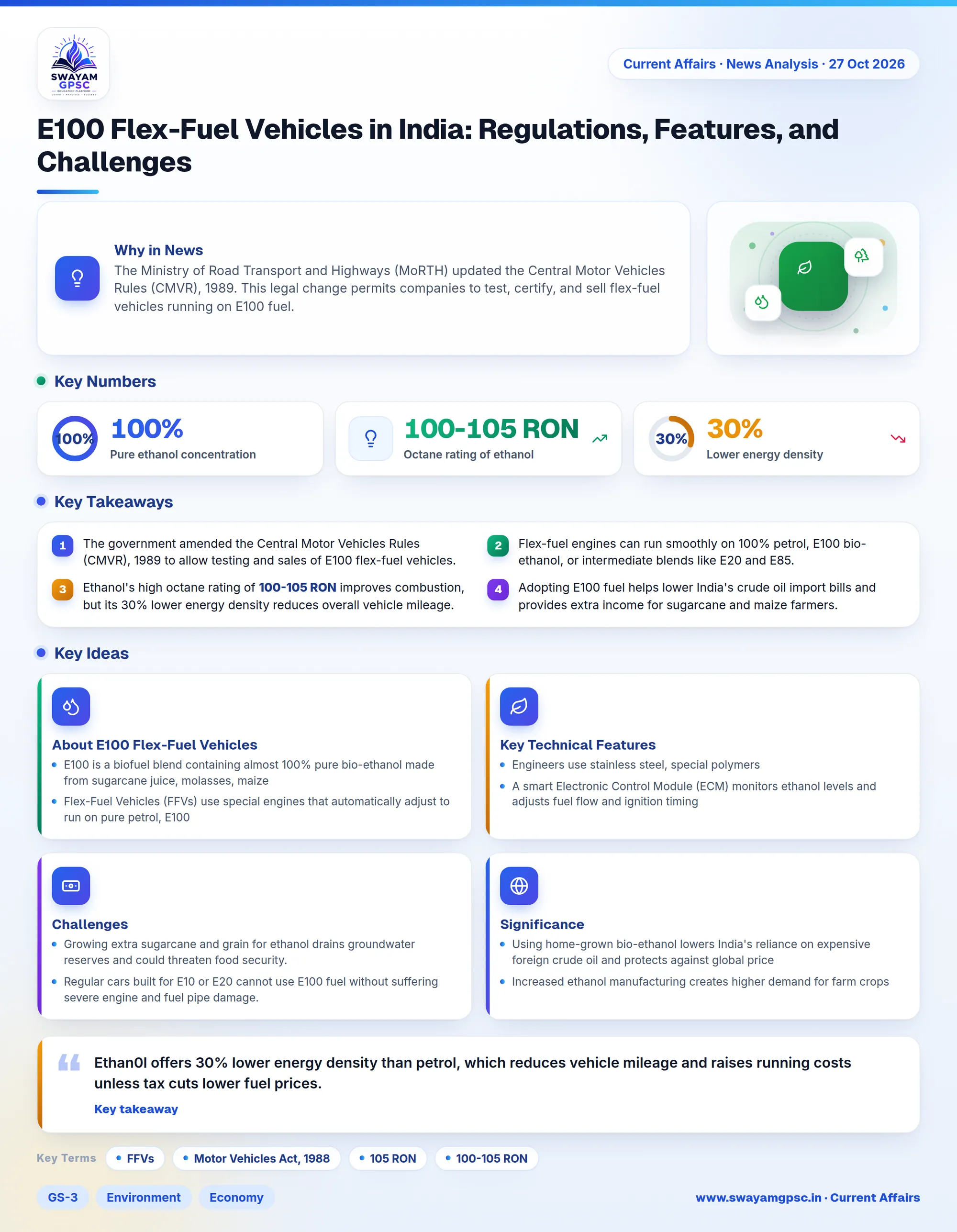
E100 Flex-Fuel Vehicles in India: Regulations, Features, and Challenges
#GS-3 #Environment #Economy #Climate Change #Infrastructure #Agriculture #Current Events #National
Key takeaways
- The government amended the Central Motor Vehicles Rules (CMVR), 1989 to allow testing and sales of E100 flex-fuel vehicles.
- Flex-fuel engines can run smoothly on 100% petrol, E100 bio-ethanol, or intermediate blends like E20 and E85.
- Ethanol's high octane rating of 100-105 RON improves combustion, but its 30% lower energy density reduces overall vehicle mileage.
- Adopting E100 fuel helps lower India's crude oil import bills and provides extra income for sugarcane and maize farmers.
Why in News
- The Ministry of Road Transport and Highways (MoRTH) updated the Central Motor Vehicles Rules (CMVR), 1989.
- This legal change permits companies to test, certify, and sell flex-fuel vehicles running on E100 fuel.
About E100 Flex-Fuel Vehicles
- E100 is a biofuel blend containing almost 100% pure bio-ethanol made from sugarcane juice, molasses, maize, or damaged grains.
- Flex-Fuel Vehicles (FFVs) use special engines that automatically adjust to run on pure petrol, E100, or any mixed blend like E20 or E85.
- The Ministry of Road Transport and Highways leads this initiative alongside the Ministry of Petroleum and Natural Gas.
- The government enacted these legal changes under the Motor Vehicles Act, 1988.
- This policy aims to clean up road transport, cut costly crude oil imports, boost farmer incomes, and create a market for flexible-fuel vehicles.
Key Technical Features
- Engineers use stainless steel, special polymers, and fluorocarbon seals to stop ethanol from corroding the fuel system.
- A smart Electronic Control Module (ECM) monitors ethanol levels and adjusts fuel flow and ignition timing automatically.
- Ethanol has a high octane rating between 100 and 105 RON, which prevents engine knocking and boosts efficiency.
- Fuel injectors are 30% larger to pump extra fuel, balancing out ethanol's lower energy content compared to petrol.
- Cars include fuel heaters or small petrol injectors to help the engine start smoothly in cold weather.
Challenges
- Ethan0l offers 30% lower energy density than petrol, which reduces vehicle mileage and raises running costs unless tax cuts lower fuel prices.
- Growing extra sugarcane and grain for ethanol drains groundwater reserves and could threaten food security.
- Regular cars built for E10 or E20 cannot use E100 fuel without suffering severe engine and fuel pipe damage.
Significance
- Using home-grown bio-ethanol lowers India's reliance on expensive foreign crude oil and protects against global price spikes.
- Increased ethanol manufacturing creates higher demand for farm crops, raising rural incomes and generating local jobs in distilleries.