DRDO Missile Breakthrough and Ballistic Missile Defence
#GS-3 #Defence Technology #Indigenization of Technology #Economy #Infrastructure
Key takeaways
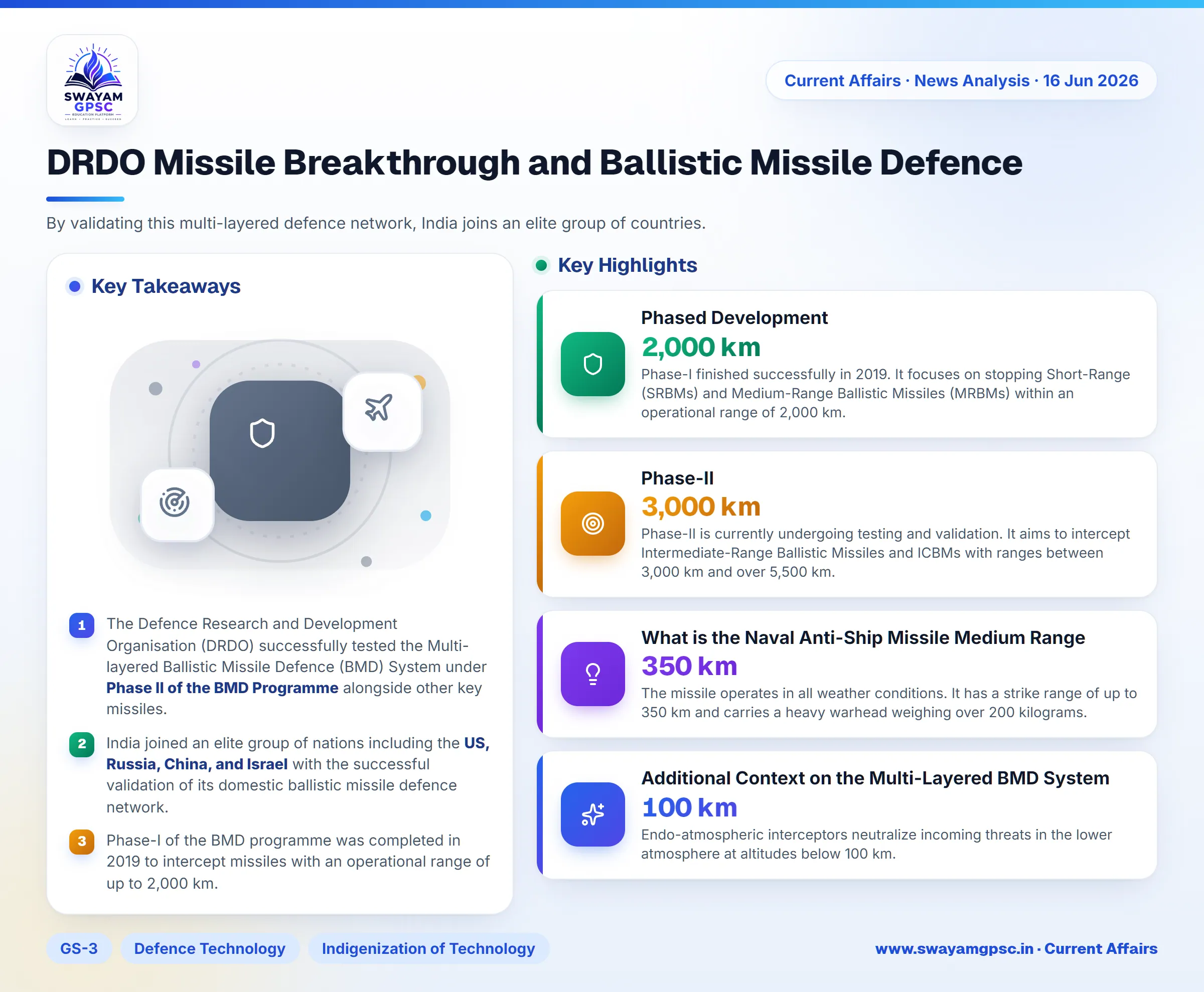
- The Defence Research and Development Organisation (DRDO) successfully tested the Multi-layered Ballistic Missile Defence (BMD) System under Phase II of the BMD Programme alongside other key missiles.
- India joined an elite group of nations including the US, Russia, China, and Israel with the successful validation of its domestic ballistic missile defence network.
- Phase-I of the BMD programme was completed in 2019 to intercept missiles with an operational range of up to 2,000 km.
- The newly tested Naval Anti-Ship Missile-Medium Range (NASM-MR) features an operational strike range of up to 350 km and carries a warhead weighing over 200 kilograms.
Why in News
- The Defence Research and Development Organisation (DRDO) recently tested three major missile systems to prove India's military strength. This includes verifying the Multi-layered Ballistic Missile Defence (BMD) System under Phase II of the BMD Programme. It also features the first test of the Naval Anti-Ship Missile-Medium Range (NASM-MR). Finally, it includes a successful flight test of the Long-Range Land Attack Cruise Missile (LRLACM).
What is the Multi-layered Ballistic Missile Defence System
- A Ballistic Missile Defence system works as an automated network of long-range radars, command centres, and interceptor missiles. Its main job is to detect, track, and destroy incoming hostile ballistic missiles before they hit their targets.
- The DRDO started developing this domestic missile defence project in 1999 after regional tensions involving nuclear and missile capabilities increased.
- By validating this multi-layered defence network, India joins an elite group of countries. This group includes the US, Russia, China, and Israel, all of which can intercept advanced threats like Intercontinental Ballistic Missiles (ICBMs).
- The system uses a two-tier structure. Exo-atmospheric interceptors destroy targets outside the atmosphere, while endo-atmospheric interceptors neutralize threats inside the atmosphere.
- These tests bring India closer to achieving Mission Sudarshan Chakra. This mission aims to build a strong missile defence shield to protect critical military installations and national infrastructure.
Phased Development
- Phase-I finished successfully in 2019. It focuses on stopping Short-Range (SRBMs) and Medium-Range Ballistic Missiles (MRBMs) within an operational range of 2,000 km.
- The first phase uses a two-tier network. The Prithvi Defence Vehicle (PDV) handles Exo-atmospheric interception outside the atmosphere. Meanwhile, the Advanced Air Defence (AAD) handles Endo-atmospheric interception.
- The system relies heavily on the Long Range Tracking Radar (LRTR), commonly known as Swordfish. This active phased array radar tracks multiple high-speed targets across vast distances.
- Phase-II is currently undergoing testing and validation. It aims to intercept Intermediate-Range Ballistic Missiles and ICBMs with ranges between 3,000 km and over 5,500 km.
- This phase uses two new high-speed solid-propellant interceptors. The AD-1 is a long-range interceptor built for low exo-atmospheric and endo-atmospheric use. The AD-2 is designed to intercept faster intermediate-range and ICBM-class trajectories.
- Phase-III is currently under development to counter next-generation weapons. It includes the AD-AH (Anti-Hypersonic) to neutralize Hypersonic Glide Vehicles (HGVs) traveling above Mach 5. It also includes the AD-AM (Anti-Missile) to counter Multiple Independently Targetable Re-entry Vehicles or MIRVs.
What is the Naval Anti-Ship Missile Medium Range
- The Naval Anti-Ship Missile-Medium Range (NASM-MR) is a subsonic, sea-skimming cruise missile built indigenously by DRDO for the Indian Navy. It destroys small-to-medium hostile warships like frigates, corvettes, and destroyers.
- This missile supports versatile deployment. Its architecture will soon include ship-launched, air-launched, and submarine-launched variants.
- The NASM-MR works alongside the existing Naval Anti-Ship Missile-Short Range (NASM-SR), which is tested from helicopters, to create a multi-tier defence against enemy warships.
- An indigenous Small Gas Turbine Jet Engine (SGTJE) powers the missile. It uses a sea-skimming flight profile to stay hidden from radar and avoid warship defences.
- The missile operates in all weather conditions. It has a strike range of up to 350 km and carries a heavy warhead weighing over 200 kilograms.
- It uses a dual-mode terminal guidance package. This system combines an active radar seeker with an imaging infrared (IR) seeker to ensure high accuracy against electronic countermeasures.
Long Range Land Attack Cruise Missile
- The LRLACM is a fully indigenous missile system. Multiple DRDO laboratories and Indian industry partners worked together on its critical parts to support the Aatmanirbhar Bharat initiative in defence manufacturing.
- The Aeronautical Development Establishment (ADE) in Bengaluru served as the nodal laboratory leading the LRLACM programme.
- Inducting this missile will boost the armed forces' readiness. It strengthens India’s long-range precision strike capabilities deep inside enemy territory.
Additional Context on the Multi-Layered BMD System
- The multi-layered system functions as an advanced military network of long-range tracking radars, synchronized command centres, and interceptor missiles.
- This defence shield acts like India's indigenous Iron Dome. It protects major strategic installations, metropolitan cities, and population centres from sudden missile attacks.
- Exo-atmospheric interceptors execute high-altitude kill missions in outer space and the upper atmosphere.
- Endo-atmospheric interceptors neutralize incoming threats in the lower atmosphere at altitudes below 100 km.
- The advanced interceptors can counter IRBMs and hostile aircraft operating at distances between 2,000 km and 5,000 km.