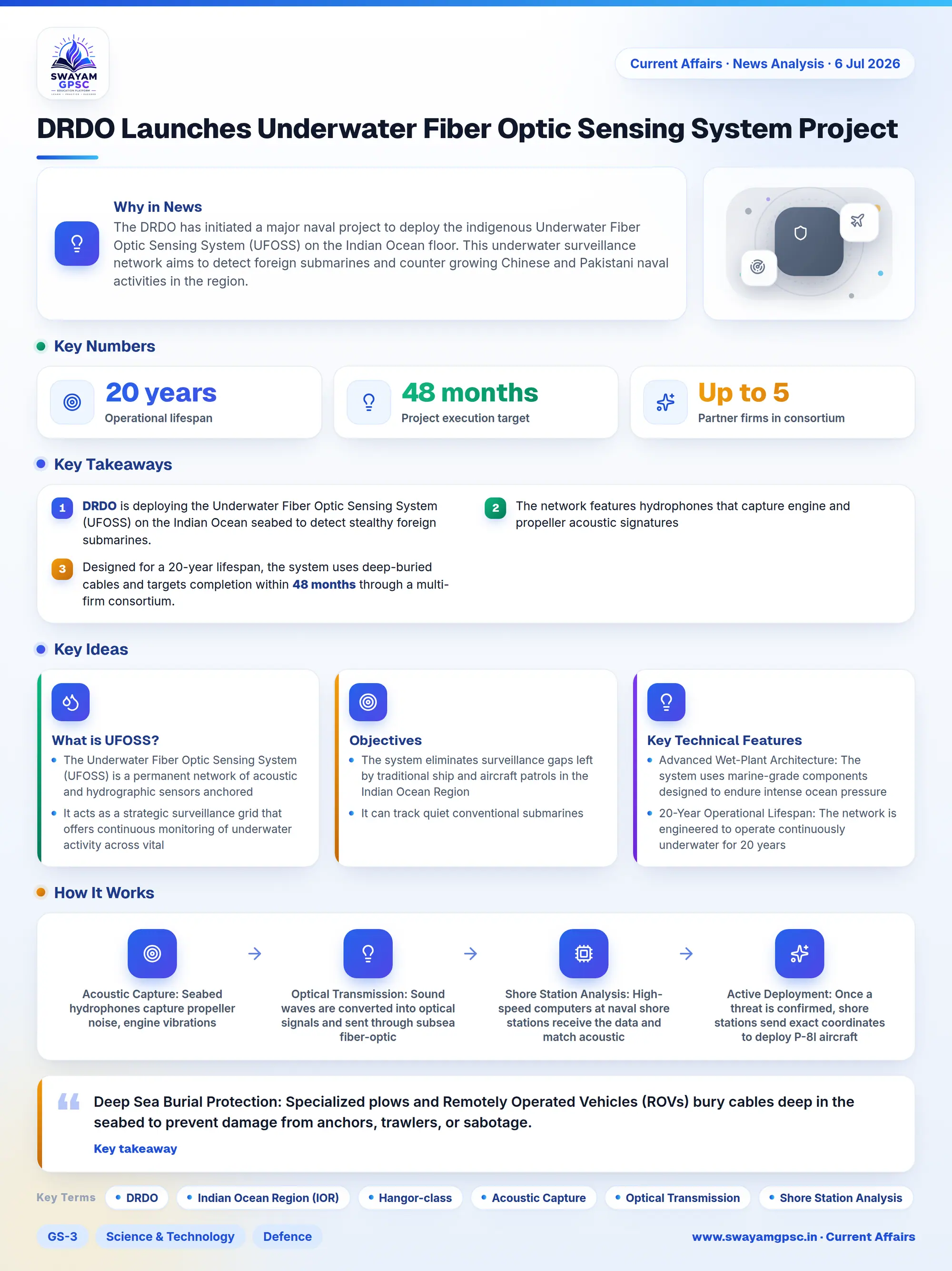
DRDO Launches Underwater Fiber Optic Sensing System Project
#GS-3 #Science & Technology #Defence #ICT #Current Events #National #Underwater Fiber Optic Sensing System #DRDO #Maritime Security
Why in News
- The **DRDO** has initiated a major naval project to deploy the indigenous **Underwater Fiber Optic Sensing System (UFOSS)** on the Indian Ocean floor.
- This underwater surveillance network aims to detect foreign submarines and counter growing Chinese and Pakistani naval activities in the region.
What is UFOSS?
- The **Underwater Fiber Optic Sensing System (UFOSS)** is a permanent network of acoustic and hydrographic sensors anchored to the seabed.
- It acts as a strategic surveillance grid that offers continuous monitoring of underwater activity across vital maritime choke points.
Objectives
- The system eliminates surveillance gaps left by traditional ship and aircraft patrols in the **Indian Ocean Region (IOR)**.
- It can track quiet conventional submarines, such as Pakistan's **Hangor-class** boats with **Air-Independent Propulsion (AIP)**, and Chinese nuclear submarines.
How It Works
- **Acoustic Capture**: Seabed hydrophones capture propeller noise, engine vibrations, and machinery hums whenever an unauthorized vessel passes over the network.
- **Optical Transmission**: Sound waves are converted into optical signals and sent through subsea fiber-optic cables, junction boxes, and branching units.
- **Shore Station Analysis**: High-speed computers at naval shore stations receive the data and match acoustic signatures against a database to identify the ship.
- **Active Deployment**: Once a threat is confirmed, shore stations send exact coordinates to deploy **P-8I** aircraft, **MH-60R** helicopters, or nearby warships for interception.
Key Technical Features
- **Advanced Wet-Plant Architecture**: The system uses marine-grade components designed to endure intense ocean pressure and saltwater corrosion.
- **20-Year Operational Lifespan**: The network is engineered to operate continuously underwater for **20 years** without needing regular maintenance.
- **Deep Sea Burial Protection**: Specialized plows and **Remotely Operated Vehicles (ROVs)** bury cables deep in the seabed to prevent damage from anchors, trawlers, or sabotage.
- **Consortium-Led Integration**: A lead bidder can collaborate with up to **5** engineering firms to pool expertise in subsea cables, marine surveys, and monitoring software.
- **48-Month Execution Target**: The setup and procurement timeline spans **48 months** from the contract award, led by a dedicated system integrator.