Draft Regulations for Artificial Intelligence Use in Indian Courts 2026
#GS-2 #GS-3 #Indian Polity & Constitution #Judiciary #Governance & Social Justice #E-Governance #Science & Technology #Artificial Intelligence #National
Why in News
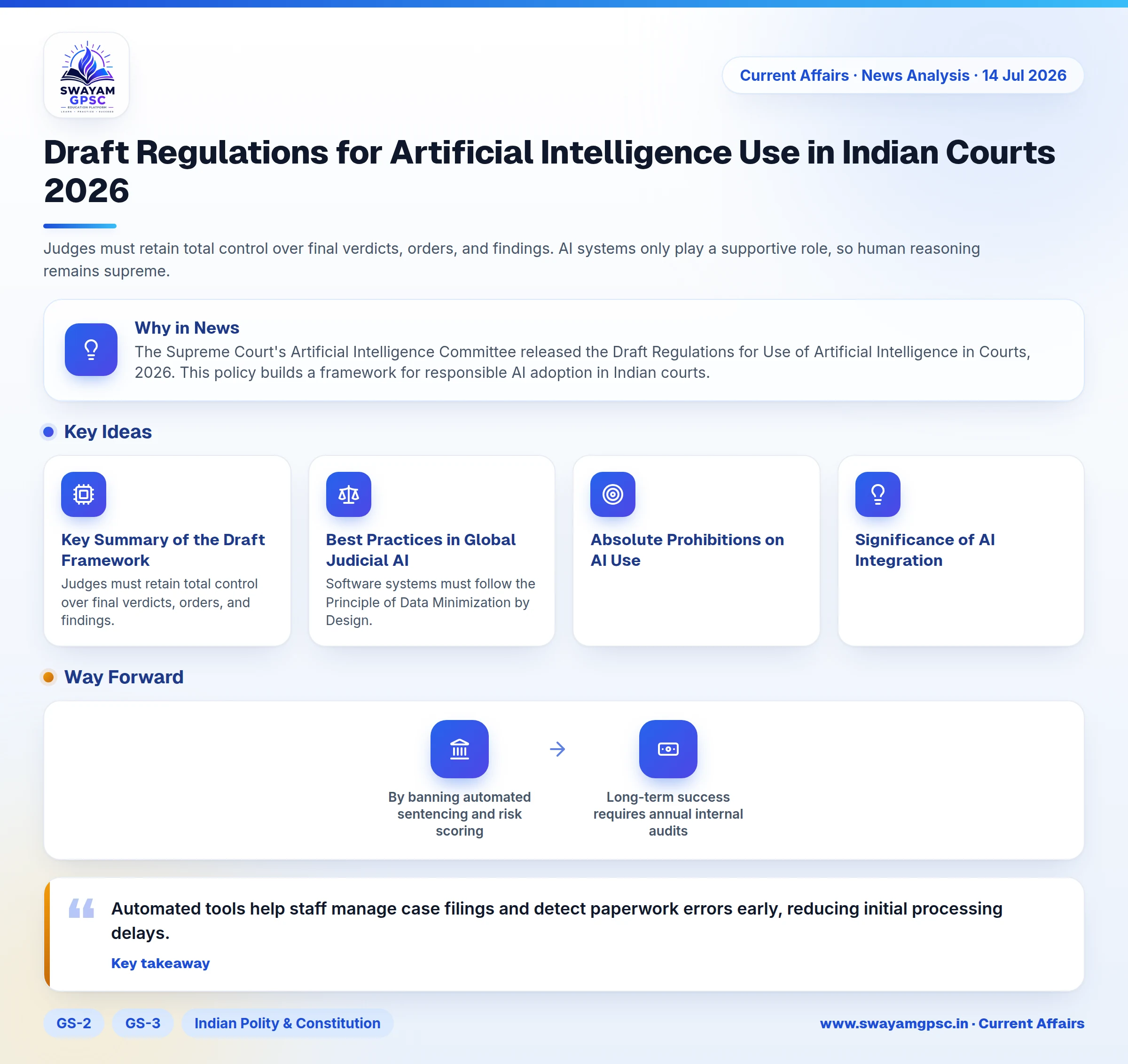
- The Supreme Court's Artificial Intelligence Committee released the Draft Regulations for Use of Artificial Intelligence in Courts, 2026. This policy builds a framework for responsible AI adoption in Indian courts.
- This draft policy sets up a clear ethical structure to control, optimize, and safely integrate AI tools across the entire judicial system.
Key Summary of the Draft Framework
- Judges must retain total control over final verdicts, orders, and findings. AI systems only play a supportive role, so human reasoning remains supreme.
- A permanent Apex Body at the Supreme Court will oversee governance. It will include sitting judges from the Supreme Court and High Courts, MeitY officials, and tech experts.
- Courts must conduct a Technical and Ethical Impact Assessment before deploying any AI application. This test checks data quality, cybersecurity, explainability, and potential AI errors.
- Private tech vendors face strict data privacy rules. They cannot use confidential court records to train private models or claim ownership over public judicial tools.
- Courts must test high-risk AI software in isolated setups called Controlled Environment Testing. Every court must also maintain a public AI Register and an internal AI Incident Database.
- Every High Court must establish a clear manual backup plan. This ensures court activities continue without interruption if AI software fails unexpectedly.
- Courts must notify litigants and lawyers whenever a judge uses an approved AI tool to process a case.
- Litigants who face harm from prohibited AI usage can request an immediate formal hearing and relief from the relevant court.
Best Practices in Global Judicial AI Governance
- Software systems must follow the Principle of Data Minimization by Design. Tools should collect and store only the minimal personal data needed for a task.
- Courts must conduct annual internal audits. Keeping technical and ethical audits in-house prevents private contractors from accessing raw citizen data and source codes.
- High-risk systems must avoid opaque logic. Courts require complete algorithmic transparency so judges and citizens can understand how software reached its result.
Absolute Prohibitions on AI Use in Courts
- AI cannot act as an independent judge or issue legal sentences without a mandatory Human-in-the-Loop structure.
- Courts cannot use AI to perform Behavioral Risk Scoring to predict flight risk, judge bail eligibility, or project future behavior.
- Systems with hidden decision-making logic, known as black box systems, are banned in cases affecting personal freedom.
- Courts cannot use AI tools for continuous monitoring or surveillance of judges, lawyers, or visitors on court premises.
- Litigants cannot submit AI-generated text or documents as independent evidence without clearly declaring their origin.
Significance of AI Integration in the Judiciary
- Automated tools help staff manage case filings and detect paperwork errors early, reducing initial processing delays.
- Analytical tools assist court registries in tracking judge performance and workload, allowing better distribution of pending cases.
- Automated translation tools convert complex judgments into regional languages, making legal orders easier for local communities to understand.
- Modern search systems quickly pull up relevant past cases and legal documents, saving hours of manual research time for legal teams.
- Features like speech-to-text and automated transcription improve access to court proceedings for people with disabilities.
Way Forward
- By banning automated sentencing and risk scoring, this draft policy protects individual rights from machine bias.
- Long-term success requires annual internal audits, active operationalization of the CoRE-AI research engine, and proper budget support for court staff.