Draft National Health Research Policy 2026: Key Features and Impact
#GS-2 #GS-3 #Governance & Social Justice #Health #Education #Science & Technology #Artificial Intelligence #National
Why in News
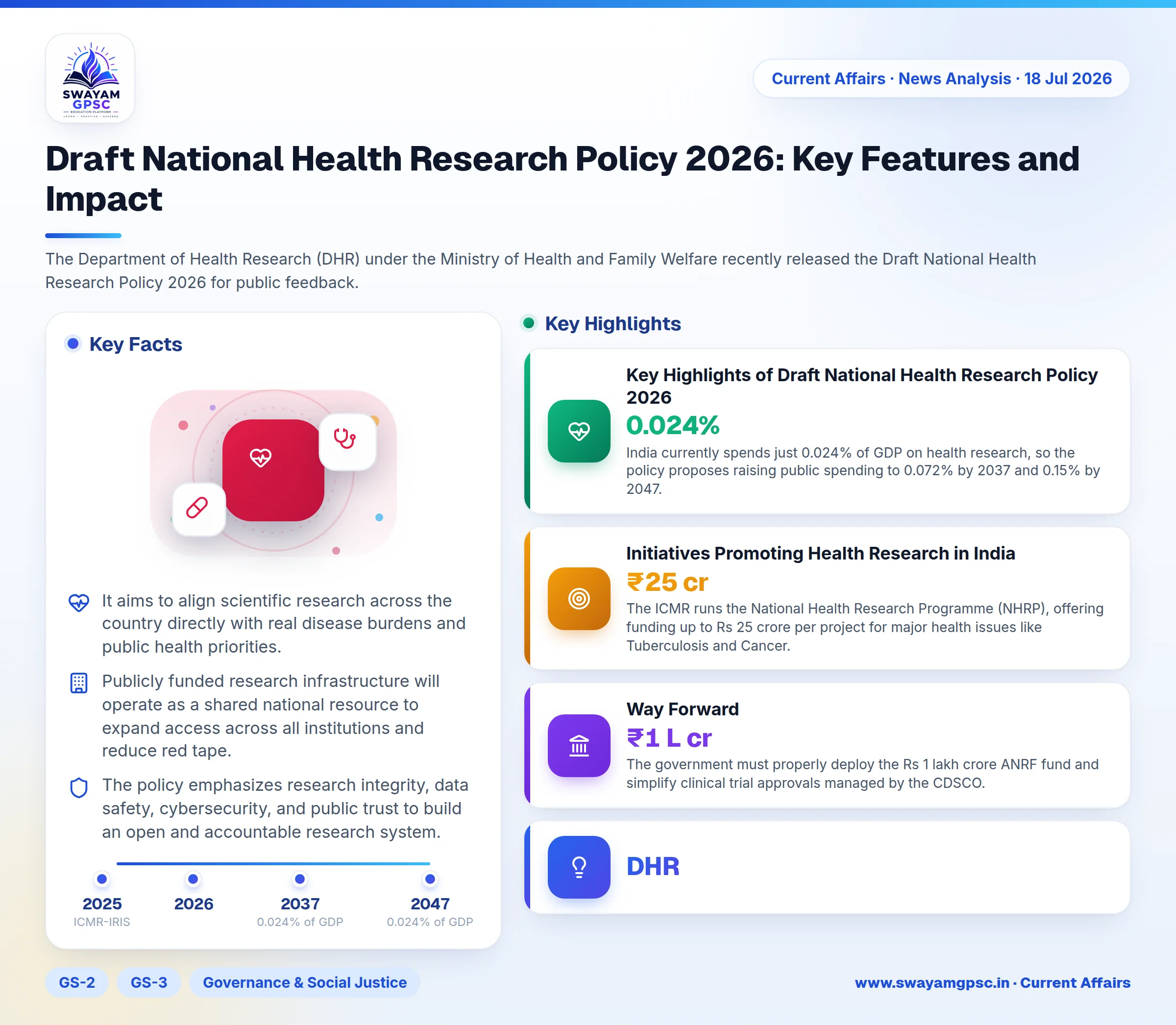
- The Department of Health Research (DHR) under the Ministry of Health and Family Welfare recently released the Draft National Health Research Policy 2026 for public feedback.
- This draft represents India's first unified framework designed to bridge biomedical science, clinical medicine, public health, epidemiology, digital health, and artificial intelligence.
- It aims to align scientific research across the country directly with real disease burdens and public health priorities.
Key Highlights of Draft National Health Research Policy 2026
- The policy proposes setting up the National Health Research Agenda (NHRA) to set research priorities based on disease burden, health equity, pandemic readiness, and strategic national goals.
- It establishes a three-tier governance model: the National Health Research Stewardship Committee for strategy, the Department of Health Research (DHR) for execution, and the Indian Council of Medical Research (ICMR) for technical leadership.
- It moves away from evaluation based only on papers and patents, opting instead for real-world impact measured by the ICMR Impact of Research and Innovation Scale (ICMR-IRIS) introduced in 2025.
- India currently spends just 0.024% of GDP on health research, so the policy proposes raising public spending to 0.072% by 2037 and 0.15% by 2047.
- It targets key emerging areas such as artificial intelligence (AI), health data science, cell therapy, gene therapy, precision medicine, and climate health alongside traditional diseases like Tuberculosis and Antimicrobial Resistance.
- Publicly funded research infrastructure will operate as a shared national resource to expand access across all institutions and reduce red tape.
- The policy emphasizes research integrity, data safety, cybersecurity, and public trust to build an open and accountable research system.
Need for National Health Research Policy
- Health research in India remains scattered across bodies like ICMR, Department of Biotechnology (DBT), CSIR, AIIMS, and state medical universities, causing duplicated effort and slow policy translation.
- Top institutions like ICMR and AIIMS hold most research capacity, while Tier-II and Tier-III medical colleges lack essential infrastructure and scientific personnel.
- Current research priorities often miss India's actual health shifts, where infectious diseases, Non-Communicable Diseases (NCDs), and climate-sensitive illnesses occur at the same time.
- A system focused strictly on journal papers creates a gap where scientific findings rarely become affordable local treatments or practical public policy.
- Rapid growth in Artificial Intelligence (AI), genomics, precision medicine, and digital health tools has moved faster than current regulatory processes.
- India ranked 66th out of 195 nations in the Global Health Security Index (2021), showing a clear need for stronger local disease surveillance and pandemic preparedness.
- Scientific credibility has suffered due to poor practices like fake data, plagiarism, peer-review fraud, weak oversight, and manipulative citations.
Initiatives Promoting Health Research in India
- The ICMR runs the National Health Research Programme (NHRP), offering funding up to Rs 25 crore per project for major health issues like Tuberculosis and Cancer.
- The ICMR introduced specialized grants such as the First in the World Challenge (FIWC), Anveshan Grants, and Nischayak Grants to encourage early innovation and local medical technology.
- The DHR manages the Human Resource Development (HRD) Scheme using Women Scientist Fellowships, Start-up Grants, and NRI/OCI Fellowships to build a skilled workforce.
- The government is building Multi-Disciplinary Research Units (MRUs) in medical colleges, Model Rural Health Research Units (MRHRUs), and a nation-wide network of Viral Research and Diagnostic Laboratories (VRDLs).
- The Anusandhan National Research Foundation (ANRF) was created to promote research culture and fund innovation across the country.
- In 2026, ISRO and AIIMS signed an agreement to advance space medicine and create medical protocols for long space flights, including the Bharatiya Antariksh Station.
Way Forward
- India needs to shift its focus from being a manufacturing hub for generic medicines to becoming a global leader in discovering novel treatments.
- The government must properly deploy the Rs 1 lakh crore ANRF fund and simplify clinical trial approvals managed by the CDSCO.
- Building a cooperative model between Government, Academia, and Industry will help India secure long-term independence in healthcare.