Draft National Food Security (Amendment) Bill 2026 and Key Concerns
#GS-2 #Governance & Social Justice #Poverty #Hunger #Welfare Schemes #GS-3 #Economy #Food Security
Why in News
- The Union Government proposed new changes to food grain allocation under the Antyodaya Anna Yojana (AAY) within the National Food Security Act, 2013. These changes have started a public discussion about how they might affect poor families and state allocations.
Summary
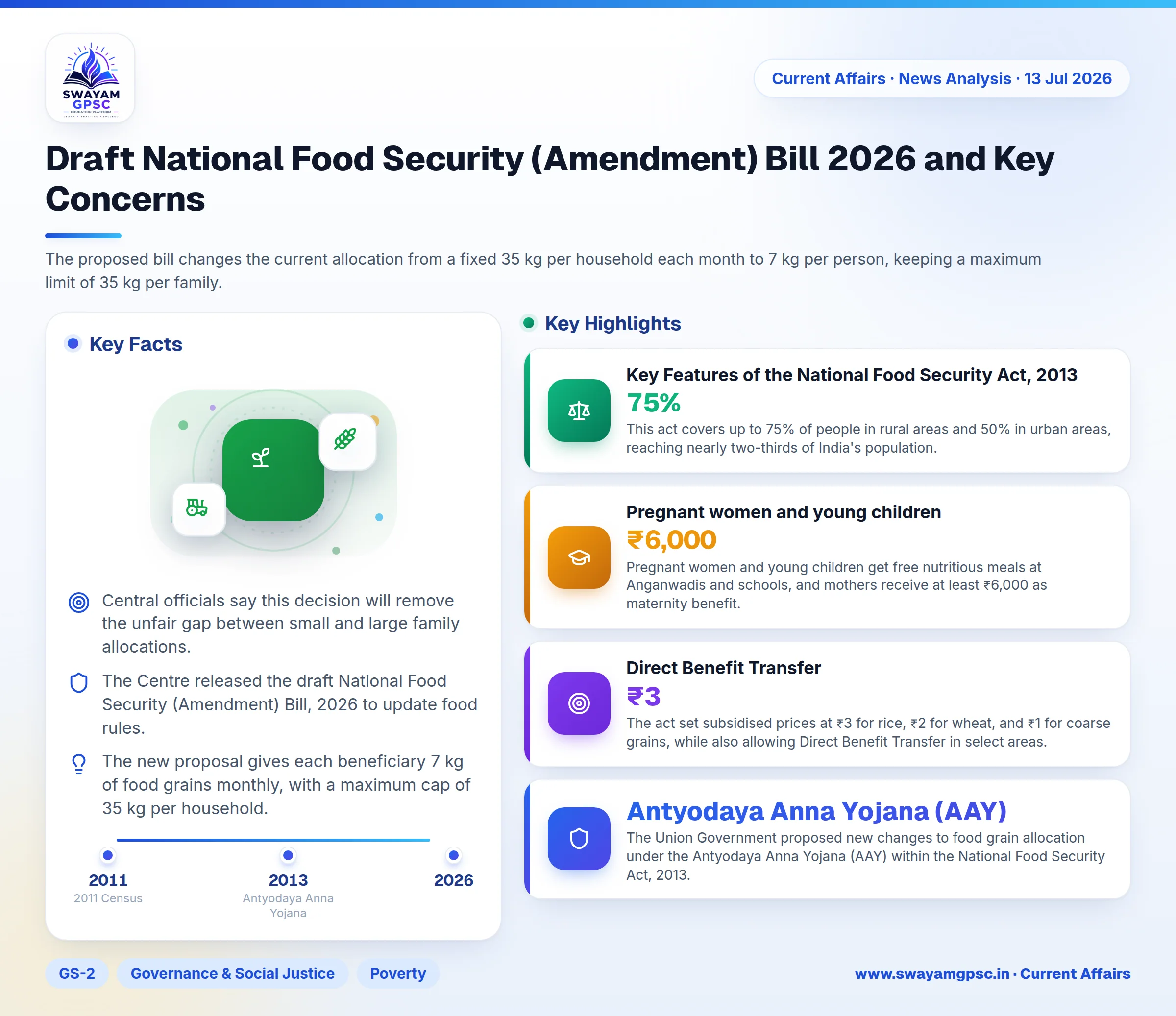
- The proposed bill changes the current allocation from a fixed 35 kg per household each month to 7 kg per person, keeping a maximum limit of 35 kg per family.
- Central officials say this decision will remove the unfair gap between small and large family allocations.
- However, states like Tamil Nadu and Kerala, along with social workers, worry that small families might lose out on essential food supply under the new system.
Key Aspects of the Draft National Food Security (Amendment) Bill, 2026
- The Centre released the draft National Food Security (Amendment) Bill, 2026 to update food rules. Officials will talk to state governments and experts before putting the final bill in Parliament.
- Under the current National Food Security Act, 2013, every AAY family gets a fixed total of 35 kg of food grains every month no matter how many people live in that house.
- The new proposal gives each beneficiary 7 kg of food grains monthly, with a maximum cap of 35 kg per household. This means only families with five or more members will get the full 35 kg quota.
- The government wants to remove inequality in per person food distribution. Currently, smaller families get more food per person while larger families get less per person.
- Under the proposed system, families with one, two, three, or four members will receive 7 kg, 14 kg, 21 kg, and 28 kg respectively. Families with more than five members will still get only 35 kg in total.
Key Features of the National Food Security Act, 2013
- Passed in 2013, the National Food Security Act (NFSA) turned welfare food schemes into a legal right for Indian citizens.
- This act covers up to 75% of people in rural areas and 50% in urban areas, reaching nearly two-thirds of India's population.
- Under this law, AAY families get 35 kg per month, while Priority Households receive 5 kg per person each month.
- State governments and Union Territories identify eligible families, issue ration cards, and remove fake entries regularly.
- To support women empowerment, the eldest woman aged 18 years or older is registered as the head of the household on ration cards.
- Pregnant women and young children get free nutritious meals at Anganwadis and schools, and mothers receive at least ₹6,000 as maternity benefit.
- If the government fails to supply monthly food grains or meals, beneficiaries can claim a Food Security Allowance from the state.
- The Centre buys and transports the food grains to states, while states distribute them through Fair Price Shops and handle grievances.
- The act set subsidised prices at ₹3 for rice, ₹2 for wheat, and ₹1 for coarse grains, while also allowing Direct Benefit Transfer in select areas.
Major Criticisms of the Proposed NFSA Amendment
- Replacing the fixed 35 kg allocation with 7 kg per person will heavily reduce monthly rations for small families, widows, elderly people, and disabled individuals.
- Putting a ceiling cap of 35 kg per household harms bigger families, as homes with more than five members will get less than 7 kg per person.
- Critics warn this rule harms southern states that controlled their population successfully and now have smaller average family sizes.
- The bill only offers grains like wheat and rice, leaving out necessary nutritious items like pulses and cooking oil which poor families cannot afford to buy from open markets.
- The policy still uses old data from the 2011 Census, leaving millions of newly deserving poor families out of the food security safety net.
- The reform ignores practical difficulties faced by poor citizens such as biometric identification failures and missing home addresses.
Way Forward
- The government must make sure no poor AAY family receives less than their current 35 kg monthly allocation, especially single elderly citizens and disabled individuals.
- If the government chooses a per person system, it should remove the 35 kg upper limit so large families get their full quota.
- The Public Distribution System should include essential items like pulses and edible oils alongside basic cereals to ensure complete health security.
- The Ministry needs to update beneficiary limits using recent population figures instead of relying on old 2011 Census numbers.
- Authorities should fix e-KYC technical errors and consult state governments and public rights experts before passing the final law.
Conclusion
- The proposed draft aims to bring balance to food distribution by switching from family-based quotas to individual quotas.
- However, setting a maximum cap without fixing a minimum lower limit can hurt small poor families in states with nuclear households.
- The central government must balance efficiency with social welfare so that no poor person loses their basic right to food.