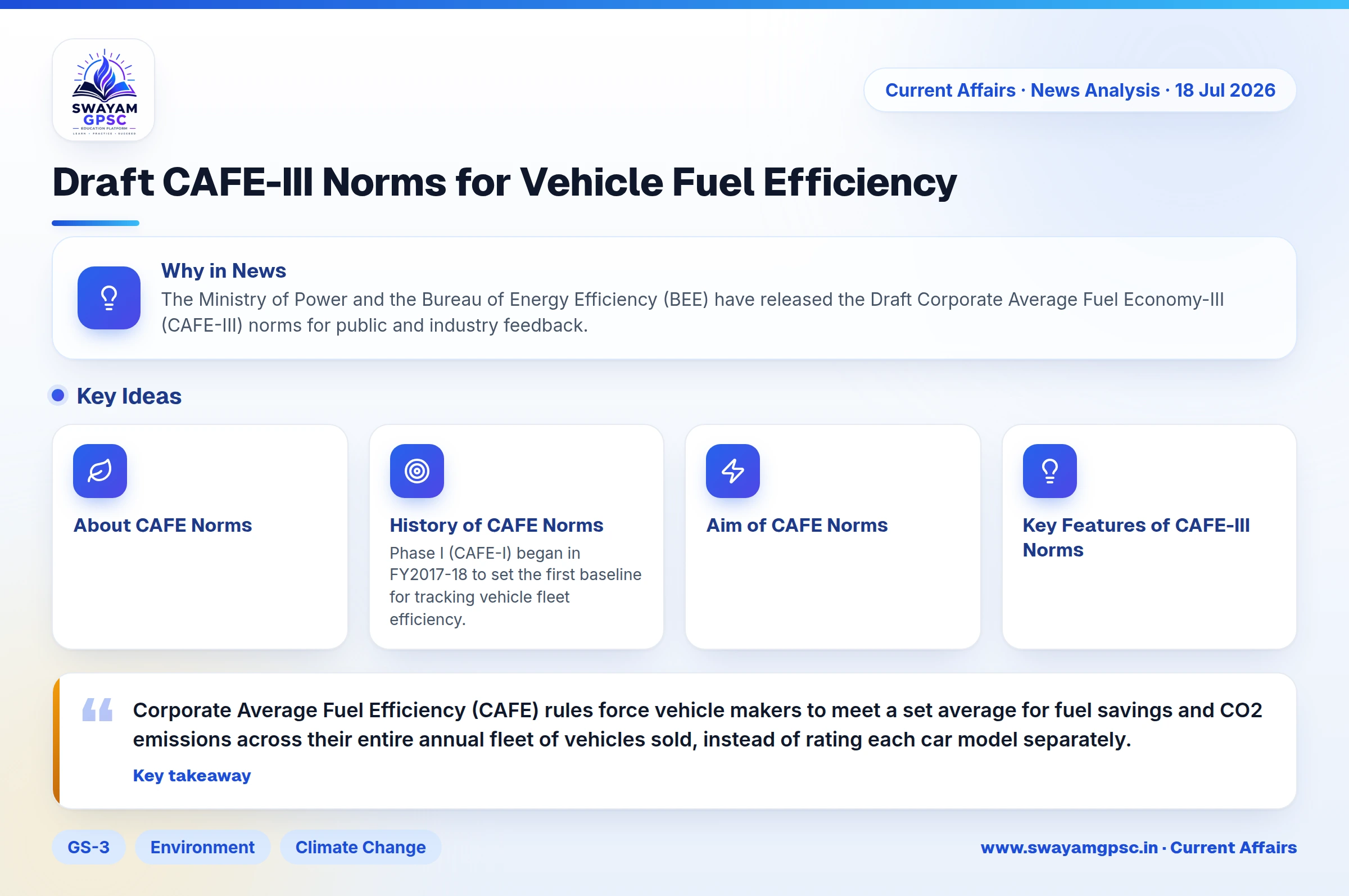
Draft CAFE-III Norms for Vehicle Fuel Efficiency
#GS-3 #Environment #Climate Change #Sustainable Development #Economy #Energy #National
Why in News
- The Ministry of Power and the Bureau of Energy Efficiency (BEE) have released the Draft Corporate Average Fuel Economy-III (CAFE-III) norms for public and industry feedback.
About CAFE Norms
- Corporate Average Fuel Efficiency (CAFE) rules force vehicle makers to meet a set average for fuel savings and CO2 emissions across their entire annual fleet of vehicles sold, instead of rating each car model separately.
History of CAFE Norms
- Phase I (CAFE-I) began in FY2017-18 to set the first baseline for tracking vehicle fleet efficiency.
- Phase II (CAFE-II) started in FY2022-23 and introduced stricter emission rules based on average vehicle weight.
- Phase III (CAFE-III) was issued in July 2026 and will take effect on April 1, 2027, running until FY2031-32.
Aim of CAFE Norms
- The government applies these rules under the Energy Conservation Act to reduce air pollution, cut greenhouse gases, and lower crude oil imports by encouraging cleaner vehicles.
Key Features of CAFE-III Norms
- Carbon emission targets will become much stricter, falling from 3.996 liters/100 km (94.76 gCO₂/km) in FY2027-28 to 3.327 liters/100 km (78.90 gCO₂/km) by FY2031-32.
- The draft replaces the old lab-based Modified Indian Driving Cycle (MIDC) with the global Worldwide Harmonised Light Vehicles Test Procedure (WLTP) to match real road conditions.
- Automakers get flexibility through multi-year compliance blocks, split into a three-year block (FY28-30) and a two-year block (FY30-32), giving them time to launch electric vehicles.
- India introduces Carbon Neutrality Factors (CNFs) for the first time, giving an 8% credit benefit to E20 fuel and up to 22.3% to flex-fuel ethanol cars and flex-fuel hybrids.
- Revised super-credit incentives grant a 3.0x multiplier for Battery Electric Vehicles (BEVs) and Range-Extended EVs, 2.5x for Plug-in Hybrids, and 1.6x for Strong Hybrids.
- A credit trading market lets companies that perform better than their emission targets earn compliance credits and sell them to other manufacturers.
- Companies can claim up to 9 gCO₂/km in benefits by using 12 approved fuel-saving features, such as automatic engine start-stop, regenerative braking, smart alternators, and Tire Pressure Monitoring Systems (TPMS).