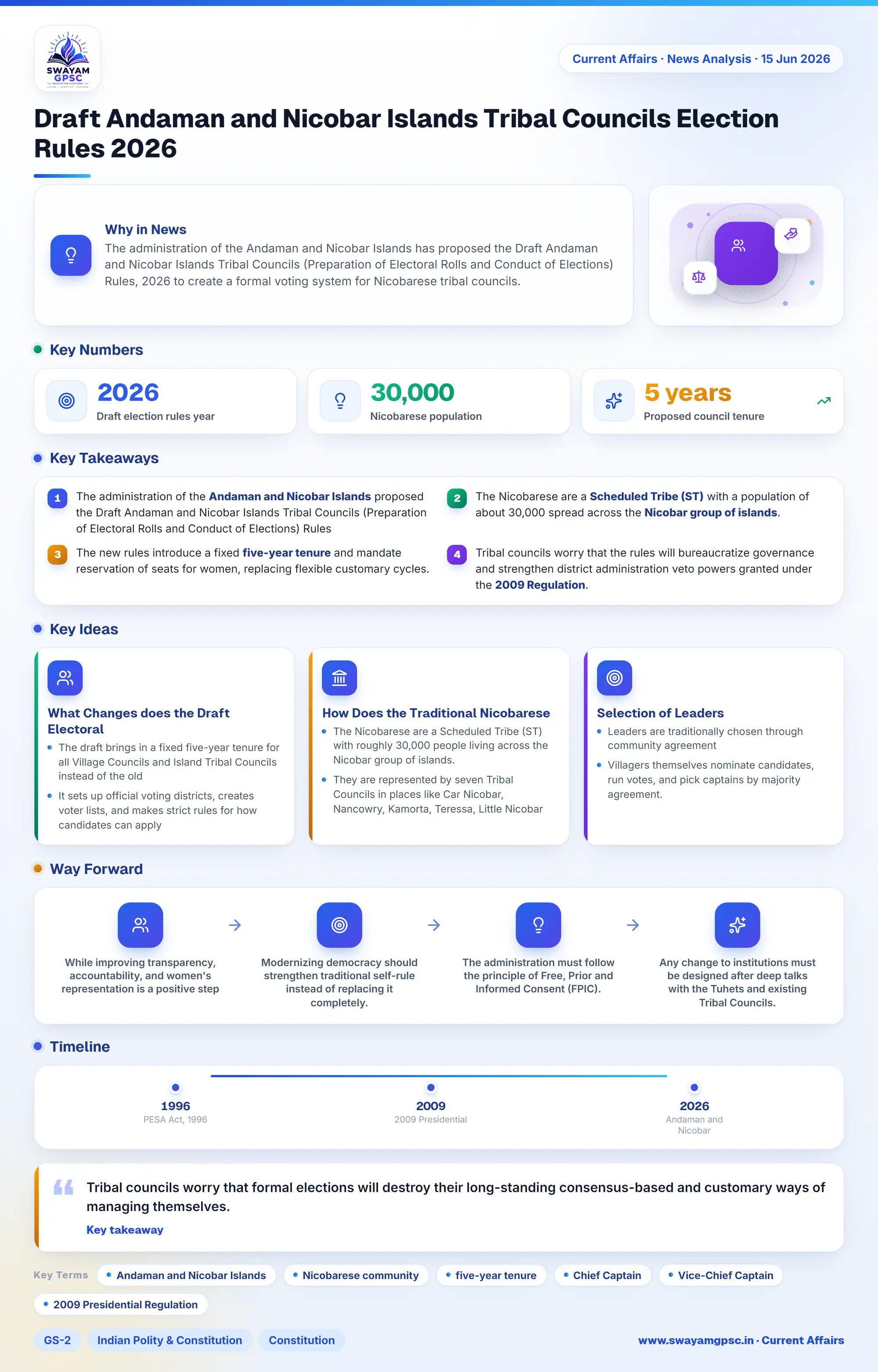
Draft Andaman and Nicobar Islands Tribal Councils Election Rules 2026
#GS-2 #Indian Polity & Constitution #Constitution #Governance & Social Justice #Vulnerable Sections #Current Events #National #Government Policies & Interventions #Issues Related to SCs & STs
Key takeaways
- The administration of the Andaman and Nicobar Islands proposed the Draft Andaman and Nicobar Islands Tribal Councils (Preparation of Electoral Rolls and Conduct of Elections) Rules, 2026 to formalize voting systems for Nicobarese tribal councils.
- The Nicobarese are a Scheduled Tribe (ST) with a population of about 30,000 spread across the Nicobar group of islands.
- The new rules introduce a fixed five-year tenure and mandate reservation of seats for women, replacing flexible customary cycles.
- Tribal councils worry that the rules will bureaucratize governance and strengthen district administration veto powers granted under the 2009 Regulation.
Why in News
- The administration of the Andaman and Nicobar Islands has proposed the Draft Andaman and Nicobar Islands Tribal Councils (Preparation of Electoral Rolls and Conduct of Elections) Rules, 2026 to create a formal voting system for Nicobarese tribal councils.
- This proposal creates worry inside the Nicobarese community because people think it will damage their traditional self-rule and weaken customary ways of making decisions.
What Changes does the Draft Electoral Model for Nicobarese Tribal Councils Propose
- The draft brings in a fixed five-year tenure for all Village Councils and Island Tribal Councils instead of the old flexible system.
- It sets up official voting districts, creates voter lists, and makes strict rules for how candidates can apply, get checked, and withdraw.
- Local villagers will directly vote to pick five to nine Captains for each village.
- Villagers will also cast direct votes to choose the Chief Captain for each Island Tribal Council.
- The First Captains from every village on an island will vote together to pick the Vice-Chief Captain.
- The final Island Tribal Council will include the Chief Captain, the Vice-Chief Captain, and all the First Captains.
- The new rules reserve specific seats and leadership roles for women in both village and island councils.
- The draft keeps a controversial rule from the 2009 Presidential Regulation.
- This rule gives local district officials like the Deputy Commissioner and Assistant Commissioner the power to cancel any council decision if they think it threatens public order or causes public annoyance.
How Does the Traditional Nicobarese Governance System Function
- The Nicobarese are a Scheduled Tribe (ST) with roughly 30,000 people living across the Nicobar group of islands.
- They are represented by seven Tribal Councils in places like Car Nicobar, Nancowry, Kamorta, Teressa, Little Nicobar, and Great Nicobar.
- Each village is run by a Village Council led by a First Captain, helped by a Second and Third Captain, who are usually chosen by secret ballot for a four-year term.
- The Tribal Council for an island group includes the First Captains from each village who then pick the Chief Captain and Vice-Chief Captain.
- The idea of captaincy started back in the 16th century when locals meeting passing foreign ships started calling themselves captains.
- The British later made this system formal in the late 19th century to make administration easier.
- The higher-level Tribal Council setup is quite new and only started in the 1990s.
- It was created mainly to help the community access central government poverty alleviation schemes and development programs, acting as a bridge between the government and local tribes.
- These bodies gained legal backing through the Andaman and Nicobar Islands (Protection of Aboriginal Tribes) Regulation, 1956 and the Nicobar Islands Tribal Council Regulation, 2009.
Selection of Leaders
- Leaders are traditionally chosen through community agreement, and elections happen only when the community wants them rather than on a set calendar.
- Villagers themselves nominate candidates, run votes, and pick captains by majority agreement.
- The traditional Tuhet extended family system forms the social base for leadership and local governance.
- Captains and council leaders act as helpers, and major choices are made through group discussions rather than by one person giving orders.
- Valued leadership qualities include education, speaking Hindi, exposure to the outside world, and the skill to talk with government officers.
- Many councils have not held formal elections for decades because current leaders still enjoy total community support.
- The traditional system suffers from a lack of written records, unclear terms for some leaders, and confusion over the exact legal powers of council chairpersons.
What are the Concerns of Tribal Councils Regarding the Proposed Electoral Model
- Tribal councils worry that formal elections will destroy their long-standing consensus-based and customary ways of managing themselves.
- The new setup might turn community leadership into a rigid bureaucratic machine, which increases paperwork and official burdens.
- The 2009 Regulation already gives the district administration absolute veto power over council choices that affect public order.
- Leaders fear the new rules will increase government control and make true self-rule disappear.
- The draft rules fail to give proper recognition to the traditional Tuhet system, which is the heart of Nicobarese society.
- These proposed changes come during heavy local opposition to the central government's Great Nicobar Development Project.
- Experts suggest the rules might be rushed through to reorganize councils and weaken local protests against the project.
- Because the Andaman and Nicobar Islands are a centrally run Union Territory, they sit outside the Fifth Schedule of the Constitution, leaving a legal gap regarding tribal self-rule.
Way Forward
- While improving transparency, accountability, and women's representation is a positive step, it must not destroy indigenous cultural heritage.
- Modernizing democracy should strengthen traditional self-rule instead of replacing it completely.
- The administration must follow the principle of Free, Prior and Informed Consent (FPIC).
- Any change to institutions must be designed after deep talks with the Tuhets and existing Tribal Councils.
- Instead of a complete overhaul, the state should try a hybrid model inspired by the PESA Act, 1996 that adds women's reservations while legally protecting the Tuhet family structure.
- The administration must build trust by keeping tribal governance reforms completely separate from the commercial and strategic goals of the Great Nicobar Development Project.
Conclusion
- To achieve true self-rule, the administration must combine progressive constitutional rules with the traditional Tuhet consensus model through open grassroots talks.
- Forcing a rigid mainland bureaucracy onto the islands without community consent risks breaking social unity and turning tribal self-rule into mere paperwork compliance.