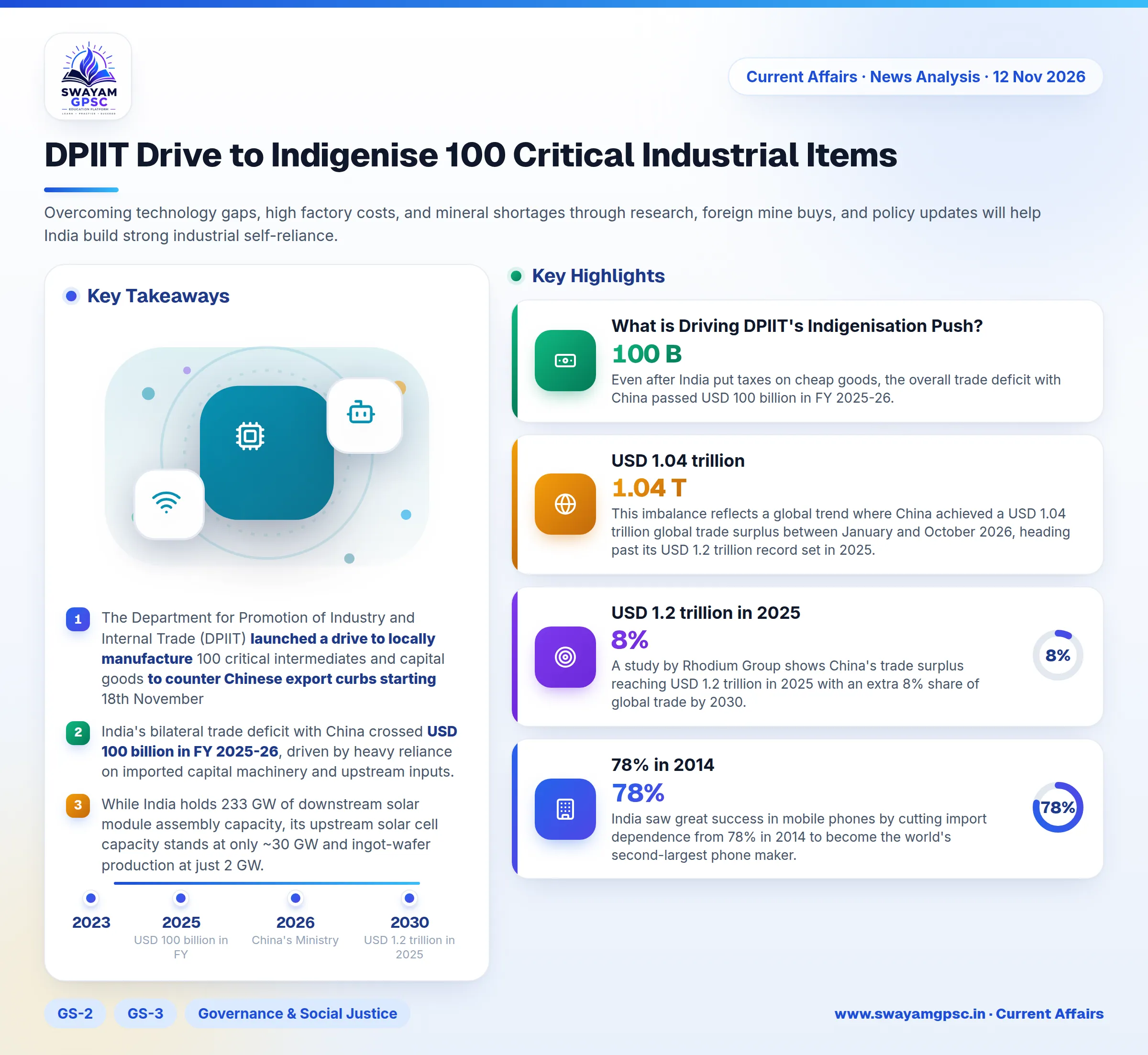
DPIIT Drive to Indigenise 100 Critical Industrial Items
#GS-2 #GS-3 #Governance & Social Justice #Current Events #Economy #Science & Technology #Government Policies & Interventions #International #Infrastructure #Indigenization of Technology #Supply Chain Resilience
Key takeaways
- The Department for Promotion of Industry and Internal Trade (DPIIT) launched a drive to locally manufacture 100 critical intermediates and capital goods to counter Chinese export curbs starting 18th November 2026.
- India's bilateral trade deficit with China crossed USD 100 billion in FY 2025-26, driven by heavy reliance on imported capital machinery and upstream inputs.
- While India holds 233 GW of downstream solar module assembly capacity, its upstream solar cell capacity stands at only ~30 GW and ingot-wafer production at just 2 GW.
- To protect small businesses while boosting local production, the government introduced measures like a Minimum Import Price (MIP) of USD 0.766/kg on PVC Suspension Resin in August 2026.
- The strategy recommends creating a National Capital Goods Mission (NCGM) and empowering KABIL to buy overseas critical mineral assets.
Why in News
- The Department for Promotion of Industry and Internal Trade (DPIIT) is leading a strategy to manufacture 100 critical intermediates and capital goods within India.
- This decision comes right after China's Ministry of Commerce announced new export limits starting on 18th November 2026 for key machinery like tunnel boring machines and solar making tools.
Summary
- The DPIIT initiative aims to cut dependence on imports from China, boost domestic machinery production, and make supply chains stronger.
- Overcoming technology gaps, high factory costs, and mineral shortages through research, foreign mine buys, and policy updates will help India build strong industrial self-reliance.
What is Driving DPIIT's Indigenisation Push?
- China is using its control over factory production as a political tool, as seen in its plan to restrict exports of specialized heavy machinery starting November 2026.
- Earlier in 2023, China limited exports of critical minerals like Gallium, Germanium, and Graphite, showing global technology risks. Making heavy machinery inside India protects domestic infrastructure and clean energy projects from foreign pressure.
- Even after India put taxes on cheap goods, the overall trade deficit with China passed USD 100 billion in FY 2025-26.
- This imbalance reflects a global trend where China achieved a USD 1.04 trillion global trade surplus between January and October 2026, heading past its USD 1.2 trillion record set in 2025.
- Making these items locally acts as a strong fix, substituting imports with home-made goods to stop the huge loss of foreign cash reserves.
- A study by Rhodium Group shows China's trade surplus reaching USD 1.2 trillion in 2025 with an extra 8% share of global trade by 2030.
- India saw great success in mobile phones by cutting import dependence from 78% in 2014 to become the world's second-largest phone maker. Following that path for industrial parts can build local scale and position India as an exporter under the China Plus One strategy.
- Earlier industrial success in India mostly focused on assembling imported parts, known as Semi-Knocked Down kits.
- The new plan shifts focus toward deep technology, building a self-sustaining local industrial setup from the ground up.
Which are the Key Sectors Targeted in the DPIIT 100-Item List?
- The government formed six sector-specific working groups to guide this initiative.
- These groups focus on medicines, biotechnology, medical devices, chemicals, textiles, footwear, heavy machinery, cars, electric vehicles, power, building equipment, civil defense items, and electronics.
- India currently has a large downstream capacity to assemble 233 GW of solar modules every year.
- However, earlier steps in the supply chain are weak, with solar cell capacity at ~30 GW and basic ingot and wafer manufacturing capacity at just 2 GW.
- This production drive aims to safeguard new solar cell and wafer plants from Chinese supply rules while the Ministry of New and Renewable Energy (MNRE) prepares clear rules for recycling solar panel waste to recover raw materials.
- A major goal of the initiative is building Tunnel Boring Machines (TBMs) locally, which are essential for defense roads, water power dams, and city metro rail lines.
- To get ready for Chinese supply cuts, a new manufacturing plant for these underground digging machines has already opened in Tamil Nadu.
- The plan targets core industrial materials like Polyvinyl Chloride (PVC), polyethylene, polypropylene, polystyrene, and ABS, which form the foundation for key industries.
- It also focuses on high-value imported chemicals including phosphoric acid, ammonia, acetic acid, and toluene.
- Private companies are expanding quickly, with Reliance Industries, which controls 51% of domestic PVC capacity, aiming to reach 1.5 MMT by 2026-27, while Adani Group is setting up a new PVC factory in Mundra.
Challenges
- Buying replacement machinery and tech from the EU, South Korea, or Japan is very costly, raising factory setup costs by 20% to 40% and making Indian goods pricier.
- Building a factory is relatively simple, but getting deep technical designs and matching the smooth, low-cost factory methods perfected by China over decades remains difficult.
- To safeguard local producers, the government set a Minimum Import Price (MIP) of USD 0.766/kg on PVC Suspension Resin in August 2026.
- While this price floor protects big companies, it inflates raw material costs for smaller MSMEs and cuts into their profit margins.
- Creating deep-tech industrial equipment takes a long waiting period of 3 to 5 years, leaving the economy exposed to supply shortages in the middle.
Way Forward
- The government should start a dedicated mission under the Ministry of Heavy Industries, modelled on the successful India Semiconductor Mission (ISM), to manage the 100-item initiative.
- To secure raw materials for capital equipment, India should expand the money and duties of KABIL (Khanij Bidesh India Ltd.).
- India needs to use partnerships like the Minerals Security Partnership (MSP) and the Quad to buy ownership shares in foreign mineral mines located in Africa, Australia, and Latin America.
- The country must actively use Pillar II (Supply Chain Resilience) of the Indo-Pacific Economic Framework (IPEF) and restart the Supply Chain Resilience Initiative (SCRI) with Japan and Australia.
- The government needs to act on the Baba Kalyani Committee (2018) ideas to replace the old SEZ Act (2005) with the proposed Development of Enterprise and Service Hubs (DESH) Bill (2022).
- This change will set up modern, global-standard factory hubs with ready infrastructure, cutting daily operating costs for heavy power-using factories.
- Based on NITI Aayog advice, the Finance Ministry must adjust import taxes so raw parts pay the lowest duty while finished machinery pays a higher duty to encourage local assembly.
- As chemical and solar factories expand, enforcing Extended Producer Responsibility (EPR) and recycling city waste will help protect the environment and recover valuable minerals.
- The NaBFID agency should supply long-term, low-cost money and issue Sovereign Green Bonds to fund long-term factory projects that regular banks often avoid funding.
- India can use the Anusandhan National Research Foundation (ANRF) and the National Deep Tech Startup Policy (NDTSP) to connect business with universities and create local engineering patents.