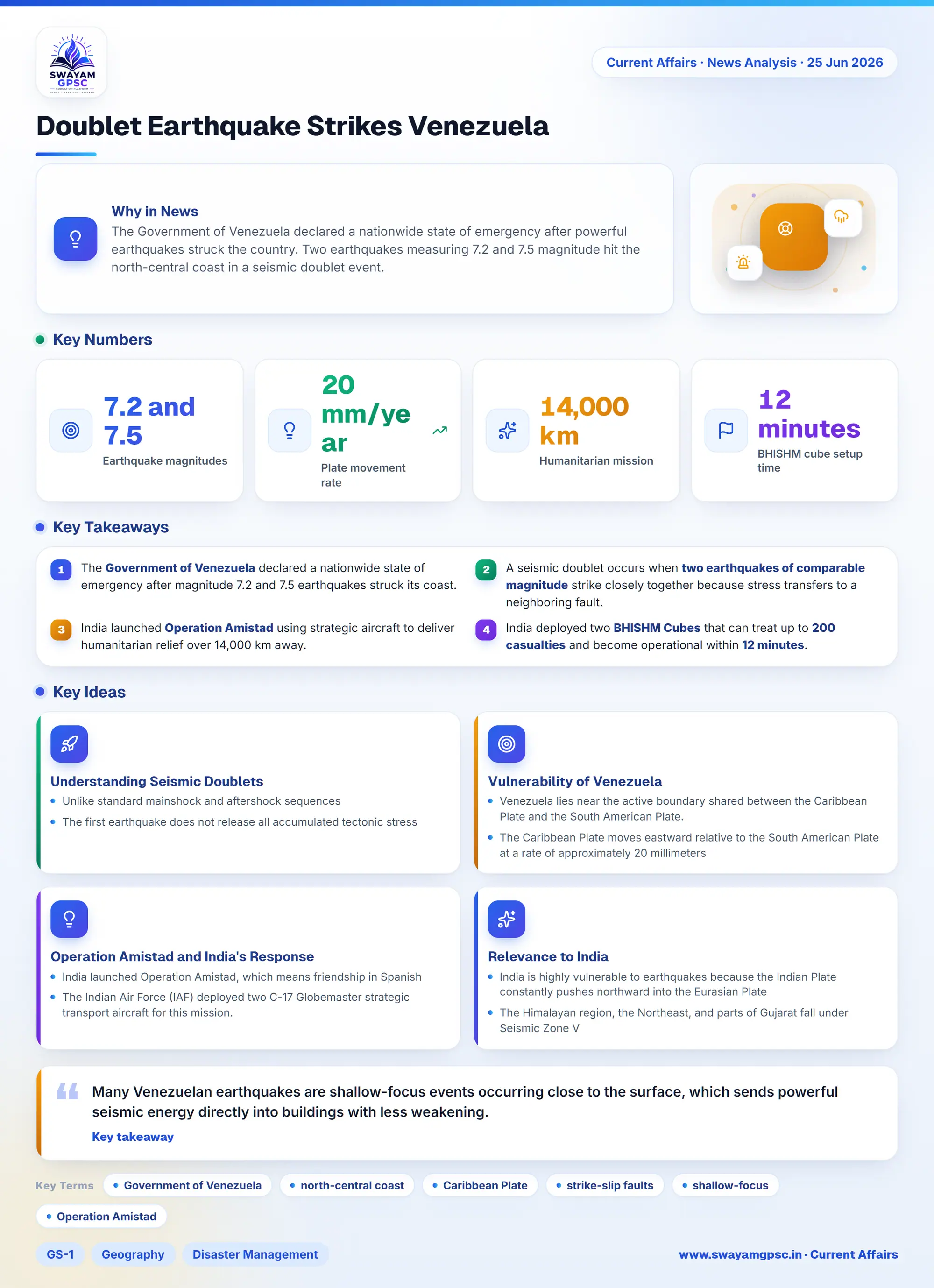
Doublet Earthquake Strikes Venezuela
#GS-1 #Geography #Disaster Management #Current Events #National #Earthquakes #Important Geophysical Phenomena
Key takeaways
- The Government of Venezuela declared a nationwide state of emergency after magnitude 7.2 and 7.5 earthquakes struck its coast.
- A seismic doublet occurs when two earthquakes of comparable magnitude strike closely together because stress transfers to a neighboring fault.
- India launched Operation Amistad using strategic aircraft to deliver humanitarian relief over 14,000 km away.
- India deployed two BHISHM Cubes that can treat up to 200 casualties and become operational within 12 minutes.
Why in News
- The Government of Venezuela declared a nationwide state of emergency after powerful earthquakes struck the country.
- Two earthquakes measuring 7.2 and 7.5 magnitude hit the north-central coast in a seismic doublet event.
- The disaster caused widespread infrastructure damage and significant loss of life across the region.
Understanding Seismic Doublets
- Unlike standard mainshock and aftershock sequences, a seismic doublet features two earthquakes of comparable magnitude occurring close together in time and space.
- The first earthquake does not release all accumulated tectonic stress, and instead transfers static stress to a neighboring fault segment or stuck rock patch.
- This stress transfer triggers a second massive rupture almost immediately instead of waiting for a long period.
Vulnerability of Venezuela
- Venezuela lies near the active boundary shared between the Caribbean Plate and the South American Plate.
- The Caribbean Plate moves eastward relative to the South American Plate at a rate of approximately 20 millimeters per year.
- Friction between these massive plates is handled by a series of strike-slip faults running east and west across northern Venezuela.
- Rock masses slide horizontally past one another in these faults, and when locked lines finally slip, they generate powerful quakes.
- Many Venezuelan earthquakes are shallow-focus events occurring close to the surface, which sends powerful seismic energy directly into buildings with less weakening.
Operation Amistad and India's Response
- India launched Operation Amistad, which means friendship in Spanish, to provide immediate Humanitarian Assistance and Disaster Relief (HADR) to Venezuela.
- The Indian Air Force (IAF) deployed two C-17 Globemaster strategic transport aircraft for this mission.
- This mission covered a distance of over 14,000 km, requiring refueling stops in friendly nations like Côte d'Ivoire.
- India deployed two BHISHM Cubes under the Aarogya Maitri Project during this operation.
- These indigenous modular portable hospitals can treat up to 200 casualties and start working within 12 minutes to save lives during the golden hour.
- The mission reflects India's civilizational value of Vasudhaiva Kutumbakam and shows its growing role in the Global South through humanitarian diplomacy.
Relevance to India
- India is highly vulnerable to earthquakes because the Indian Plate constantly pushes northward into the Eurasian Plate along a convergent boundary.
- The Himalayan region, the Northeast, and parts of Gujarat fall under Seismic Zone V, which is classified as a very high risk zone.
- This high vulnerability makes India susceptible to major seismic events, including the potential for earthquake doublets in highly stressed fault systems.