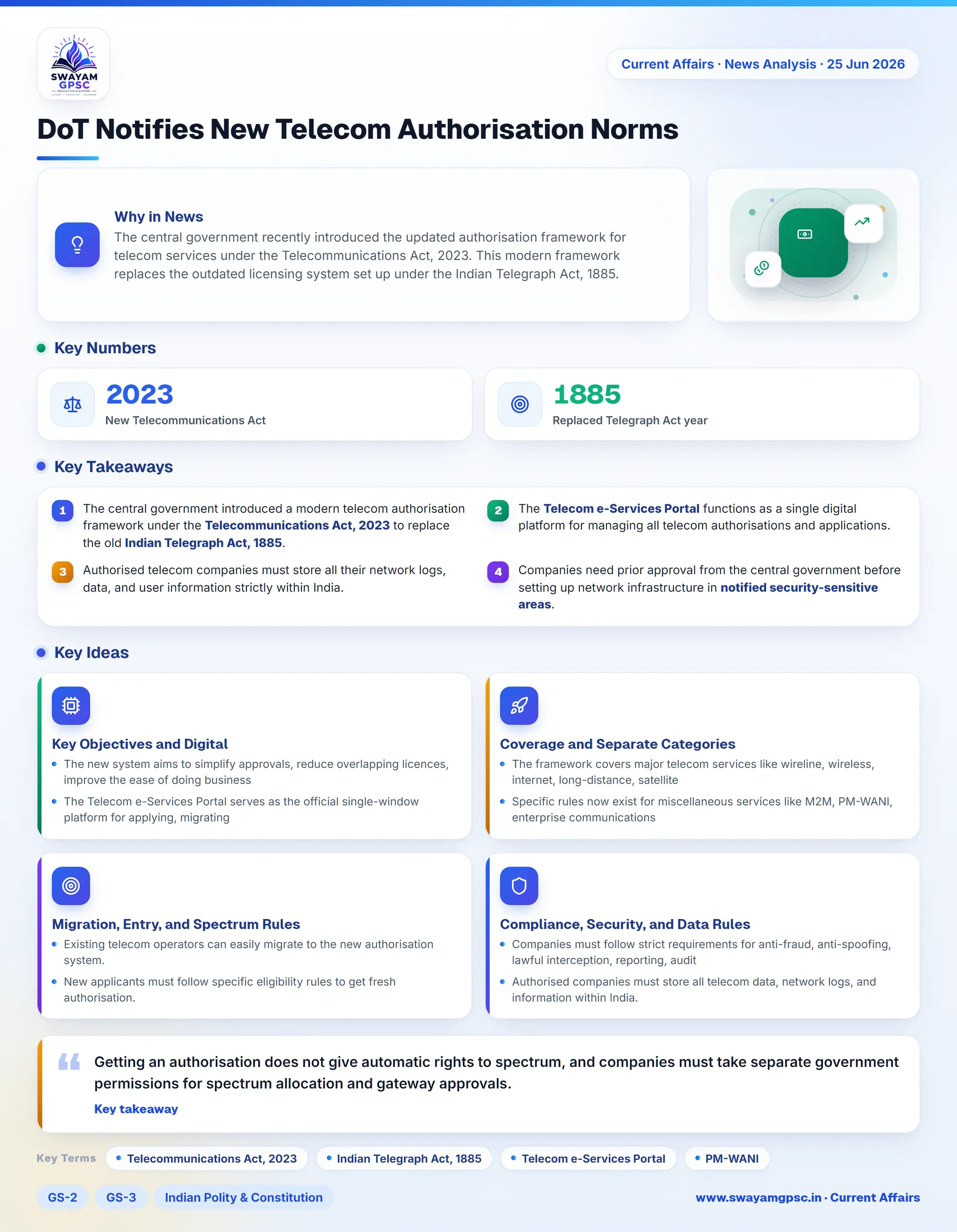
DoT Notifies New Telecom Authorisation Norms
#GS-2 #GS-3 #Indian Polity & Constitution #Governance & Social Justice #Economy #Infrastructure #Current Events #National #Rapid Fire CA #Quick Facts For Prelims
Key takeaways
- The central government introduced a modern telecom authorisation framework under the Telecommunications Act, 2023 to replace the old Indian Telegraph Act, 1885.
- The Telecom e-Services Portal functions as a single digital platform for managing all telecom authorisations and applications.
- Authorised telecom companies must store all their network logs, data, and user information strictly within India.
- Companies need prior approval from the central government before setting up network infrastructure in notified security-sensitive areas.
Why in News
- The central government recently introduced the updated authorisation framework for telecom services under the Telecommunications Act, 2023.
- This modern framework replaces the outdated licensing system set up under the Indian Telegraph Act, 1885.
Key Objectives and Digital Implementation
- The new system aims to simplify approvals, reduce overlapping licences, improve the ease of doing business, and support modern telecom technologies.
- The Telecom e-Services Portal serves as the official single-window platform for applying, migrating, and managing authorisations.
Coverage and Separate Categories
- The framework covers major telecom services like wireline, wireless, internet, long-distance, satellite, earth stations, and related telecom services.
- Specific rules now exist for miscellaneous services like M2M, PM-WANI, enterprise communications, in-flight and maritime connectivity, and captive or private telecom networks.
Migration, Entry, and Spectrum Rules
- Existing telecom operators can easily migrate to the new authorisation system.
- New applicants must follow specific eligibility rules to get fresh authorisation.
- Getting an authorisation does not give automatic rights to spectrum, and companies must take separate government permissions for spectrum allocation and gateway approvals.
Compliance, Security, and Data Rules
- Companies must follow strict requirements for anti-fraud, anti-spoofing, lawful interception, reporting, audit, accounting, and security, including the use of artificial intelligence and big data for stopping fraud.
- Authorised companies must store all telecom data, network logs, and information within India.
- Companies must take prior approval from the central government before setting up or expanding telecom networks in notified security-sensitive areas.